
About Achille Germain
Lived 1884 – 1938 (aged 53). Achille Germain was a French sport cyclist.
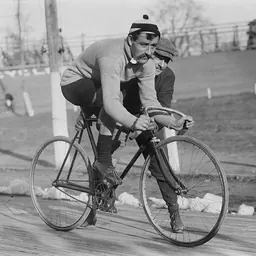
Achille Germain (May 5, 1884 – April 12, 1938) was a French road and track cyclist.
A professional from 1905 to 1919, he won many local events but also shone on the velodromes of Paris, where he gained a great reputation in middle-distance races, notably taking third place in the French championship in 1914. Second in the Six Days of Toulouse in 1906, in partnership with Jean Gauban, he also participated twice in the Six Days of New York and took part in the first Six Days of Paris in 1913.
Germain, nicknamed “Germain de la Flèche” by his followers, also competed in road races, taking part in the 1908 Tour de France, where he placed 16th, achieving his best result with an eighth-place finish on the tenth stage to Bordeaux.
The following year, he won a stage in the Circuit de la Loire and finished second overall.
Mobilized as a corporal cyclist with the 317th Infantry regiment during the First World War, he retired from the sport in 1919 following an injury sustained during the conflict. He retired to La Flèche to run a cycle repair shop and became so involved in local life that he was elected town councilor in his final years.
Biography
Early cycling career Achille Germain was born in Beaupréau, Maine-et-Loire, on May 5, 1884, but his family moved to La Flèche, Sarthe, when he was still very young. His beginnings in cycling were fairly modest. He took part in his first races in his adopted town in 1902, at the July 14th races held on the Promenade du Pré. He came second in the bonus race.
The following year, he joined the newly-formed Union vélocipédique fléchoise (UVF), and at the same July 14 meeting, came second in the speed final and third in the bonus race. On September 20, he finished second in the 100-kilometer UVF Cup behind Mareau from Mance, a member of the Union Auto-Cycliste de la Sarthe. from Mance. He went on to achieve good results on the Fléchoise track, finishing third in the Sarthe departmental championship and then in the La Flèche championship in June, and fourth in the regional final the following month, an event won by Nantes rider Hardy. Back in La Flèche in September, he took second place in the UVF speed championship behind clubmate Albert Leroy, who had just taken part in the Tour de France. He also distinguished himself in more modest competitions, such as the 4-kilometer cantonal race he won in Verron in early October 5,
During the winter of 1905–1906, Germain trained alongside the best specialists of the day on the Vélodrome d'Hiver track in Paris. Though he could see the gap existing between him and those in the lead, Germain's persistence in training was noticed. Along with Georges Parent, he was chosen to join the coaching team of Henri Cornet, winner of the 1904 Tour de France, in a 50-kilometer tandem match against Karl Ingold. Cornet won by nine laps. At the same meeting, Germain made his mark as an individual in the 15-kilometer race behind motorcycles. Third behind Paul Rugère and Anton Jaeck, his offensive behavior throughout the race was praised by the spectators. On February 18, he teamed up with Denmark's Axel Hansen in the American-style Twelve Hours race, in which the two competitors took turns at will. At the end of the race, fourteen teams were still classified in the same lap: victory was therefore decided over six laps between the best sprinters in each team. Hansen initially placed fourth, but the commissaries were slow to validate the results after a crash on the last lap. The race was eventually canceled. Achille Germain (left) at the start of a race at the Parc des Princes on June 3, 1906. The outdoor season brought him many successes. On April 23, 1906, in La Flèche, he won the 15-kilometer race behind motorcycles ahead of Arthur Pasquier, then set the track record over 10 kilometers. At the beginning of July, at the Vélodrome Buffalo, he failed in his attempt to beat the world record for 10 kilometers without trainers, held by Lucien Petit-Breton, but a few days later he scored a clear success over 15 kilometers behind motorcycles on the same track.
Germain then took part in the Six Jours de Toulouse, the first race of its kind in Europe, held on the Bazacle velodrome, where he teamed up with local rider Jean Gauban. The duo achieved a promising second place, second only to brothers Émile and Léon Georget. Throughout the event, the Fléchois rider was extremely active, winning numerous prizes, including those for the 47th and 49th hours. On his return, he was triumphantly welcomed back to La Flèche. A few days later, he was sent to Toul barracks, where he was to perform his military service with the 153rd infantry regiment.
Germain was rarely granted leave, but managed to take part in a few races in 1907: beaten by Arthur Pasquier over 40 kilometers in Tours on April 21, he took his revenge and beat him the following week in La Flèche at the Grand Prix du Printemps. On the velodrome track in La Flèche, in early April, he won the Sarthe speed championship, then finished second to Pasquier in the Grand Prix du Printemps. In May, on the same track, he won a 12-hour race by a clear 16-lap margin over his nearest rival. A few days later, he came second in the 40-kilometer Grand Prix d'Angers with trainers and announced his entry in the Tour de France. It was the only Tour he contested during his career. This encouraging participation earned him the congratulations of many specialists, such as L'Auto journalist Charles Ravaud, who considered him capable of achieving excellent results if he chose to devote himself even more to the road. His participation in the Grande Boucle further boosted his popularity: he was carried in triumph on his return to La Flèche station and welcomed into town by over 2,000 people. Beaten in Angers by Daniel Lavalade over 40 kilometers behind motorcycles, Invited to take part in the eighth stage of the Wolber Grand Prix, organized by Peugeot on June 13 between Paris and La Flèche, Germain placed sixth and, according to L'Auto, earned “his stripes as a great road racer”. He was also invited to take part in the ninth stage to Nantes, where he finished fourth before being downgraded for a course error.
Germain made his return to the road at the end of September with Paris–Tours. His eighteenth-place finish was anecdotal, just as his last few outings on the track were hardly conclusive: he failed twice in his attempt to set the record for the hour without a trainer at La Flèche.
Middle-distance specialist (1910–1913)
At the beginning of 1910, Germain once again gave priority to the track. He obtained convincing results at the local level but struggled to confirm his performance in the major Parisian events. In May, however, he competed in the French road championships with coaches. Dropped after the first few kilometers, he eventually came tenth. After a detour to the track and a success in Brest over 25 kilometers at the expense of César Simar, he returned to the road to take tenth place in Paris-Le Mans. During the summer, Germain took several places of honor on the velodromes, coming second in the Grand Prix d'inauguration du vélodrome d'Angers, the Challenge Cointreau in the same town, and the Huit heures de Tours, which earned him selection for the Bol d'or. Ill and suffering from the pace set by Léon Georget, he retired shortly after the halfway mark. As in the previous year, he was selected to take part in the Six Days of New York, this time in partnership with the Belgian Verlinden. The two men never found their rhythm and retired after just eight hours of racing. His winter season began with several places of honor, but it was on December 17, at the Vélodrome d'Hiver, that he won a convincing victory in the Prix Robl, a middle-distance race run over 25 kilometers and organized in tribute to the German champion Thaddäus Robl, who died in a plane crash. A week later, in Nantes, he finally beat worthy rivals Émile Bouhours and César Simar in a 50-kilometer race. In August, he came third in the Critérium de demi-fond at Le Buffalo, then won the Le Mans meeting on the Jacobins Velodrome. On September 15, he suffered a severe setback in the Grand Prix de France de Vitesse at the Parc des Princes, failing in the heats, but returned to the limelight at the end of the year with a convincing victory in the Prix Stocks, run over 40 kilometers at the Vélodrome d'Hiver. Danish rider Herman Kjeldsen was the only rider to stand up to him in this event, but Germain was the strongest and displayed a radiant form that earned him selection for the first Six Jours de Paris, on January 13, 1913. After the race, Germain's popularity soared once again, enabling him to negotiate higher participation rates at various velodrome meetings. After successes in Angers in March, he made a strong impression on April 13, winning a 30-kilometer race ahead of Daniel Lavalade and César Simar at the Buffalo. A journalist from L'Auto declared: "The middle-distance race has returned to the runner with courage personified. My name is Achille Germain." Considered an outsider for the French middle-distance championship, he took fourth place, a long way behind the winner Paul Guignard. At the Grand Prix de Paris, he came second in the 50-kilometer race, well ahead of Georges Sérès, but containing the return of several well-known runners. He concluded the season with another place of honor, finishing second in the Grand Prix de clôture de Roubaix. After a series of fine performances at the Paris meetings and a major success at the Grand Prix du Printemps de Limoges, he achieved the best result of his career at the French middle-distance championship on July 19, finishing third in the event, won once again by Paul Guignard.
World War I and end of career (1914–1919) A few days later, the First World War broke out and, like his competitors, Germain was mobilized. Assigned to the 317th Infantry Regiment as a corporal cyclist, he was in charge of transporting mail by bicycle. During the war, however, he took part in several races on leave. On November 19, 1916, he took part in a 400-lap American-style race at the Vélodrome d'Hiver. Teaming up with Marius Chocque, he came tenth. In December 1917, on the same track, he won the Prix de la Capitale over 30 kilometers, and the following year he won the Prix d'Avril middle-distance race at the Vel' d'Hiv'. He then beat a Belgian runner in a middle-distance match held at the Beaulieu velodrome in Le Mans.
Reconversion and end of life Germain then retired to La Flèche to run his cycle repair shop. Very involved in local life, he invited his friend Robert Spears, world track speed champion, to lay a wreath at the cemetery to commemorate the Armistice on November 11, 1920. In 1922, to pay tribute to the veterans of the Great War, he inaugurated a commemorative plaque on the birthplace of Fléchois aviator Charles Godefroy, made famous by his flight under the Arc de Triomphe in Paris on August 7, 1919. Two years later, a Poilus banquet was organized on his initiative in the ballroom of the Hôtel du Cheval Blanc. On this occasion, he donated one of his racing bicycles, and offered to the winner of a tombola organized for the benefit of the veterans.
But he didn't give up cycling. In 1920, he took on the role of motorcycle coach to Tunisian Ali Neffati, and in the same year, together with his friends, set up a new multi-sports club, "La Flèche-Sportive". At the same time, Germain was involved in the construction of a new stadium and velodrome to replace Belleborde. After several months of negotiation, work began on a plot of land adjacent to the Route d'Angers: the stadium was inaugurated in November 1921 for a soccer match, while the track was built in early 1922 thanks to the financial support of several great champions, including Robert Spears, Oscar Egg, Maurice Brocco, aviator Georges Kirsch and boxer Georges Carpentier.
In April 1931, he stood as an Independent Republican candidate in the municipal by-elections in La Flèche. Obtaining 1,111 votes, the highest total, he was among the five newly elected. He also ran in the 1932 legislative elections. With 4,108 votes, he came third, more than 5,600 votes behind the incumbent Radical candidate Jean Montigny, who was elected in the first round.
Re-elected to the La Flèche town council in 1935, still as an independent, he served until his death on April 12, 1938, at the age of 54. He is buried in the Saint-Thomas cemetery. On May 22, 1978, the town of La Flèche paid tribute to him by naming the street of a newly built housing estate after him.
1906 2nd Six Jours de Toulouse (with Jean Gauban) 1914 3rd French National Stayers Championship
On the road
1908 16th in the Tour de France 1909 Sarthe Championship Loire Circuit Stage 1 2nd overall
Don’t just read it —
keep it.
Full-length biographies made to live with: read them, listen on the way to work, watch them tonight.
- E-book
- Audio
- Video
Instant download · yours to keep · every purchase keeps this site free
Important facts
People in Achille Germain's life
Named in this biography and alive at the same time



Related people
Same field, nearest in time




Contemporaries
People whose lives overlapped Achille Germain's
Frequently asked questions
Who was Achille Germain?
French bicycle racer
When was Achille Germain born?
Achille Germain was born on 5 May 1884 in Beaupréau.
When did Achille Germain die?
Achille Germain died on 12 April 1938 in La Flèche.
What was Achille Germain's occupation?
Achille Germain was a sport cyclist.
What nationality was Achille Germain?
Achille Germain was French.
Sources & further reading
Cite this page
APA: Biography.guide. (2026). Achille Germain. https://biography.guide/achille-germain/
MLA: "Achille Germain." Biography.guide, https://biography.guide/achille-germain/.
Chicago: "Achille Germain." Biography.guide. https://biography.guide/achille-germain/.
Data last updated: 2026-09-20 · Spot an error? Report a correction.
Page generated 2026-09-27 05:21 UTC