
Abram Petrovich Gannibal
African-born Russian general and military engineer
About Abram Petrovich Gannibal
Lived 1696 – 1783 (aged 86–87). Abram Petrovich Gannibal was a Russian military engineer, military personnel, engineer and soldier.
Abram Petrovich Gannibal, also Hannibal or Ganibal, or Abram Hannibal or Abram Petrov (; c. 1696 – 14 May 1781 ), was a Russian Chief Military Engineer, General-in-Chief, and nobleman of African origin. As a child, Gannibal was captured by Ottomans and brought to Russia as a gift for Peter the Great. He was then raised in the emperor's court, with the emperor becoming his godfather at his baptism.
Gannibal eventually rose to become a prominent member of the imperial court in the reign of Peter's daughter Elizabeth. He had ten children, most of whom became members of the Russian nobility. One of his great-grandsons was the author and poet Alexander Pushkin.
Richard Pankhurst, the former professor at the Institute of Ethiopian Studies at the University of Addis Ababa in Ethiopia, believed the young Abram, Ibrahim or Abraham, as he named him, was born around 1698. He was the son of a minor "prince" or chief. His father was relatively affluent, owning many livestock both inherited and taken in battle; he had several wives and 19 children. However, after his father died in battle trying to defend his territory from the Ottoman Turks trying to conquer the Red Sea, Abram was captured and taken to Constantinople by ship. His sister, Lagan, is said to have drowned in the sea in a desperate attempt to save her brother.
Abram stayed in the Ottoman Empire for about a year in the service of Sultan Ahmed III's household. At the time, the Russian ambassador Sava Vladislavich-Raguzinsky, representing Peter the Great, was looking for "a few clever little African slaves" for the Tsar's palace in Moscow; a Kammermohr was a common feature of European courts of the time, as an exotic symbol of the court's prestige. On orders of Vladislavich's superiors (one of whom was Pyotr Andreyevich Tolstoy, great-grandfather of the celebrated writer Leo Tolstoy), Abram was selected for this purpose and soon ransomed from the Sultan's viziers with a bribe. In 1704, the ambassador immediately dispatched him by land to Moscow in order to be presented to Tsar Peter the Great.
The Tsar is noted to have taken a liking to the boy's intelligence and potential for military service, and brought the child into his household.
Education 1888 artist's conception of Gannibal speaking with Alexander Suvorov.
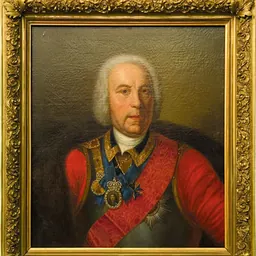
In 1717, Abram was sent to Metz, France, to receive an education in the arts, sciences and warfare from the highest institutes available. By then he was fluent in several languages and excelled in mathematics and geometry. In 1718 Abram joined the French Royal Army with hopes of pleasing his godfather by expanding his learning in military engineering. In Paris he met and befriended such Enlightenment figures as Montesquieu and Voltaire (this claim by his biographer Hugh Barnes is disputed by reviewer Andrew Kahn ). Voltaire called Gannibal the "dark star of the Enlightenment". Gannibal returned to Russia the following year and became first an engineer and then a mathematics tutor for one of the Tsar's private guard units. other studies identify it as a portrait of Abram Petrovich Gannibal Gannibal's education was completed by 1723, and he was due to return to Russia. After the death of Peter in 1725, Prince Menshikov gained power in Russia due to his good standing with Peter. However, Menshikov was not fond of Gannibal and was suspicious of his foreign origins and superior education. After being made the chief military engineer of the Russian army in 1756, he received the rank of general-in-chief in 1759. He eventually retired to the estate Empress Elizabeth gave him, in 1762 during the reign of Catherine the Great.
In an official document that Gannibal submitted in 1742 to Empress Elizabeth, while petitioning for the rank of nobility and a coat of arms, he asked for the right to use a family crest emblazoned with an elephant and the mysterious word "FVMMO", which may mean "homeland" in the Kotoko language. In his book, Gannibal: The Moor of Petersburg, Hugh Barnes writes of meeting with the sultan of Logone-Birni, who gave him the same translation of the word. Gannibal’s suspicions were confirmed when Dioper gave birth to a white daughter. Her paternal grandfather was Gustaf Siöberg, Rittmester til Estrup, who died in 1694, whose wife Clara Maria Lauritzdatter Galtung (ca. 1651–1698) was the daughter of Lauritz Lauritzson Galtung (ca. 1615–1661) and of Barbara Grabow til Pederstrup (1631–1696).
Abram Gannibal and Christine Regina Siöberg had ten children. Their oldest son, Ivan, became an accomplished naval officer who helped found the city of Kherson in southern Ukraine in 1779 and attained the rank of general-in-chief, the second-highest military rank in imperial Russia. Another son, Osip, had a daughter, Nadezhda, who became the mother of the great writer Alexander Pushkin. More than one British aristocratic family descends from Pushkin, notably the Grosvenors (Duke of Westminster via Anastasia de Torby) and the Mountbattens (Marquess of Milford Haven, via Anastasia's sister Nadejda de Torby).
Legacy Debate over Gannibal's place of birth Peter the Great with a black page, by Gustav Von Mardefeld. Gannibal would have been in his mid-twenties at the time of this painting, so he is not the black page depicted here. Gannibal's actual place of birth continues to be uncertain, and is subject to speculation by modern historians. Until recent scholarly field work, it was generally assumed that he originated in Ethiopia. Chiefly Russian scholars for many years believed that he was from the vicinity of Mereb Melash, a province of the Ethiopian Empire in present-day Eritrea. In a letter he wrote to Empress Elizabeth, Peter the Great's daughter, Gannibal stated that he was from the town of "Logon" However, the notion that Gannibal may have been born in Ethiopia holds little currency with the general Ethiopian population. It also erected its own statue of Pushkin and named a street after him in 2009. He seemed to use his own experiences, along with Gannibal's to create the plot for The Moor of Peter the Great.
Art and film Abram Gannibal is a protagonist of the Soviet comedy movie How Czar Peter the Great Married Off His Moor, although the film's plot has almost nothing to do with Gannibal's real biography. The film is partly based on Pushkin's Moor of Peter the Great.
There are several portraits thought to depict Gannibal, which include a painting of the Battle of Lesnaya by Pierre-Denis Martin the Younger. The young boy present in Martin’s painting is argued to be Gannibal, because of the young boy’s role as valet to Peter during military campaigns and Gannibal’s possible connection to the artist while in France. In the Lesnaya painting, the young boy is dressed in traditional slave attire, which Gannibal did not wear due to his status under Peter the Great.
Don’t just read it —
keep it.
Full-length biographies made to live with: read them, listen on the way to work, watch them tonight.
- E-book
- Audio
- Video
Instant download · yours to keep · every purchase keeps this site free
Important facts
People in Abram Petrovich Gannibal's life
Named in this biography and alive at the same time
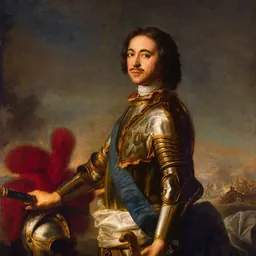
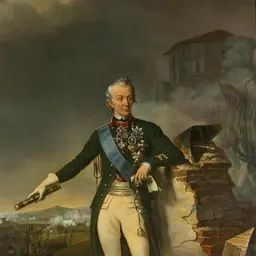
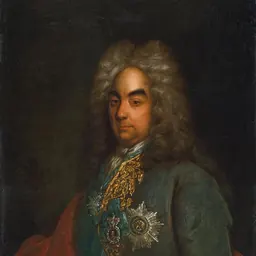

Related people
Same field, nearest in time


Contemporaries
People whose lives overlapped Abram Petrovich Gannibal's


Frequently asked questions
Who was Abram Petrovich Gannibal?
African-born Russian general and military engineer (c.1696–1781)
When was Abram Petrovich Gannibal born?
Abram Petrovich Gannibal was born in 1696 in Ethiopian Empire, Logone-Birni.
When did Abram Petrovich Gannibal die?
Abram Petrovich Gannibal died in 1783 in Suyda.
What was Abram Petrovich Gannibal's occupation?
Abram Petrovich Gannibal was a military engineer, military personnel, engineer and soldier.
What nationality was Abram Petrovich Gannibal?
Abram Petrovich Gannibal was Russian.
Sources & further reading
· Wikipedia: Abram Petrovich Gannibal
· DBpedia: Abram Petrovich Gannibal
Cite this page
APA: Biography.guide. (2026). Abram Petrovich Gannibal. https://biography.guide/abram-petrovich-gannibal/
MLA: "Abram Petrovich Gannibal." Biography.guide, https://biography.guide/abram-petrovich-gannibal/.
Chicago: "Abram Petrovich Gannibal." Biography.guide. https://biography.guide/abram-petrovich-gannibal/.
Data last updated: 2026-09-25 · Spot an error? Report a correction.
Page generated 2026-09-27 05:11 UTC