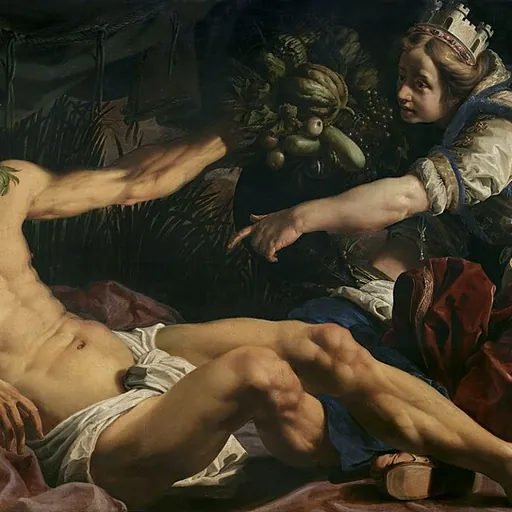
About Abraham Janssens I
Lived 1575 – 1632 (aged 56–57). Abraham Janssens I was a painter and designer.
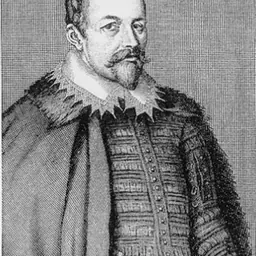
Abraham Janssens I, Abraham Janssen I or Abraham Janssens van Nuyssen (1575–1632) was a Flemish painter, who is known principally for his large religious and mythological works, which show the influence of Caravaggio. He was the leading history painter in Flanders prior to the return of Rubens from Italy.
Life Abraham Janssens was born in Antwerp as the son of Jan Janssens and Roelofken van Huysen or Nuyssen. There is some uncertainty regarding his year of birth. He was previously thought to have been born in the year 1567, but it is now more generally assumed that his date of birth was 1575.
Janssens studied under Jan Snellinck and was registered as a pupil in the local Guild of Saint Luke in 1585. He travelled to Italy where he resided mainly in Rome between 1597 and 1602. After returning to his home country he became a master in the Antwerp Guild in the guild year 1601–1602.
On 1 May 1602 he married Sara Goetkint (died in Antwerp on 7 April 1644) with whom he had 8 children, five of whom were still alive at the time of her death: Maria Anna, who also became a painter and married Jan Brueghel the Younger, Sara, Catharina, Lucretia and Abraham II.
In 1607 he became the dean of the Antwerp Guild of St Luke. This is also the time when he received his first major commissions, which initiated the most important period of his career.
Janssens joined in 1610 the Confrerie of Romanists, a society of Antwerp humanists and artists who had travelled to Rome. The diversity and high positions held by the Confrerie's membership offered him a good opportunity to meet with potential patrons.
Janssens died in Antwerp.
Janssens affixed the signature "Janssens van Nuyssen" to several of his pictures. It is believed that 'van Nuyssen' was the family name of his mother and that Janssens added it to his signature to distinguish himself from his namesakes as the family name Janssens was very common in 17th-century Flanders.
It is difficult to determine the chronology of Janssens's oeuvre, as he only dated or documented a few of his works.
Early works His earliest works are steeped in late 16th-century Mannerism and are characterized by an artificial design and a palette composed of dispersing colours. Still it remains possible that this impressive work had some influence on Rubens' painting as there are, for example, similarities in the colour of the garments of the female protagonists in Rubens' Samson and Delilah (c. 1609–10; National Gallery, London). The latter painting was likely commissioned as an altarpiece. This Caravaggesque composition predates comparable Dutch works such as Dirck van Baburen's Roman charity by a decade.
Later works
Janssens's later work is regarded as less convincing. After 1612 his painting style, like that of his other colleagues in Antwerp, came under the strong influence of the free style of Rubens' pictorial technique. Janssens's paintings of half-length figures were still regarded as innovative and influential while his devotional pictures were also successful. A good example of the latter is The crucifixion (Musée des beaux-arts de Valenciennes, c. 1620) in which the figures look painted like sculptures and take on an iconic timelessness.
Don’t just read it —
keep it.
Full-length biographies made to live with: read them, listen on the way to work, watch them tonight.
- E-book
- Audio
- Video
Instant download · yours to keep · every purchase keeps this site free
Important facts
more
Abraham Janssen van Nuyssen, Abraham Jansens, Ab. Janssens, Abraham Jensens, Abraham Jansène, Abrah. Janssens, A. Jansens, Jansens d'Anvers, Ab. Janssen, Abraham Janssens van Nuyssen, abraham Janssens I von Nuyssn, Janssens, A. Janssens, Abr. Janssen, Habraham Jean Sence, A. Jausens, A. Janssen, A. Janson, Abr. Janssens, Abr. Jansen, Abraham JPeople in Abraham Janssens I's life
Named in this biography and alive at the same time


Related people
Same field, nearest in time

Contemporaries
People whose lives overlapped Abraham Janssens I's



Frequently asked questions
Who was Abraham Janssens I?
Flemish painter
When was Abraham Janssens I born?
Abraham Janssens I was born in 1575 in Antwerp.
When did Abraham Janssens I die?
Abraham Janssens I died in 1632 in Antwerp.
What was Abraham Janssens I's occupation?
Abraham Janssens I was a painter and designer.
What nationality was Abraham Janssens I?
Abraham Janssens I's recorded nationality: Habsburg Netherlands.
Sources & further reading
· Wikipedia: Abraham Janssens I
Cite this page
APA: Biography.guide. (2026). Abraham Janssens I. https://biography.guide/abraham-janssens-i/
MLA: "Abraham Janssens I." Biography.guide, https://biography.guide/abraham-janssens-i/.
Chicago: "Abraham Janssens I." Biography.guide. https://biography.guide/abraham-janssens-i/.
Data last updated: 2026-09-22 · Spot an error? Report a correction.
Portrait: Wikimedia Commons · author & licence
Page generated 2026-09-27 05:02 UTC