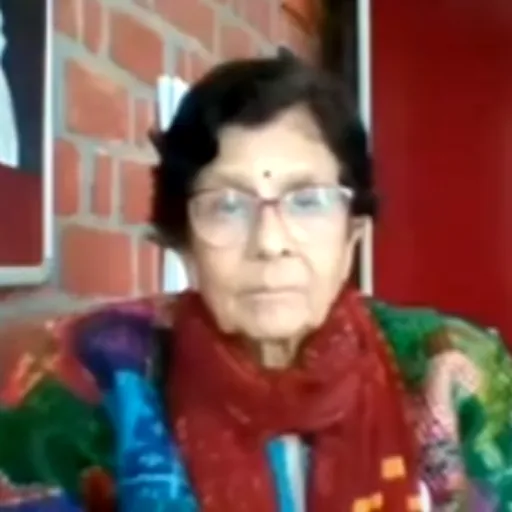
About Abha Bhaiya
Abha Bhaiya was an Indian anthropologist, women's rights activist, feminist and writer.
Abha Bhaiya (born 1948) is an Indian feminist activist and cofounder of Jagori Rural Charitable Trust (JRCT), a community-based women empowerment organization. She has been an active participant in women's rights movements since the 1970s, advocating for a range of issues including "social, political and economic rights of women; the status of single women; women's right to health, bodily integrity and well-being; sex and sexualities; against militarization, fundamentalisms; food securities and livelihoods, organic agriculture and the increasing erosion of civil rights of the poorest."
Early life and education Bhaiya was born in 1948 to a conservative Marwari family in Jaipur, Rajasthan. She has three siblings—two sisters and one brother. Growing up, Bhaiya observed that her brother was afforded preferential treatment in the household, and began to understand "why he was conceived in the first place after three girls". As a child and young adult, she struggled to get an education and to choose a profession aligned with her interests, as her family did not see the merit in educating girls. In 1961, while completing her schooling, she met and befriended poet, author, developmental feminist activist, and social scientist Kamla Bhasin.
Within her social context, Bhaiya had no role models, except her mother. Despite their "rather strained" relationship, she was inspired by her mother's strength to navigate life under extenuating circumstances with minimal resources. For Bhaiya, "living in a conservative family as a married daughter-in-law, confined to home and domesticity", was unimaginable; as a result, she started questioning the "politics of poverty and powerlessness" in the context of "women's oppression and subordination" and began to challenge "traditions, expectations and social taboos, including the institutions of marriage, family and motherhood".
After she completed her postgraduate degree in philosophy at 21 years old, Bhaiya faced immense familial pressure to get married. She was forced to elope from home and seek refuge at Lakshmi Ashram in Kausani, Uttarakhand that was run by Sarla Behn, a British Gandhian social activist. At the Ashram, Bhaiya helped educate girls from marginalized backgrounds and lived a "simple self-dependent life". Later, she agreed to her father's numerous pleas to return home under two conditions: one, she will no longer be goaded into a marriage, and two, she will not be prevented from working. She was greatly influenced by the welfare approach of social work practice in the 1960s Germany while working with homeless communities and children of Gasterbeiters.
She completed her third postgraduate degree from Delhi School of Social Work (DSSW) in 1973.
1981–1990: Collaboration with Bhasin on Saheli, Sangat and Jagori Bhasin and Bhaiya were both part of a Delhi-based feminist collective led by Saheli, one of the first few NGOs in the country focusing on women empowerment that was formed by Bhaiya in 1981. "Our concern was [working] with women who had been denied literacy skills," Bhaiya recalled. The feminist-duo started by updating the lyrics of traditional folk songs to reflect feminist messages about "gender inequality, discrimination, experience of violence and denial that women go through at so many levels". Other key events unfolded: the undermining in Shah Bano case related to maintenance allowance for divorced Muslim women (1986); the anti-sati movement (1987); the gang rape of Bhanwari Devi (1992) that led to the introduction of Vishaka guidelines for the protection of women against sexual harassment in the workplace (1997), and the demolition of the Babri Masjid (1992). One of Bhasin's earliest songs, Tod Tod ke Bandhano ko Dekho Behne Aati Hain, emerged as a response to these events and went on to become the signature protest song for women.
In 2002, Bhasin-Bhaiya started the Jagori Rural Charitable Trust in Himachal Pradesh's Kangra district to work with the "most marginalized" women and to challenge "multiple systems of domination, discrimination and exploitation". The same year, Bhaiya set up a feminist retreat called Training and Research Academy (TARA) in the lower Himalayas to provide facilities for the organization of "workshops, seminars and alternative healing sessions".
Bhasin-Bhaiya started the One Billion Rising campaign in 2013 with American playwright and performer Eve Ensler, calling for an end to violence against women and girls globally, that was eventually joined by activists from 176 countries.
She voiced support for the Kurdish women's movement in 2024, underscoring "the importance of women-led grassroots movements in transforming paradigms of governance and challenging prevailing norms of violence and oppression". She also praised Abdullah Öcalan's "federal model of governance" for offering "hope for a different world order in which women's emancipation is central to overcoming the ills of capitalist civilisation."
Awards and honours Women's Sexualities and Masculinities in a Globalizing Asia, edited by Saskia Wieringa, Evelyn Blackwood, and Abha Bhaiya, received the Ruth Benedict Prize for Edited Volume in 2007.
Selected publications
Kathuria, Poonam; Bhaiya, Abha, eds. (2018). Indian feminisms: individual and collective journeys. New Delhi: Zubaan Books. . Wieringa, Saskia E.; Bhaiya, Abha; Nursyahbani, Katjasungkana (2015-09-01). Heteronormativity, Passionate Aesthetics and Symbolic Subversion in Asia. Liverpool University Press. . Bhaiya, Abha (2007). Wieringa, Saskia E.; Blackwood, Evelyn; Bhaiya, Abha (eds.), "Flames of Fire: Expressions and Denial of Female Sexuality". Women's Sexualities and Masculinities in a Globalizing Asia. New York: Palgrave Macmillan US. pp. 203–215. .
Don’t just read it —
keep it.
Full-length biographies made to live with: read them, listen on the way to work, watch them tonight.
- E-book
- Audio
- Video
Instant download · yours to keep · every purchase keeps this site free
Important facts
Related people
Same field, nearest in time




Frequently asked questions
Who was Abha Bhaiya?
Indian anthropologist
What was Abha Bhaiya's occupation?
Abha Bhaiya was an anthropologist, women's rights activist, feminist and writer.
What nationality was Abha Bhaiya?
Abha Bhaiya was Indian.
Sources & further reading
Cite this page
APA: Biography.guide. (2026). Abha Bhaiya. https://biography.guide/abha-bhaiya/
MLA: "Abha Bhaiya." Biography.guide, https://biography.guide/abha-bhaiya/.
Chicago: "Abha Bhaiya." Biography.guide. https://biography.guide/abha-bhaiya/.
Data last updated: 2026-09-20 · Spot an error? Report a correction.
Portrait: Wikimedia Commons · author & licence
Page generated 2026-09-27 04:58 UTC