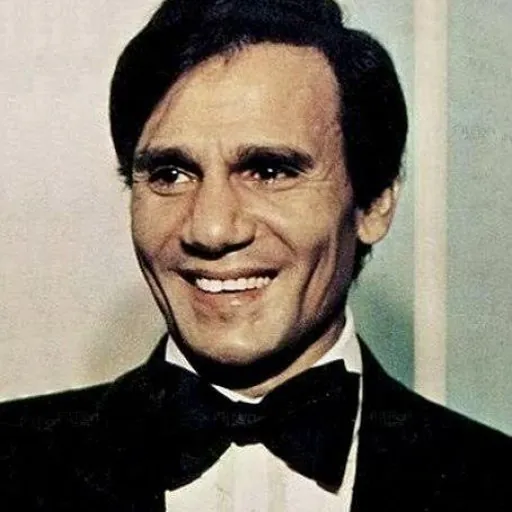
About Abdelhalim Hafez
Lived 1929 – 1977 (aged 47). Abdelhalim Hafez was an actor, singer, film actor, composer, musician and conductor.
Abdel Halim Ali Shabana , commonly known as Abdel Halim Hafez (, ) (21 June 1929 – 30 March 1977),
Abdel Halim is considered to be one of the greatest Egyptian musicians of his era, along with Umm Kulthum, Mohamed Abdel Wahab, Farid Al Atrach, Mohamed Fawzi, and Shadia. As his popularity grew, he was given the nickname 'el-Andaleeb el-Asmar , meaning The Brown-Skinned Nightingale. He achieved extraordinary success as a popular musician throughout the Arab world, with estimated sales of over 80 million records.
Early life Born Abdel Halim Ali Shabanah in El-Halawat in El Sharqia, 80 kilometers (50 miles) north of Cairo, he was the fourth child of Ali Ismail Shabanah. He had two brothers, Ismail and Mohamed, and one sister, Alyah. His mother died from labor complications three days after giving birth to him – something that made people around him believe that he brought bad luck. His father died as well a few months later, leaving him and his siblings orphaned at a young age. He lived in a poor orphanage for a number of years.
Abdel Halim's musical abilities first became apparent while he was in primary school and his older brother Ismail Shabanah was his first music teacher. At the age of 14 he joined the Arabic Music Institute in Cairo and became known for singing the songs of Mohammed Abdel Wahab. He dropped out from the Higher Theatrical Music Institute as an oboe player.
Musical career In the very beginning, Abdel Halim worked as a teacher of music at schools in Tanta and El-Mahalla El-Kubra. While singing in clubs in Cairo, Abdel Halim was drafted as a last-minute substitute when the singer Karem Mahmoud was unable to sing a scheduled live radio performance in 1953.
Abdel Halim's performance was heard by Hafez Abdel Wahab, the supervisor of musical programming for Egyptian national radio. Abdel Halim took 'Hafez', Abdel Wahab's first name, as his stage-surname in recognition of his patronage. In collaboration with composer Mohammed Abdel Wahab, Abdel Halim went on to produce many popular love songs such as Ahwak ("I adore you"), Nebtedi Minen el Hekaya ("Where should we start the story"), and Fatet Ganbena( "She passed by us"). Hafez also worked with Egyptian poet Mohamed Hamza on songs including Zay el Hawa ("It feels like love"), Sawah ("Wanderer"), Hawel Teftekerni ("Try to remember me"), Aye Damiet Hozn ("Any tear of sadness"), and Maw'ood ("Destined").
During his career, he was very popular and always performed in sold-out arenas and stadiums. Despite his popularity, he rarely released a studio album since he worked purely as a live singer. His entire catalogue was acquired by the Mazzika group in the early 2010s after the sale and break-up of EMI.
Fame In Egypt, Halim is known as the "King of Music", "The Son of Nile", "The voice of the people", "The son of the revolution", and "King of emotions and feelings". His patriotic songs were the most frequent songs sung by the crowds during the Egyptian Revolution of 2011. His way of singing, the popularity of his songs and his behavior made him a role model for almost every modern singer in the entire region.
Personal life
At the age of 11, Abdel Halim contracted schistosomiasis
In 1969, Halim built a hospital in Egypt. He treated the poor, the rich, and presidents equally in the Arab World. Halim was reported to have had many more dreams and goals that he wanted to achieve, though his early death prevented him from doing so.
Legacy Abdel Halim Hafez's song "Khosara" received notice in the Western world in 1999 when elements from it were used for Jay-Z's recording "Big Pimpin'." Two complete bars from "Khosara" were rerecorded, not sampled, and used without permission from the song's producer and copyright holder, Magdi el-Amroussi. Jay-Z's use of an interpolation, rather than an actual sample, allowed him to avoid paying royalties for the use of the song.
Over 300 of Abdel Halim Hafez's songs were recorded and he starred in 16 classic and successful films, including Dalilah , which was the Middle East's first color motion picture. In the same year a soap opera "Al-andaleeb hikayt shaab" was produced in Egypt with Shadi Shamel starring as Abdel Halim. Shamel won the lead role in a televised competition.
On 21 June 2011, Google celebrated his 82nd birthday with a Google Doodle.
On 19 April 2019, Lebanese singer Carole Samaha performed alongside a Pepper's ghost image of Abdel Halim Hafez at the Manara Hall in New Cairo. The concert, titled "Helm" (dream), was Egypt's first concert featuring a Pepper's ghost.
Songs Some of Halim's most popular songs are:
"Ahwak" (I adore you), "Ala Ad El Sho'" (As much as the longing), "Ala Hesb Wedad" (Wherever my heart leads me), "Betlomooni Leih" (Why do you blame me), "El Massih" (Christ), "Fatet Ganbena" (She passed by us), "Gabbar" (Arrogant), "Gana El Hawa" (The mood struck us), "Sawwah" (Wanderer), "Maw'ood" (Destined), "Zai El Hawa" (Like passion), "Qari'at Al Fingan" (The coffee fortune-teller), his last song while alive "Habibati Man-Takoon" (My Love, Who Is She), released posthumously
Patriotic songs 'The New Testament', written by Mahmoud Abdel Hai and composed by Abdel Hamid Tawfiq Zaki, was the first national anthem sung by Abdel Halim Hafez in 1952. Abdel Halim sang it after the July 23 revolution. 'We are the people' was the first song Abdel Halim sang to President Gamal Abdel Nasser after his election in 1956. This marked the first collaboration between Abdel Halim, Kamal Al-Taweel and Salah Jahin. 'God, our country' was the first collaboration between Mohamed Abdel-Wahab and Abdel Halim in the field of patriotic songs, also in 1956. Abdel Halim sang it after the Tripartite Aggression. 'On Its Land' or 'Christ's Song' is about Jerusalem. It was written by Abdel Rahman Al-Abnoudi, composed by Baligh Hamdi, and arranged by Ali Ismail. 'Your Son Says You're a Hero' was written by Abdul Rahman Al-Abnoudi and composed by Kamal Al-Taweel. 'The Greater Homeland Anthem', written by Ahmed Shafiq Kamel and composed by Mohamed Abdel Wahab, was released in 1960. 'The Story of a People', also written by Ahmed Shafiq Kamel, was composed by Kamal Al-Taweel for the 'Adwaa Al-Madina' party held in Aswan to celebrate the laying of the foundation stone for the construction of the High Dam. 'Matalib Shaab' was written by Ahmed Shafiq Kamel and composed by Kamal Al-Taweel for the tenth commemoration of the revolution on 23 July 1962. He sang "Sourah" on Revolution Day on 23 July 1966. It was written by Salah Jaheen and composed by Kamal Al-Taweel. In 1967, he sang "Aadah Al-Nahar", one of Abdel Halim's most prominent songs, written by Abdel Rahman Al-Abnoudi and composed by Baligh Hamdi. In 1967, he sang "I swear by its name", promising to perform it at all his concerts until Egypt was liberated in Sinai. It was written by Abdel Rahman Al-Abnoudi and composed by Kamal Al-Taweel. 'The Gun Talk' was written by Abdel Rahman Al-Abnoudi and composed by Kamal Al-Taweel in 1968. 'Aash lih Aal' was the first song Abdel Halim sang after the October Victory of 1973. It was written by Mohamed Hamza and composed by Baligh Hamdi, and it was the first song in which Abdel Halim praised President Mohamed Anwar Sadat's role in Egypt's great victory. 'Good Morning, Sinai' was another collaboration between Abdel Halim and Kamal Al-Taweel in 1974. 'Al Najmah Malet Ala Amar' (1975) was written by Mohsen Al-Khayat and composed by Muhammad Al-Mouji. 'The Boat is Back' was written by Mustafa Al-Damrani and composed by Muhammad Abdel Wahab after the Suez Canal reopened to global navigation.
Religious invocations
"Nafadet Einayah Almanamm" (My eyes shook the dream) "Ana min al tourab" (I am from dust) "Ala Toutah" (On the raspberry) "Adaaouka Ya Samaah" (I call you, Listener) "Wa Rahmatoka fi Nasim" (And your mercy in the breeze") "Bayneh wa Bayn Al nas" (Between me and the people) "Wa Habeh fih Al-ared" (And the grain in the earth) "Khalineh Kelmah" (Let me a word) "Waraa Al shajar" (Tree leaves) "Bayna Sohbat Al Ward" (Among the company of Roses) "Ya Khalek Alward" (The Creator of the flowers) All of theses religious invocations were written by the poet Abdel-Fattah Mustafa, and composed by Muhammad Al-Mouji.
Filmography Title Release Date Role Co-stars DirectorNotesLahn El Wafa''' (The Song of Faithfulness) 1 March 1955 Galal Shadia Ibrahim Amara Abdel Halim Hafez co-directed Ayyamna al-Holwa (Our Beautiful Days) 1 March 1955 Ali Faten Hamama, Omar Sharif, Ahmed Ramzy Helmy Halim Ayam We Layali (Days and Nights) 8 September 1955 Yehia Eman Henry Barakat Mawed Gharam (Love Rendez-vous) 3 January 1956 Samir Faten Hamama Henry Barakat Dalila|20 October 1956 Ahmed Shadia Mohamad Karim This was Egypt's first movie to be in Cinemascope Layali el hub| 1956 Abdel Halim Hafez Helmy Rafla Banat El Yom (The Girls of Today) 10 November 1957 Khaled Magda, Amal Farid Henry Barakat Hafez performed the popular love song "Ahwak" for the first time in this film Fata Ahlami (The Man of My Dreams) 7 March 1957 Adel Amal Farid Helmy Rafla Alwisada El Khalia (The Empty Pillow) 20 December 1957 Salah Abdel Halim Hafez, Lubna Abed El Aziz Salah Abu Yousef The song Asmar Y'Asmarani was performed in this movie by Faeza Ahmed. Halim performed Awel Marra in this movie. Share' El Hob (Love Street) 5 March 1958 Abd-El Moneim Sabah Ezz El-Dine Zulficar Hekayit Hob (A Love Story) 12 January 1959 Ahmed Sami Mariam Fakhr Eddine Helmy Halim El Banat Wel Seif (Girls and Summer) 5 September 1960 Mohamed Suad Husni, Zizi El Badrawi Salah Abu Yousef, Ez El Deen Zol Faqar, Fateen Abed El Wahhab This movie consisted of 3 stories. Abdel Halim Hafez acted in one of these. Yom Men Omri (A Day of My Life) 8 February 1961 Salah Zubaida Tharwat Atef Salem El Khataya (The Sins) 12 November 1962 Hussien Madiha Yousri, Hassan Youssef (actor), Nadia Lutfi Hassan El Imam Featured the songs Wehyat Alby, Maghroor, Last Adry, Olly Haga, and El Helwa Maabodat El Gamahir (The Beloved Diva) 9 January 1967 Ibrahim Farid Shadia Helmy Halim Featured the songs Haga Ghareeba, Balash Etaab, Last Kalby, Gabbar, and Ahebek Abi Foq El Shagara'' (My Father Atop a Tree)17 February 1969AdelNadia Lutfi, Mervat AminHussein KamalFeatured the songs Ady El Belag, El Hawa Hawaya, Ahdan El Habayeb, Ya Khali El Alb, and Gana El Hawa. Hafez also produced this movie and was the last film in which he appeared. This movie is still the longest running motion picture in movie theaters in the Arab world to date., (Last appearance)
Don’t just read it —
keep it.
Full-length biographies made to live with: read them, listen on the way to work, watch them tonight.
- E-book
- Audio
- Video
Instant download · yours to keep · every purchase keeps this site free
Important facts
People in Abdelhalim Hafez's life
Named in this biography and alive at the same time





Related people
Same field, nearest in time



Contemporaries
People whose lives overlapped Abdelhalim Hafez's

Frequently asked questions
Who was Abdelhalim Hafez?
Egyptian singer and actor (1929–1977)
When was Abdelhalim Hafez born?
Abdelhalim Hafez was born on 21 June 1929 in Elhallawat.
When did Abdelhalim Hafez die?
Abdelhalim Hafez died on 30 March 1977 in London.
What was Abdelhalim Hafez's occupation?
Abdelhalim Hafez was an actor, singer, film actor, composer, musician and conductor.
What nationality was Abdelhalim Hafez?
Abdelhalim Hafez's recorded nationality: Kingdom of Egypt, Republic of Egypt, United Arab Republic.
Sources & further reading
Cite this page
APA: Biography.guide. (2026). Abdelhalim Hafez. https://biography.guide/abdelhalim-hafez/
MLA: "Abdelhalim Hafez." Biography.guide, https://biography.guide/abdelhalim-hafez/.
Chicago: "Abdelhalim Hafez." Biography.guide. https://biography.guide/abdelhalim-hafez/.
Data last updated: 2026-09-22 · Spot an error? Report a correction.
Portrait: Wikimedia Commons · author & licence
Page generated 2026-09-27 05:03 UTC