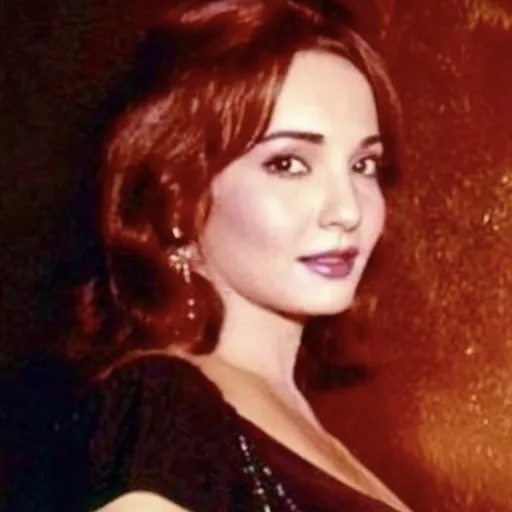
About Shadia
Lived 1931 – 2017 (aged 86). Shadia was an Egyptian singer and actor.
Fatma Ahmad Kamal Shaker (; 8 February 193128 November 2017), better known by her stage name Shadia (, Shādya), was an Egyptian actress and singer. She was famous for her roles in light comedies and drama in the 1950s and 1960s. She was the third wife of Salah Zulfikar. Shadia was one of the iconic actresses and singers in Egypt and the Middle East region and a symbol of the golden age of Egyptian cinema and is known of her many patriotic songs.
Shadia's films and songs are popular in Egypt and all the Arab world. Critics consider her the most successful comprehensive Egyptian and Arabic artist of all time. Her first appearance in a film was in "Azhar wa Ashwak" (Flowers and Thorns), and her last film was "La Tas'alni Man Ana" (Don't Ask Me Who I Am).
She is also known for her patriotic song "Ya Habibti Ya Masr" (Oh Egypt, My Love.) Her breakthrough leading role came in the 1959 Egyptian film "Al Maraa Al Maghoula" (The Unknown Woman) directed by Mahmoud Zulfikar. Six of her movies are listed in the top 100 Egyptian movies of the 20th century.
In April 2015, Shadia became the first actress to be awarded an honorary doctorate by the Egyptian Academy of Arts. She was given the nickname "Idol of the Masses" following her successful movie "Ma'budet el Gamahir" (Idol of the Masses). Other notable nicknames include "The Guitar of the Egyptian Singing" and "The Golden Guitar" .
Early life Shadia was born "Fatma Ahmad Kamal Shaker" on 8 February 1931, in Elhelmiyya Elgedida, in Cairo, Egypt, to an Egyptian father Ahmed Kamal Sahker from Sharqia and a mother of Turkish origin. In 1947, she fell in love with an Egyptian officer from Upper Egypt, and was heartbroken by his death during the 1948 war. Shadia had five sisters and brothers. She was the youngest of her sisters and the second youngest among all her siblings. Since her childhood, Shadia loved to sing and was encouraged to pursue music at primary school.
Career
Shaker gave herself the stage name "Shadia", after the name of a newborn of one of her family's friends. She began acting at the age of fifteen. In her heyday during the 1950s and 1960s, Shadia acted in numerous melodramas, romance, and comedy films. However, it was her singing talent that established Shadia as one of the most important Egyptian cinema stars of her era.
Overall, as "Shadia", she performed in more than 100 films.
Her famous trilogy alongside Salah Zulfikar; "Merati Modir 'Am " (My Wife, the Director General, 1966), "Karamat Zawgaty" (My Wife's Dignity, 1967) and "Afrit Merati" (My Wife's Goblin, 1968), were huge successes. and "Aqwa Mn El Zaman" (Stronger Than Time). She participated in many operettas about Egypt and the Arab world along with other Egyptian and Arabic singers, including: "Al Watan Al Akbar" (The Great Nation), "El Geel El Sa'ed" (The Rising Generation), and "Soot El Gamaheer" (The Voice of the Masses). Her mega hit song "Ya Habibti Ya Masr" (Oh Egypt, My Love), was considered one of the best patriotic songs ever. During a TV-interview, Shadia said regarding her famous patriotic song: "When I am singing to my homeland, it is even way more romantic and more honest than any romantic song. Here I am singing to my home, my land. There was a period when Egypt's name was erased (Nasser's era), Egypt’s name will never get erased from our hearts".
Upon returning from the premiere of "Raya and Sakina", Shadia stated that she gave serious thought that night to the idea of repentance. The following morning, she informed her producers that she wanted no part in the play from then on, but eventually promised to finish her work when they insisted that she do so. Thereafter, Shadia retired from the film and music industry, and went on a Umrah to Mecca, where she met the popular Egyptian Azhari scholar Sheikh El Shaarawy. Her meeting with El-Shaarawy influenced Shadia to reach her final decision to start wearing the hijab.
Retirement Shadia retired at the age of 50, citing the reason for her retirement as religious. She explained that she had been through many hard periods and rough circumstances throughout her life including struggling with cancer and depression that had veered her from her career. She decided to dedicate the rest of her life to caring for orphan children, stating that was her life's greatest joy. She also donated to charities, a decision she said she never once hesitated to make.
Personal life leftShadia fell in love with an army officer who was killed during the battles of the 1948 Palestine War. Years later, In 1953, she was married to actor Emad Hamdy. This marriage lasted for 3 years and ended with divorce on good terms. In 1958, Shadia married Aziz Fathi, who was a radio engineer. He was several years younger than Shadia, and it did not take long until problems arose between Shadia and her husband. She filed a lawsuit that continued for a long time in courts and was sentenced to divorce after a marriage that lasted 3 years.
Shadia's third and final marriage came after a highly publicized love story with actor and producer Salah Zulfikar. She fell in love with Zulfikar in 1964 while filming Aghla Min Hayati (1965) and they married in the same year. Zulfikar, who was a box-office star, shared the lead with Shadia in highly successful ventures mid-1960s. In one of her press interviews, she stated that he was the love of her life and he was the only man with whom she wished to have children. Unfortunately, she became pregnant three times and suffered a miscarriage each time. This turned out with depression though Zulfikar who already had children from his first marriage, tried to help her overcome her depression and produced A Taste of Fear (1969) with Shadia in the lead, the film turned out to be one of her cinematic masterpieces. Her depression lead to the end of this marriage and they got divorced around 1970. Shadia never remarried after Zulfikar.
Illness and death Shadia was hospitalised on 4 November 2017 after suffering a massive stroke in Cairo. She was placed under intensive care. Her nephew, Khaled Shaker, said during a televised phone conversation that she recovered from the stroke and could identify her relatives and the people around her. He added, however, that her illness was complicated by pneumonia, despite her recovery. Shadia's condition stabilised on 9 November,
On 28 November, Shadia died from respiratory failure caused by the pneumonia.
Tribute
On 8 February 2021 Google celebrated her 90th birthday with a Google Doodle. The Doodle was displayed in Egypt, Palestine and Sweden.
Filmography Source:
Don’t just read it —
keep it.
Full-length biographies made to live with: read them, listen on the way to work, watch them tonight.
- E-book
- Audio
- Video
Instant download · yours to keep · every purchase keeps this site free
Important facts
People in Shadia's life
Named in this biography and alive at the same time



Related people
Same field, nearest in time



Contemporaries
People whose lives overlapped Shadia's

Frequently asked questions
Who was Shadia?
Egyptian actress/singer (1931–2017)
When was Shadia born?
Shadia was born on 8 February 1931 in Cairo.
When did Shadia die?
Shadia died on 28 November 2017 in Cairo.
What was Shadia's occupation?
Shadia was a singer and actor.
What nationality was Shadia?
Shadia was Egyptian.
Sources & further reading
Cite this page
APA: Biography.guide. (2026). Shadia. https://biography.guide/shadia/
MLA: "Shadia." Biography.guide, https://biography.guide/shadia/.
Chicago: "Shadia." Biography.guide. https://biography.guide/shadia/.
Data last updated: 2026-09-22 · Spot an error? Report a correction.
Portrait: Wikimedia Commons · author & licence
Page generated 2026-09-27 05:03 UTC