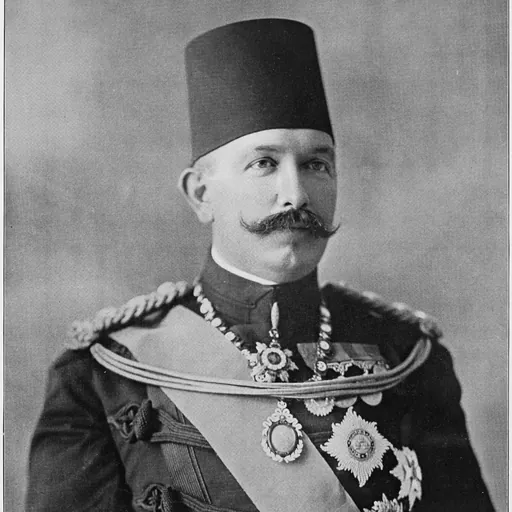
About Abbas II
Lived 1874 – 1944 (aged 70). Abbas II was a politician and governor.
Abbas Helmy II (also known as ʿAbbās Ḥilmī Pāshā, ; 14 July 1874 – 19 December 1944) was the last Khedive of Egypt and the Sudan, ruling from 8January 1892 to 19 December 1914. In 1914, after the Ottoman Empire joined the Central Powers in World War I, the nationalist Khedive was removed by the British, then ruling Egypt, in favour of his more pro-British uncle, Hussein Kamel. As the latter became sultan of Egypt, the deposition of Abbas II marked the de jure end of the nearly four-century long era of Ottoman Egypt, which had started with Ottoman conquest in 1517.
Early life
Abbas II (full name: Abbas Hilmy), the great-great-grandson of Muhammad Ali, was born in Alexandria, Egypt on 14 July 1874. In 1887 he was ceremonially circumcised together with his younger brother Mohammed Ali Tewfik. The festivities lasted for three weeks and were carried out with great pomp. As a boy he visited the United Kingdom, and he had a number of British tutors in Cairo including a governess who taught him English. In a profile of Abbas II, the boys' annual, Chums, gave a lengthy account of his education. His father established a small school near the Abdin Palace in Cairo where European, Arab and Ottoman masters taught Abbas and his brother Mohammed Ali Tewfik. An American officer in the Egyptian army took charge of his military training. He attended school at Lausanne, Switzerland; then, at the age of twelve, he was sent to the Haxius School in Geneva, in preparation for his entry into the Theresianum in Vienna. In addition to Arabic and Ottoman Turkish, he had good conversational knowledge of English, French and German. Cromer initially supported Abbas, but the new Khedive's nationalist agenda and association with the anti-colonial nationalist movements in Egypt put him in direct conflict with British colonial officers, and Cromer later interceded on behalf of Lord Kitchener (British commander in the Sudan) in an ongoing dispute with Abbas about Egyptian sovereignty and influence in that territory.
At the outset of his reign, Khedive Abbas II surrounded himself with a coterie of European advisers who opposed the British occupation of Egypt and Sudan and encouraged the young khedive to challenge Cromer by replacing his ailing prime minister with an Egyptian nationalist.
By 1899 he had come to accept British counsels. The western world would characterize him as a revolutionary against peace, although his main goal was to gain independence for Egypt. Their demand for a constitutional government in 1906 was rebuffed by Abbas II, and the following year he formed the National Party, led by Mustafa Kamil Pasha, to counter the Ummah Party of the Egyptian moderates. However, in general, he had no real political power. When the Egyptian Army was sent to fight Abd al-Rahman al-Mahdi in Sudan in 1896, he only found out about it because the Austro-Hungarian Archduke Francis Ferdinand was in Egypt and told him after being informed of it by a British Army officer.
His relations with Cromer's successor, Sir Eldon Gorst, however, were excellent, and they co-operated in appointing the cabinets headed by Butrus Ghali in 1908 and Muhammad Sa'id in 1910 and in checking the power of the National Party. The appointment of Kitchener to succeed Gorst in 1912 displeased Abbas II, and relations between the Khedive and the British deteriorated. Kitchener, who exiled or imprisoned the leaders of the National Party,
During the war, Abbas II sought support from the Ottomans, including proposing to lead an attack on the Suez Canal. He was replaced by the British by his uncle Hussein Kamel from 1914 to 1917, with the title of Sultan of Egypt. He died at Geneva on 19 December 1944, aged 70, unmarried and without issue, received decoration of the Order of Charity, 1st class, 31 May 1895; Princess Atiyatullah (Cairo, 9 June 1896 – 1971),
Honours
Don’t just read it —
keep it.
Full-length biographies made to live with: read them, listen on the way to work, watch them tonight.
- E-book
- Audio
- Video
Instant download · yours to keep · every purchase keeps this site free
Important facts
Family & relationships
People in Abbas II's life
Named in this biography and alive at the same time


Related people
Same field, nearest in time





Contemporaries
People whose lives overlapped Abbas II's

Frequently asked questions
Who was Abbas II?
Khedive of Egypt (1874-1944) (r. 1892-1914)
When was Abbas II born?
Abbas II was born on 14 July 1874 in Alexandria.
When did Abbas II die?
Abbas II died on 19 December 1944 in Geneva.
What was Abbas II's occupation?
Abbas II was a politician and governor.
What nationality was Abbas II?
Abbas II's recorded nationality: Khedivate of Egypt, Sultanate of Egypt, Kingdom of Egypt.
Sources & further reading
Cite this page
APA: Biography.guide. (2026). Abbas II. https://biography.guide/abbas-ii/
MLA: "Abbas II." Biography.guide, https://biography.guide/abbas-ii/.
Chicago: "Abbas II." Biography.guide. https://biography.guide/abbas-ii/.
Data last updated: 2026-09-23 · Spot an error? Report a correction.
Portrait: Wikimedia Commons · author & licence
Page generated 2026-09-27 05:07 UTC