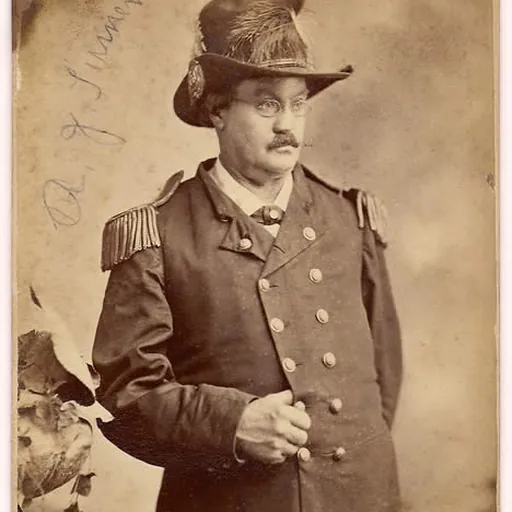
About A. J. Turner
Lived 1818 – 1905 (aged 86). A. J. Turner was an American composer, pianist, conductor and bandleader.
Augustus John Turner (October 12, 1818 – May 14, 1905), known as "A. J. Turner", was an American composer, band leader and music professor.
He was the first director of the Stonewall Brigade Band of Staunton, Virginia, the oldest continuous community band funded by tax moneys in the United States. They were mustered into the Stonewall Brigade under Stonewall Jackson of the Confederacy during the Civil War. Turner served through the Valley Campaign, the Seven Days Battles, and was at the Battle of Cedar Mountain.
Turner was a professor of music at the Wesleyan Female Institute, the Staunton Male Academy, and the Deaf, Dumb, and Blind Institute. He also played a part in the temperance movement.
Ancestry and early years Augustus John Turner was born on October 12, 1818, in Spartanburg County, South Carolina, to Samuel M. Turner and Mahala Johnson Chapman. His father Samuel was a farmer living near the site of Fort Prince.
Both Turner's grandfathers fought in the Revolutionary War. His father Samuel's father was James Turner, who settled in South Carolina near Coulter's Ford on the Pacolet River with his father George Henry Turner, after the death of his mother Hannah Middleton in Virginia.
James Turner prepared beef for the patriots the night before the Battle of Cowpens.
Frederick County
Before moving to Staunton, Turner lived in Middletown and Newtown (now Stephen's' City), near Winchester in Frederick County, Virginia. He married Catherine ("Kate") Montrose Aby on July 1, 1845, in Middletown. The ceremony was performed by John Allemong. Kate Aby's father was a shoemaker and veteran of the War of 1812. Her mother, who lived at Thorndale Farm, was the daughter of a drummer in the American Revolution.
In 1846, a son was born in Newtown, Charles W. Turner. Turner also spent time at Greenville, where he played with the famous banjoist Joel Sweeney in 1847, and organized a band in Middlebrook. In 1847 a second son was born in Middletown, T. M. Turner. In 1849 a third, M. S. Turner.
Turner's house in Newtown was destroyed in a fire on December 1, 1856.
Staunton Turner moved to 26 Fayette Street in Staunton by 1858. He eventually moved to 15 Fayette Street in Staunton. He grew tomatoes in his garden.
Stonewall Brigade Band
In Staunton, Virginia, in 1855, David W. Drake sought help in founding a band. He enlisted the help of Turner, his former music teacher in Newtown, persuading him to move to Staunton. Together with two other citizens of Staunton, they formed the Mountain Saxhorn Band. Turner was the band's first director, and it is still active today, the oldest continuous community band funded by tax moneys in the United States. At the concert on December 1, 1857, Turner was presented by lawyer A. H. H. Stuart and the band with a silver cornet.
By 1859 the band had come to be known as Turner's Silver Cornet Band. At Armory Hall on April 4, 1861, Turner's Silver Cornet Band, together with the Staunton Musical Association and the Glee Club, presented the last concert to be given before the Civil War. Soon after the Battle of First Manassas, the band earned the name Stonewall Brigade Band, and has been known as such ever since.
As well as playing their instruments, band members fought and acted as couriers and letter bearers or medical assistants. Though not in the band, Turner's first son Charles was an orderly and courier for Stonewall Jackson.
A. J. Turner and his son T. M. Turner enlisted for the Confederacy on April 1, 1862. They were discharged because of age (A. J. too old and T. M. too young) on August 22, 1862. They were then in the Churchville Cavalry Troop, 14th Virginia Company I for a time, commanded by James A. Cochran. A. J. Turner directed the band until 1884. An 1860 advert for his services reads, "Teaches Piano, Guitar, Flute, Violin, &c, &c; also Ballad Singing". An 1896 ad reads, "Prof. A. J. Turner respectfully solicits a class of young people of both sexes in music ... Instruments: violin, piano, guitar, mandolin, cello and cornet." One source reads "Prof. Turner seems perfectly at home in the business of music. With the facility of the ready artist, he passes from instrument to instrument, as if the whole armory of the muse of song, from the harp to the organ, were his playthings." Turner could even play a recognizable tune on a common tin dinner horn. and was also an agent for the sale of Knabe and Stieff pianos. Wesleyan Female Institute Turner's first job in Staunton was teaching vocal and instrumental music at the Wesleyan Female Institute, next to the Methodist Church, and across from Trinity Episcopal Church.
Deaf, Dumb, and Blind Institute
Turner taught music at Staunton's Deaf, Dumb, and Blind Institute (pictured). Turner was appointed professor of music at the Deaf, Dumb, and Blind Institute in November 1866, replacing William C. Graham. Turner taught the blind pupils until the 1890s. He "evolved many of the methods now in vogue for giving blind children a musical education." One account of the institute's annual concert praises the pupils for "a high degree of musical taste and talent".
Staunton Male Academy In 1888-89, Turner was a professor of music teaching piano, violin, guitar, and cornet at the Staunton Male Academy.
Temperance Turner was active in the temperance movement and in 1878 was elected the Most Worthy Grand Chief of the Sons of Jonadab, for the district covering Virginia and West Virginia. He would reside there until his death in Washington Township. His former house in Staunton sold for $3,350 soon after his death.
List of compositions "Gallopade", 1857 "Bessie Bell Waltz", 1858 "Pray Maiden, Pray", 1864, lyrics by A. W. Kercheval. "Palmetto Schottisch", 1864 "Spring time polka", 1864 "La Perle", 1875, melody by J. P. Kavenaugh, arranged for piano by A. J. Turner "Dedication March", 1879 "Peyton Summerson's Funeral March", 1879
Don’t just read it —
keep it.
Full-length biographies made to live with: read them, listen on the way to work, watch them tonight.
- E-book
- Audio
- Video
Instant download · yours to keep · every purchase keeps this site free
Important facts
People in A. J. Turner's life
Named in this biography and alive at the same time



Related people
Same field, nearest in time



Contemporaries
People whose lives overlapped A. J. Turner's


Frequently asked questions
Who was A. J. Turner?
American composer and pianist (1818-1905)
When was A. J. Turner born?
A. J. Turner was born on 12 October 1818 in Spartanburg County.
When did A. J. Turner die?
A. J. Turner died on 14 May 1905.
What was A. J. Turner's occupation?
A. J. Turner was a composer, pianist, conductor and bandleader.
What nationality was A. J. Turner?
A. J. Turner was American.
Sources & further reading
Cite this page
APA: Biography.guide. (2026). A. J. Turner. https://biography.guide/a-j-turner/
MLA: "A. J. Turner." Biography.guide, https://biography.guide/a-j-turner/.
Chicago: "A. J. Turner." Biography.guide. https://biography.guide/a-j-turner/.
Data last updated: 2026-09-22 · Spot an error? Report a correction.
Portrait: Wikimedia Commons · author & licence
Page generated 2026-09-27 05:02 UTC