
About Zhou Mi
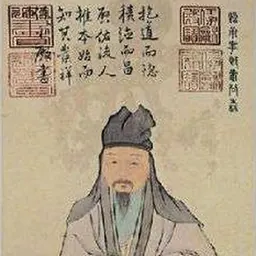
Lived 1232 – 1298 (aged 65–66). Zhou Mi was a Chinese writer, poet, ci lyric writer, connoisseur and scholar.
Zhou Mi (12321298), also known in Chinese by his courtesy name Zhou Gongjin and his style names Zhou Caochuang, Sishui Qianfu, Bianyang Laoren, and Bianyang Xiaoweng, was a Chinese scholar-official of the Southern Song and Yuan Empires.
Life Zhou Mi's family was a prominent one from Jinan and Qizhou in the Song Empire's Jingdong Circuit (now Shandong province, China), having served in government office for six generations before him. His great-grandfather Zhou Bi fled south with the emperor after the Fall of the Northern Song Dynasty in AD1127 and was rewarded with the position of vice-censor, enabling him to establish a sprawling estate in Wucheng (now Huzhou) north of the new imperial capital Lin'an in Liangzhe Circuit (now Hangzhou, Zhejiang).
Zhou was born in Fuyang, where his father Zhou Jin was serving as the local magistrate, on the 21st day of the 5th lunar month in 1232. The family returned to Wucheng at the end of his father's term three years later but continued to travel extensively throughout the region. In 1246, he accompanied his father to a new post overseeing Quzhou, where he met several prominent scholars and artists, and at age 20 he passed the entrance exam to the capital's Imperial Academy. He avoided the subsequent imperial exam for the degree and took a secondary one instead, relying on his family connections for his eligibility for government office. Having secured that, he seems to have traveled and enjoyed his affluent life for several years thereafter before finally beginning to serve in 1261.
As a scholar-official in his own right, he served in a series of positions in what is now Zhejiang, China, and the surrounding areas. He began his work under the Song as an assistant to Ma Guangzu ; 1200–1270), the prefect of Lin'an and pacification commissioner ) for Zhexi Circuit (, ), the Song territory around the capital. In 1263, he was commissioned to oversee Jia Sidao's land reform project in Piling (now Changzhou) but quickly resigned his post owing to his filial duty to care for his dying mother. He later worked for the imperial treasury in Jiankang (now Nanjing); was a clerk at the transportation office ) for Liangzhe, covering both Zhexi and neighboring Zhedong ); served at the Lin'an Public Pharmacy; and, in 1274, worked at the capital's reserve granary. He was appointed magistrate for Yiwu Prefecture in 1276, but may have not even reached it before it was surrendered to the Mongols after the fall of Lin'an in the 3rd lunar month.
During Song's conquest by the Mongol Empire, his family's property in Wuxing had been looted and burned, so Zhou moved to Lin'an, most likely to property held by his wife's relatives. Greatly distraught by the Mongol conquest and by the Tibetan Buddhist desecration of the Song imperial tombs under the Tangut monk and official Yang Lianzhenjia (Chinese: zh:, ; Tibetan:, ) in 1285, he is said to have wrote poetry compulsively during this period, although those works have been lost.
By this point he had become famous for his and poetry and as a connoisseur of Han art and literature. The artist Zhao Mengfu composed and illustrated Autumn Colors on the Que and Hua Mountains as a gift to him in 1296. Zhou died in 1298.
Works
Zhou's or 1290 Antiquities of the Martial Forest ) is a 10- account of the Southern Song capital Lin'an. It is an important source for the Southern Song, especially its popular culture, and for the history of various Chinese performing arts.
His Rustic Talk from East of Qi ) is a 20- popular history of the Song Dynasty, partially based upon notes compiled by his father and grandfather.
Don’t just read it —
keep it.
Full-length biographies made to live with: read them, listen on the way to work, watch them tonight.
- E-book
- Audio
- Video
Instant download · yours to keep · every purchase keeps this site free
Important facts
more
Huabuzhu Shanren, Bianyang Xiaoweng, Sishui Qianfu, Huabu Zhushanren, Shandong Cangfu, Hsiao-chai, Xiao Zhai, Hsiao Chai, Pien-yang Lao-jen, Zhou Caochuang, Chou Ts'ao-ch'uang, Pien-yang Lao-jên, Chou Tsao-chuang, Pien-yang Hsiao-wêng, Pien-yang Hsiao-weng, Zhou Gongjin, Chou Kung-chin, Kung-chin, Ssu-shui-chìen-fu, Ssu-shui Chien-fu, Ssu Shui Chien-fuPeople in Zhou Mi's life
Named in this biography and alive at the same time
Related people
Same field, nearest in time


Contemporaries
People whose lives overlapped Zhou Mi's



Frequently asked questions
Who was Zhou Mi?
Song Chinese official and scholar (1232–1298)
When was Zhou Mi born?
Zhou Mi was born in 1232 in Huzhou.
When did Zhou Mi die?
Zhou Mi died in 1298.
What was Zhou Mi's occupation?
Zhou Mi was a writer, poet, ci lyric writer, connoisseur and scholar.
What nationality was Zhou Mi?
Zhou Mi was Chinese.
Sources & further reading
Cite this page
APA: Biography.guide. (2026). Zhou Mi. https://biography.guide/zhou-mi-writer/
MLA: "Zhou Mi." Biography.guide, https://biography.guide/zhou-mi-writer/.
Chicago: "Zhou Mi." Biography.guide. https://biography.guide/zhou-mi-writer/.
Data last updated: 2026-09-20 · Spot an error? Report a correction.
Page generated 2026-09-27 05:32 UTC