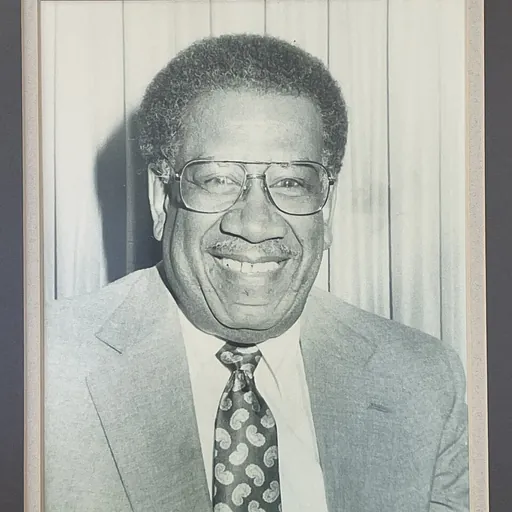
About Zelma Wyche
Lived 1918 – 1999 (aged 81). Zelma Wyche was an American businessperson, politician, barber and government official.
Zelma Charles Wyche (January 24, 1918 – September 24, 1999) was an African-American veteran of World War II, civil rights activist, and later an elected politician in Tallulah, the parish seat of Madison Parish in northeastern Louisiana.
In 1962 Wyche and other plaintiffs won a civil suit against the local registrar and state government, and were able to register to vote. He encouraged other Black residents in town to register. Beginning in 1969, and following passage of the Voting Rights Act of 1965, Wyche was elected to the local office of police chief of the city; he was reelected and served eleven years. In 1986 he was elected as mayor of Tallulah, serving one term until 1990.
After decades as a grassroots organizer, Wyche began to receive national attention for his work to dismantle racial segregation. In January 1970, six months after he was elected as Tallulah police chief, Ebony Magazine featured him in the article, "Black Lawman in KKK Territory." This was a reference to the Tallulah branch of the Ku Klux Klan, whose numerous local chapters fought desegregation in the American South. Until Wyche became police chief, he had earned his living as a barber.
Early life and education Wyche was born in 1918 and raised in Tallulah, Louisiana, where he attended segregated schools. Both the city and parish were majority black, the center of an agricultural area, but African Americans were largely disfranchised for decades into the mid-20th century, as they were throughout most of the Jim Crow South. Wyche studied and became a barber, which could offer a decent living. When he was in his 20s, he enlisted in the US Army and served during World War II.
Even before he served in the war, Wyche began to work for African-American civil rights. Since 1942, Wyche had chaired the group "Equal Rights for Black People". He also worked to get other African Americans registered. In his barbershop, Wyche often spoke of his interest in law enforcement and such television series as Highway Patrol, starring Broderick Crawford, Dragnet with Jack Webb, and Perry Mason, starring Raymond Burr. Wyche served thirty-four days of the four-month sentence, during which he picked 250 pounds of cotton in a parish penal unit.
In 1966, Wyche ran for a seat as alderman, but failed by 111 votes.
When voters marked the straight Democratic ticket with a single lever of the voting machine, several hundred Wyche supporters thought they had cast a vote for Wyche. When he and his supporters found out about the peculiarity of the ballot and the "missing" votes, Wyche successfully sued for another election. A federal judge ruled that the way the ballots had been set up for the special election was discriminatory.
Wyche won the next special election for Police Chief and took office on June 26, 1969. The police force already had four black and six white officers; after two of the latter left, he replaced them, and hired two more black officers. He would send them out in teams. In his first months in office, Wyche held what he called "sensitivity sessions", inviting the public to meet his officers and trying to improve relations with the community. He noted that blacks had often been harassed by police.
Time in 1970 described Sheriff Wyche by the following:
... the massive, 6-ft. 2-in. figure swaggers down the sidewalk. There is the natty uniform with gold stars on a white starched shirt, a button open at the neck. And there is the amiable cockiness, the touch of braggadocio, the blunt cigar and the smile revealing two gold-crowned teeth. Only one anomaly destroys the stereotype: Chief Wyche is black.
Wyche was reelected twice in regular elections, and served in total for more than two terms as chief, until June 30, 1978. He was succeeded by Howard Claxton Sr.
Wyche served as chairman of the political action commission of the Louisiana's 5th congressional district Black Caucus. This district was long represented by Otto Passman (D) (1947-1977), a white conservative who was first elected in the years of disenfranchisement of blacks and was a critic of civil rights legislation. Passman was defeated in the 1976 Democratic primary by Jerry Huckaby. (The 5th district was redrawn in 2013 following reapportionment after the 2010 census.)
In 1972, Wyche was elected as a chairman of the Louisiana delegation to the Democratic National Convention, which met in Miami Beach, Florida, and nominated the McGovern-Shriver ticket. Newly elected Governor Edwin Edwards (D) attended the convention. After he refused to back party nominee George McGovern, Edwards was snubbed by the Louisiana delegation. Edwards was unhappy with the McGovern nomination; he predicted that incumbent President Richard M. Nixon [a Republican] would win the electoral vote of Louisiana. In keeping with the increasing shift of white Democrats to Republican candidates, Nixon carried much of the South in 1972.
In 1978, Wyche was a dinner guest of U.S. President Jimmy Carter at Blair House in Washington, D.C. Two other African-American candidates were eliminated in the nonpartisan blanket primary: incumbent Democratic Mayor Leander A. "Doc" Anthony, who finished in a strong third-place showing; and Adell Williams, Tallulah's first African-American mayor, elected in 1974.
In the 1986 election Republican candidates won two of the five city council seats. One, Charles Michael Finlayson (born ), has been repeatedly re-elected to the District 1 seat, later becoming mayor himself and succeeded by the first black female elected, Yvonne Lewis.
Wyche was defeated for a second term as mayor in the primary election held on April 7, 1990, by Donald E. Walker, who finished with 54.4 percent of the ballots cast. Other candidates were former mayor Adell Williams, and Republican Donna Cummins, who polled 3.9 percent of the vote.
Personal life and death
Wyche was the chairman of the board of the Madison Parish Hospital and president of Delta Community Action Agency. He organized Tallulah's first troop of the Boy Scouts of America. He was an associate in the construction of three apartment complexes, one of which bears his name. Wyche was a member of the Masonic lodge, the Benevolent and Protective Order of Elks, and the deacon board of the Greater Mt. Olive Baptist Church at 316 North Walnut Street in Tallulah. He is interred at Oakwood Cemetery in Tallulah.
Don’t just read it —
keep it.
Full-length biographies made to live with: read them, listen on the way to work, watch them tonight.
- E-book
- Audio
- Video
Instant download · yours to keep · every purchase keeps this site free
Important facts
People in Zelma Wyche's life
Named in this biography and alive at the same time




Related people
Same field, nearest in time

Contemporaries
People whose lives overlapped Zelma Wyche's

Frequently asked questions
Who was Zelma Wyche?
African-American politician and barber
When was Zelma Wyche born?
Zelma Wyche was born on 24 January 1918 in Tallulah.
When did Zelma Wyche die?
Zelma Wyche died on 24 September 1999.
What was Zelma Wyche's occupation?
Zelma Wyche was a businessperson, politician, barber and government official.
What nationality was Zelma Wyche?
Zelma Wyche was American.
Sources & further reading
Cite this page
APA: Biography.guide. (2026). Zelma Wyche. https://biography.guide/zelma-wyche/
MLA: "Zelma Wyche." Biography.guide, https://biography.guide/zelma-wyche/.
Chicago: "Zelma Wyche." Biography.guide. https://biography.guide/zelma-wyche/.
Data last updated: 2026-09-20 · Spot an error? Report a correction.
Page generated 2026-09-27 05:10 UTC