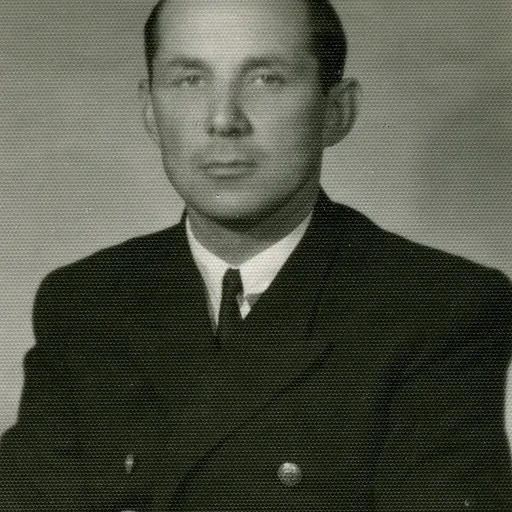
About Zbigniew Przybyszewski
Lived 1907 – 1952 (aged 45). Zbigniew Przybyszewski was a Polish military officer, oberleutnant and sea captain.
Zbigniew Przybyszewski (1907–1952) was a Polish military officer and a Commander in the Polish Navy. During the early stages of World War II he served with distinction as the commanding officer of the Heliodor Laskowski's Artillery Battery No. 31 at Hel Peninsula. After the war he returned to Poland from a prisoner of war camp and resumed his service, rising to the post of CO Coastal Artillery and deputy commander of the Naval Branch of the General Staff. Arrested by Soviet authorities under false charges of espionage, he was sentenced to death in a show trial and executed.
Biography He took up his first official position in the Navy Staff in Świecie, where he became the commander of a training platoon. From 1931 to 1932 he was the watch officer of the torpedo boat ORP "Krakowiak". In the meantime, as an acting watch officer, he participated in the cruise of the destroyer ORP "Wicher" to Sweden. At the beginning of 1933 he was appointed deputy commander of ORP "Krakowiak", and at the end of the year he moved to the Fleet Staff in Gdynia as a company commander. In 1934 he became an artillery officer on the submarine ORP "Wilk". In the years 1935-1936 he was at the Maritime Yachting Training Centre, initially as deputy commander, and later as commander of the unit. In 1936 he became executive officer of the torpedo boat ORP "Mazur", and from 1937 he sailed as the first artillery officer on the destroyers: ORP "Burza" and ORP "Błyskawica".
At the end of 1938 he became commander of the headland battery no. 31 in the Coastal Artillery Division on Hel. During the Invasion of Poland in 1939 he led effective fire against the German training battleships "Schleswig-Holstein" and "Schlesien", scoring hits on September 25. On the same day he was injured as a result of shelling of the headland by German ships. In his absence the battery again accurately hit the battleships on September 27. On September 28 he returned to the frontline and took command of the unit, which retained operational capability until the end of the defense of the Polish coast.
After the capitulation of Hel on 2 October 1939 he was taken prisoner and for the rest of the war he was in oflags: XVIII B Spittal and II C Woldenberg. In Woldenberg he tried to escape twice by digging a tunnel under the fence and hiding in a truck. Unfortunately both attempts ended without success.
When liberation came in 1945, he decided to return to Poland and began working at the Sea Fishing Institute in Gdynia. In the same year he was accepted into the forming Navy and appointed commander of the 2nd company at the School of Naval Specialists. In early 1946, he was briefly adjutant to the commander of the Navy, and when the chaser division was formed, he took over its command. At the end of 1946 he became commander of the 31st coastal artillery division. In the years 1949–1950 he held the positions of head of the Naval Artillery Service and deputy head of the Naval Department of the General Staff of the Polish Armed Forces.
In 1950 he was unexpectedly arrested by the Main Directorate of Information of the Polish Army. On July 21, 1952, the Supreme Military Court in Warsaw issued a verdict in the case of "organizing a conspiracy in the army". On false charges of espionage, 7 Navy officers were sentenced to death or life imprisonment. In December 1952, 3 officers were shot in the back of the head in the prison in Warsaw's Mokotów district, including Zbigniew Przybyszewski who died on December 16. The body of Commander Przybyszewski was secretly buried by the officers from Ministry of Public Security. The remaining 4 convicted officers remained in prison until 1956. On 24 April 1956 the Supreme Military Court decided that the criminal proceedings should be resumed and after a retrial, the 1952 verdict was overturned, stating the total innocence of the convicted.
Promotions
Awards and decorations
Don’t just read it —
keep it.
Full-length biographies made to live with: read them, listen on the way to work, watch them tonight.
- E-book
- Audio
- Video
Instant download · yours to keep · every purchase keeps this site free
Important facts
Related people
Same field, nearest in time



Contemporaries
People whose lives overlapped Zbigniew Przybyszewski's



Frequently asked questions
Who was Zbigniew Przybyszewski?
Naval officer of Poland
When was Zbigniew Przybyszewski born?
Zbigniew Przybyszewski was born on 22 September 1907 in Giżewo.
When did Zbigniew Przybyszewski die?
Zbigniew Przybyszewski died on 16 December 1952 in Warsaw.
What was Zbigniew Przybyszewski's occupation?
Zbigniew Przybyszewski was a military officer, oberleutnant and sea captain.
What nationality was Zbigniew Przybyszewski?
Zbigniew Przybyszewski was Polish.
Sources & further reading
· Wikipedia: Zbigniew Przybyszewski
· DBpedia: Zbigniew Przybyszewski
Cite this page
APA: Biography.guide. (2026). Zbigniew Przybyszewski. https://biography.guide/zbigniew-przybyszewski/
MLA: "Zbigniew Przybyszewski." Biography.guide, https://biography.guide/zbigniew-przybyszewski/.
Chicago: "Zbigniew Przybyszewski." Biography.guide. https://biography.guide/zbigniew-przybyszewski/.
Data last updated: 2026-09-23 · Spot an error? Report a correction.
Portrait: Wikimedia Commons · author & licence
Page generated 2026-09-27 05:06 UTC