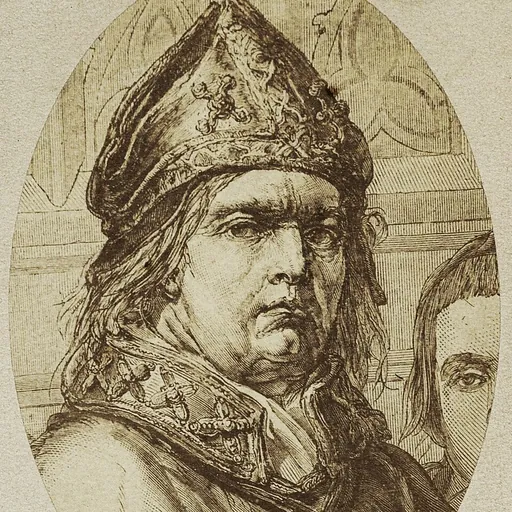
About Zbigniew Oleśnicki
Lived 1389 – 1455 (aged 65). Zbigniew Oleśnicki was a Polish diplomat, catholic priest, catholic bishop and bishop.
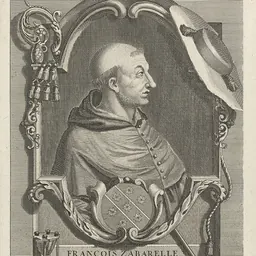
Zbigniew Oleśnicki (; 5 December 1389 – 1 April 1455), known in Latin as Sbigneus, was a high-ranking Roman Catholic clergyman and an influential Polish statesman and diplomat. He served as Bishop of Kraków from 1423 until his death in 1455. He took part in the management of the country's most important affairs, initially as a royal secretary under King Władysław II Jagiełło and later as the effective regent during King Władysław III's minority. In 1439, he became the first native Polish cardinal.
Biography
Shortly before his birth, his father, Jan Oleśnicki, was dispatched by King Władysław II Jagiełło to serve as captain of Vilnius and to bring a detachment of knights there. At the beginning of the Lithuanian Civil War the city was under the governance of the Polish king's brother, Skirgaila, and came under siege by the combined forces of the pagan Samogitians under Jagiello's cousin and rival Vytautas and the army of the Teutonic Order with their guest crusaders from France, England, and the Holy Roman Empire. He was apparently successful in his mission as, despite repeated sieges, the Teutonic Order was never able to take Vilnius.
At the age of twenty, he was secretary to King Władysław II Jagiełło, and fought with him in the battle of Grunwald on 15 July 1410. A favourite with the king, he took part in the management of the country's most important affairs.
On 18 December 1439, he was created cardinal priest with the titular church of St. Prisca, by Pope Eugene IV. ). As cardinal, his influence in Poland was second only to that of the king, and, during the frequent absence of Casimir IV in Lithuania, he transacted the affairs of the State.
In 1449, after the death of archbishop of Gniezno and primate of Poland Wincenty Kot, the position was proposed to Oleśnicki, but he refused it. It then passed to his political rival, bishop Władysław Oporowski.
In his conduct of Poland's affairs, Oleśnicki entertained far-reaching imperial dreams, which included a complete assimilation of Lithuania into the Polish state and the conquest of Silesia from the Kingdom of Bohemia. In particular, Oleśnicki pursued the idea of a Crusading alliance with Hungary against the Ottoman Turks, with the ultimate aim of extending Poland's boundaries to the Black Sea. This was manifested in promoting Władysław III's taking the Hungarian Crown - to which some Polish magnates were strongly opposed. However, all these aspirations came to naught with King Władysław's death at the Battle of Varna.
Being a man of great learning, he advanced the study of arts and letters in every possible way, and the flourishing condition of the University of Krakow during his episcopacy is due chiefly to his efforts. To repress the spread of Hussitism he called Giovanni da Capistrano (then in Breslau) and the Minorites to Kraków.
Da Capistrano, whom Oleśnicki invited, was also known for his anti-Jewish zeal, in which he engaged in Poland as in other countries. Oleśnicki's own Anti-Jewish intolerance was manifested in his strongly criticising Casimir IV Jagiellon for reaffirming in 1453 the tolerant measures towards Jews enacted by Casimir III the Great. Under Oleśnicki's influence, the 1454 Statutes of Nieszawa included the provisions that Jews' rights be "restricted when they contradict canon law" and that Polish Jews be compelled to wear distinctive clothing. However, this was never enforced in practice.
Don’t just read it —
keep it.
Full-length biographies made to live with: read them, listen on the way to work, watch them tonight.
- E-book
- Audio
- Video
Instant download · yours to keep · every purchase keeps this site free
Important facts
People in Zbigniew Oleśnicki's life
Named in this biography and alive at the same time


Related people
Same field, nearest in time




Contemporaries
People whose lives overlapped Zbigniew Oleśnicki's



Frequently asked questions
Who was Zbigniew Oleśnicki?
Catholic cardinal (1389–1455)
When was Zbigniew Oleśnicki born?
Zbigniew Oleśnicki was born on 5 December 1389 in Sandomierz.
When did Zbigniew Oleśnicki die?
Zbigniew Oleśnicki died on 1 April 1455 in Sandomierz.
What was Zbigniew Oleśnicki's occupation?
Zbigniew Oleśnicki was a diplomat, catholic priest, catholic bishop and bishop.
What nationality was Zbigniew Oleśnicki?
Zbigniew Oleśnicki was Polish.
Sources & further reading
· Wikipedia: Zbigniew Oleśnicki
· DBpedia: Zbigniew Oleśnicki (cardinal)
Cite this page
APA: Biography.guide. (2026). Zbigniew Oleśnicki. https://biography.guide/zbigniew-olesnicki-diplomat/
MLA: "Zbigniew Oleśnicki." Biography.guide, https://biography.guide/zbigniew-olesnicki-diplomat/.
Chicago: "Zbigniew Oleśnicki." Biography.guide. https://biography.guide/zbigniew-olesnicki-diplomat/.
Data last updated: 2026-09-22 · Spot an error? Report a correction.
Portrait: Wikimedia Commons · author & licence
Page generated 2026-09-27 05:03 UTC