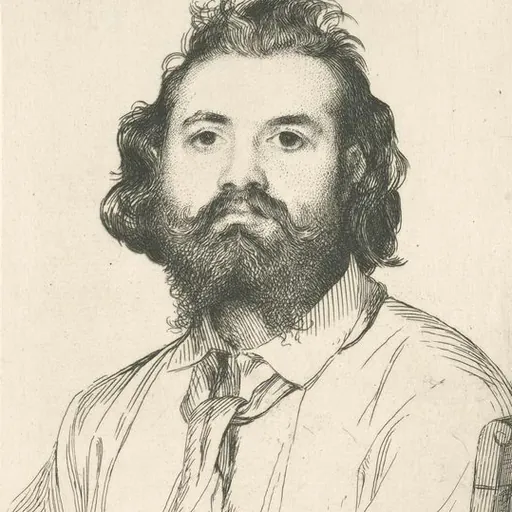
Zacharie Astruc
French sculptor, painter, poet, and art critic
About Zacharie Astruc
Lived 1833 – 1907 (aged 74). Zacharie Astruc was a French sculptor, art critic, painter, poet, composer and journalist.
Zacharie Astruc (23 February 1833 in Angers – 24 May 1907 in Paris) was a French sculptor, painter, poet, and art critic.
Biography Astruc was an important figure in the cultural life of France in the second half of the 19th century, and participated in the First Impressionist Exhibition of 1874 and also in the Exposition Universelle of 1900. As an art critic, writing primarily between 1859 and 1872, he was a strong defender of Courbet, and was one of the first to recognize the talent of Manet, who he had befriended as early as 1854, or 1857 at the latest. He also defended Monet, Whistler, Carolus-Duran, Fantin-Latour, and Alphonse Legros. Art historian Michael Fried has written that Astruc "more than any other writer spoke for Manet's generation" and that "between 1859 and 1863 the young Astruc may have been the best critic of new art in France."
Astruc had a very wide range of artistic interests, both in subject and in form. Before becoming most well-known as a sculptor, he was a writer, critic, painter, playwright, and composer. Astruc helped to promote a widespread revival of interest in El Greco's paintings. He wrote a song dedicated to the Spanish dancer Lola de Valence in 1863, which was printed with a reproduction of a painting by Manet of de Valence as cover art. He wrote a Japanese-influenced play, L'ile de la demoiselle, in 1865.
Astruc was an important connecting figure in the French art world of the time, if not a hugely important artist in his own right, and can be seen in several notable artworks of the 1860s to 1880s. He appears in Henri Fantin-Latour's painting A Studio at Les Batignolles, where he is seated next to Manet, who is shown painting his portrait. Astruc is generally credited with titling Manet's painting Olympia since an excerpt from an Astruc poem was included in the catalogue entry with the piece when it was exhibited at the 1865 Salon. Manet painted Astruc at least twice: Once in a portrait in 1866,
Along with many figures in the French art world of the late 1800s, Astruc inspired a character in French writer Marius Roux's novel The Substance and the Shadow, a roman à clef whose main character was a thinly disguised Paul Cézanne. "Lespignac", Astruc's character, is a con artist who becomes an art dealer.
Works by Astruc
Works featuring Astruc A friend of many French artists of his era, Astruc was often included in their works.
Don’t just read it —
keep it.
Full-length biographies made to live with: read them, listen on the way to work, watch them tonight.
- E-book
- Audio
- Video
Instant download · yours to keep · every purchase keeps this site free
Important facts
People in Zacharie Astruc's life
Named in this biography and alive at the same time


Related people
Same field, nearest in time




Contemporaries
People whose lives overlapped Zacharie Astruc's


Frequently asked questions
Who was Zacharie Astruc?
French sculptor, painter, poet, and art critic (1833-1907)
When was Zacharie Astruc born?
Zacharie Astruc was born on 23 February 1833 in Angers.
When did Zacharie Astruc die?
Zacharie Astruc died on 24 May 1907 in Paris.
What was Zacharie Astruc's occupation?
Zacharie Astruc was a sculptor, art critic, painter, poet, composer and journalist.
What nationality was Zacharie Astruc?
Zacharie Astruc was French.
Sources & further reading
Cite this page
APA: Biography.guide. (2026). Zacharie Astruc. https://biography.guide/zacharie-astruc/
MLA: "Zacharie Astruc." Biography.guide, https://biography.guide/zacharie-astruc/.
Chicago: "Zacharie Astruc." Biography.guide. https://biography.guide/zacharie-astruc/.
Data last updated: 2026-09-20 · Spot an error? Report a correction.
Portrait: Wikimedia Commons · author & licence
Page generated 2026-09-27 05:22 UTC