
About Yunmen Wenyan
Lived 864 – 909 (aged 44–45). Yunmen Wenyan was a Chinese buddhist monk, poet and philosopher.
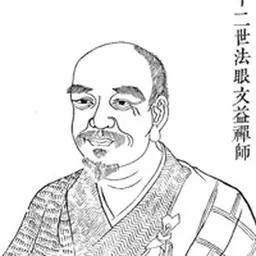
Yunmen Wenyan (; Japanese: Ummon Bun'en; 862 or 864 – 949 CE), was a major Chinese Chan master of the Tang dynasty. He was a dharma-heir of Xuefeng Yicun.
Yunmen founded the Yunmen school, one of the five major schools of Chán (Chinese Zen). The name is derived from Yunmen monastery of Shaozhou where Yunmen was abbot. The Yunmen school flourished into the early Song Dynasty, with particular influence on the upper classes, and eventually culminating in the compilation and writing of the Blue Cliff Record.
The school would eventually be absorbed by the Linji school later in the Song. The lineage still lives on to this day through Chan Master Xuyun (1840–1959).
Biography
Early years Yunmen was born in the town of Jiaxing near Suzhou and southwest of Shanghai to the Zhang family, apparently in 864 CE. His birth year is uncertain. The two memorial stele at the Yunmen monastery states he was 86 years old when he died in 949 CE, which suggests that he was born in 864 CE.
Initial Zen-studies While a boy, Yunmen became a monk under a "Commandment master" named Zhicheng in Jiaxing. He studied there for several years, taking his monastic vows at age 20, in 883 CE.
The teachings there did not satisfy him, and he went to the school of Reverend Muzhou Daoming (Chinese: 睦州道明; Pinyin: Mùzhōu Dàomíng), also known as Muzhou Daozong (Chinese: 睦州道蹤; Pinyin: Mùzhōu Dàozōng) (also known as Bokushu, Reverend Chen, Muzhou Daozong, Ch'en Tsun-su, Mu-chou Tao-tsung, Tao-ming, Muzhou Daoming etc.; Xuefeng Yicun of Mount Xianggu, in Fuzhou in modern-day Fujian Province, and become his disciple, as Daoming was by then too old (~100 years old) to further teach Yunmen.) After a few years studying with him, Yunmen did so, and received enlightenment after several years.
Advanced Zen-studies While Yunmen had received his teacher's seal of approval, he nevertheless did not become abbot, probably because he had only stayed there for 4 or 5 years. When Xuefeng Yicun died, Yunmen began travelling and visited quite a number of monasteries, cementing his reputation as a Chan master.
During a subsequent visit to the tomb of the Sixth Patriarch in Guangdong, Yunmen eventually joined (c. 911 CE) the monastery of Rumin Chanshi/Ling-shu Ju-min, who died in 918 CE. They became great friends. With his death, Yunmen became head priest of the Lingshu monastery on Mount Lingshu.
In this Five Dynasties and Ten Kingdoms period, the Tang dynasty was greatly weakened, and entire sections of the empire had broken away. The South was peaceful and developed, but the "North was torn by the ravages of war". ). His foremost disciple was accounted Baiyun Zixiang (Chinese: 白雲子祥; Pinyin: Báiyún Zixiáng), who had founded his own temple on the nearby Mount Baiyun.
Teachings
Yunmen was renowned for his forceful and direct yet subtle teaching, often expressed through sudden shouts and blows with a staff, and for his wisdom and skill at oratory:
Yet, his teachings are also described as "difficult to understand". According to Gyomay Kubose: "Yunmen's school is deep and difficult to understand since its mode of expression is indirect; while it talks about the south, it is looking at the north."
One Word Barriers Yunmen is known for apparently meaningless short sharp single word answers, like "Guan!" (literally, "barrier" or "frontier pass") – these were called "Yunmen's One Word Barriers". These one-word barriers
Koans
An apocryphal anecdote that began circulating around the beginning of the 12th century has Yunmen going so far as to forbid any of his sayings or teachings from being recorded by his many pupils:
Despite this, Yunmen is one of the greatest sources of "live words", "old cases", and paradoxical statements that would later evolve into the koan tradition, along with Zhaozhou (Japanese: Jōshū Jūshin). Most were collected in the Yúnmén kuāngzhēn chánshī guǎnglù (雲門匡眞禪師廣錄).
Eighteen koans in the Blue Cliff Record involve Yunmen: A monk asked Yunmen (Ummon), "What is the teaching that transcends the Buddha and patriarchs?" Yunmen (Ummon) said, "A sesame bun." (From the Blue Cliff Record, case no. 77) Eight of Yunmen's sayings are included in Book of Equanimity, and five in The Gateless Gate: A monk asked Yunmen, "What is Buddha?" Yunmen said, "Dried shitstick." (From case no. 21, The Gateless Gate)
Eighteen other koans were later discovered when a subsequent master of the Yunmen school, Xuedou Chongxian (Setchō Jūken, 980–1052 CE), published his Boze songgu, which contained one hundred "old cases" popular in his teaching line, in which the eighteen Yunmen koans were included. Further examples can be found in the Jen-t'ien Yen-mu, and the Yün-men Lu.
While his short ones were popular, some of his longer ones were iconic and among the most famous koans:
Lineage Painting of Yunmen (styled as Ummon Bun'en) by Hakuin Ekaku, c. 18th century, Edo era. His disciples reputedly numbered 790, an unusual number of whom became enlightened. The Yunmen School flourished as one of the Five Schools for about 300 years, after which it was absorbed into the Linji school towards the end of the Southern Song dynasty (~1127 CE).
The lineage still lives on to this day through Chan Master Xuyun (1840–1959). He rebuilt the Yunmen Temple as well as Huineng's temple, Nanhua Temple. The Yunmen school continues through Master Hsu Yun, Fo Yuan, and Master Ming Zhao Shakya, who have disciples in America and abroad.
Legacy Despite being a popular place for pilgrimages, the legendary Mount Wutai in Shanxi was ordered off-limits by Yunmen and his dharmic descendent, Linji Yixuan. When the legendary monk Ikkyū was studying under Kaso, he was assigned kōan no. 15 from the Gateless Gate where Yunmen/Ummon rebukes Tozan for wandering from one monastery to another; after being reprimanded, Tozan experiences enlightenment. When Ikkyū 'penetrated' into understanding this kōan, he was rewarded his dharma name.
The Rinzai master Shuho Myocho experienced great enlightenment after contemplating a Yunmen kōan for ten days. After the moment of enlightenment, his master Nanpo Shomyo told him: "Yesterday I dreamed that the great Ummon (Yunmen) personally came to my room. Today, it is you - the second Ummon."
By its preservation in the Blue Cliff Record, Yunmen's famous saying "Nichinichi kore kōnichi" ("Every day is a good day") became a useful phrase for later Zen teachers, including Kōdō Sawaki and his student Taisen Deshimaru. The avant-garde composer John Cage featured the saying in his Song Books as "Solo for Voice 64", specifically as a repetition of “kichi kichi kiri ko nichi”.
The shit stick kōan of Yunmen (case no. 21, The Gateless Gate) became renowned for its incomprehensibility. American Zen teacher Robert Baker Aitken explained that the term was used as "a soft stick that was used the way our ancestors used a corncob in their outhouses" Jack Kerouac paraphrased the kōan in his book The Dharma Bums as "The Buddha is a dried piece of turd." Wumen Huikai appended the kōan with the following verse:
Yunmen's Japanese name, Ummon, was the namesake for a prominent character in Dan Simmons's Hyperion Cantos science fiction series; Simmon's Ummon was a vastly advanced AI from the "TechnoCore", who reveals key plot elements to the main characters through kōans and mondo (dialogue).
Don’t just read it —
keep it.
Full-length biographies made to live with: read them, listen on the way to work, watch them tonight.
- E-book
- Audio
- Video
Instant download · yours to keep · every purchase keeps this site free
Important facts
People in Yunmen Wenyan's life
Named in this biography and alive at the same time


Related people
Same field, nearest in time


Contemporaries
People whose lives overlapped Yunmen Wenyan's


Frequently asked questions
Who was Yunmen Wenyan?
Chinese Buddhist philosopher
When was Yunmen Wenyan born?
Yunmen Wenyan was born in 864 in Jiaxing.
When did Yunmen Wenyan die?
Yunmen Wenyan died in 909 in Southern Han, Yunmen Temple (Guangdong).
What was Yunmen Wenyan's occupation?
Yunmen Wenyan was a buddhist monk, poet and philosopher.
What nationality was Yunmen Wenyan?
Yunmen Wenyan was Chinese.
Sources & further reading
Cite this page
APA: Biography.guide. (2026). Yunmen Wenyan. https://biography.guide/yunmen-wenyan/
MLA: "Yunmen Wenyan." Biography.guide, https://biography.guide/yunmen-wenyan/.
Chicago: "Yunmen Wenyan." Biography.guide. https://biography.guide/yunmen-wenyan/.
Data last updated: 2026-09-25 · Spot an error? Report a correction.
Page generated 2026-09-27 05:10 UTC