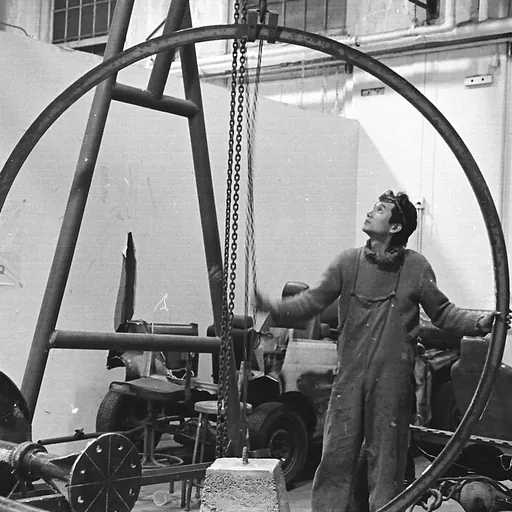
Yukinori Yanagi
Japanese conceptual artist (born 1959)
About Yukinori Yanagi
Born 1959. Yukinori Yanagi is a Japanese artist, installation artist, conceptual artist, sculptor, assemblage artist and photographer.
is a contemporary Japanese artist.
Yukinori Yanagi is a contemporary Japanese artist who has addressed themes of national and transnational sovereignty, globalization and borders, as well as Japan’s imperial history and nationalism. He is considered one of the first postwar Japanese artists that is openly critical of Japanese society and governmental policy. Many of Yanagi’s artworks consists of large-scale, site-specific installations that engage with movement and symbols of nationalism.
Yukinori Yanagi achieved a major international breakthrough in 1993 when he was awarded the Aperto Award at the 45th Venice Biennale. Following this recognition, his work entered major international collections, including the Museum of Modern Art (New York) and Tate Modern (London). He is widely recognized for his role in regional revitalization, most notably for the Inujima Seirensho Art Museum. This long-term project began in 1995 and culminated in the 2008 opening of a permanent art complex created by revamping a long-defunct copper refinery on the island of Inujima, which has become an integral location of the Setouchi International Art Triennale.
His global profile remains prominent through recent contributions to major biennials including the Busan Biennale 2016 in Busan, South Korea, the 21st Biennale of Sydney, Australia (2018), and the Ad-Diriyah Biennale in Diriyah, Saudi Arabia (2021), His primary ongoing initiative is ART BASE MOMOSHIMA, a non-profit art project established in 2012. He has spoken of his childhood experiences of picking up ‘everyday objects’ marked with Korean hangul that had washed up on the shore from the Sea of Japan as the beginning of his long-term interest in transpacific and transnational boundaries and movement. In his artwork, Yanagi considers continuity and diversity with regards to his own position and the place of the Japanese nation within this tumultuous history.
He was interested in the work of artists from the Mono-ha generation, especially of Noriyuki Haraguchi's industrial sculptures,
Move to the United States Despite the promising trajectory of his art career in Tokyo following his graduation, Yanagi was increasingly disillusioned with the Japanese art world, describing his feeling of “being trapped in a giant Japanese flag, in a cage, engulfed by national identity.” He began to engage seriously with the idea of "wandering as a permanent position," creating artworks to dissolve the fixity of symbols associated with nations and regions, attempting to account for the changes that occur through time and circumstance. Ants and national boundaries – late 1980s–1990s
Artworks from Yale University, 1988–1989 In the first year of his MFA at Yale University, Yanagi began thinking about the figure of the wandering ant as a multifaceted allegory for transnational movement. World Flag Ant Farm was a large-scale installation consisting of 180 national ‘flags’ representing the members of the United Nations at the time. The World Flag Ant Farm was exhibited at the 45th Venice Biennale in 1993, where Yanagi became the first Japanese artist to be awarded the Aperto Award as an emerging artist. In 1992, with the aid of the Asian Cultural Council, Yanagi was invited to the International Studio Program at PS1 Contemporary Art Center in New York.
This artwork marked the maturation of Yanagi’s ant farm idea and the beginning of a long series of Ant Farm Projects in which colonies of ants would slowly dissolve symbols of nationalism, including flags, currency, and American art. World Flag Ant Farm (1990) is in the collection of the Benesse House, Naoshima Contemporary Art Museum, Naoshima.
Ant Farm Project series (1990–2002) Yanagi produced many more flag-based ant farm projects with a wide variety of different geopolitical combinations in the years following his debut of World Flag Ant Farm (1990), while living in New York but traveling to Japan regularly. Some works include In God We Trust (1999), Dollar Pyramid (2000), Yukichi KV644955H (2002), and Euro Circuit (2002). Euro Circuit consisted of 12 ant colony units, one to represent the highest value of cash currency for each country that originally joined the European Union. As the ants tunnel through the installation, the distinctive currencies gradually dissolve into a ‘universal’ banknote, demonstrating Yanagi’s reflections on the possibilities of a world becoming more and more transnational. The uniforms of the toys create an illusion that once again alludes to the radiating beams of the Japanese Empire’s military flag. as the central window artwork for the seminal exhibition “Japanese Art After 1945: Scream Against the Sky” at the Guggenheim Museum SoHo in 1994; as well as again at his solo exhibition “Akitsushima” at the Hiroshima City Museum of Contemporary Art in 2001. The artwork consists of a large, red carpet designed to look like a Japanese passport. with a quote by poet and novelist Mishima Yukio superimposed in red, reading “Why should his Imperial Majesty become human?” Yanagi's carpet and the historical photograph have been installed together for several exhibitions together in the 1990s, including at the Art Tower Mito Contemporary Art Center in Ibaraki and the National Gallery of Australia in Canberra, both of which also included war paintings from the Pacific War as part of the installation.
In 1997, Yanagi created a smaller version of the Chrysanthemum Carpet as limited edition multiple entitled Loves Me/Loves Me Not (1997) during his residency at the Fabric Workshop and Museum in Philadelphia, Pennsylvania. For this exhibition, Yanagi produced a series of textual installations that focused explicitly on the Article 9 clause in the postwar Japanese constitutio n. Inujima Project (1995 - 2008)
Inujima Seirensho Art Museum In 1992, Yanagi was invited to hold a solo exhibition at the brand new Naoshima Contemporary Art Museum (now Benesse House at Benesse Art Site Naoshima). In 2010, the inaugural Setouchi International Art Triennale featured three installations created by Yanagi in collaboration with architect Kazuyo Sejima, in addition to the Injuma Seirensho Art Museum
Hero Dry Cell (2008) Inside the defunct copper refinery that makes up the Inujima Seirensho Art Museum, Yanagi spent more than a decade constructing a six-part permanent art installation entitled Hero Dry Cell (2008) that utilized mirrors, natural light, local stones, water elements, and architectural collage to create an interconnected, multi-layered installation about the modernization of Japan and legacy of the postwar. This sensation is similarly described by the artist himself when recounting his first morning on Inujima in 1995: the rising sun made an "imprint on his retina" that developed into this six-part installation which functions an "after-image of the sun he saw that first morning." The series formally initiated with Pacific K100B (1997), a cast-iron model of the battleship Kongō exhibited at the 1998 Taipei Biennial. By examining the submerged sunken battleship from a sea perspective, Yanagi seeks to excavate forgotten borders and Japan's detached territories, treating the Pacific seabed as a repository of hidden history. By replicating childhood plastic model kits in cast iron, the work initiates a reassessment of collective histories and state exploitation. These installations address how technological advances in naval construction historically served as instruments of imperial expansion and national power.
The project made its major institutional debut with the solo exhibition Akitsushima at the Hiroshima City Museum of Contemporary Art (MoCA) in 2000, featuring the photograph Akitsushima and the cast-iron Akitsushima 50 • I. This particular work emerged from Yanagi's personal underwater explorations of the second World War II Japanese warship Akitsushima in Coron Bay, Philippines. Yanagi further developed the series with Nagato 70 • I (2020). This work was informed by his fieldwork conducted in 1996 at Bikini Atoll—the site of Cold War hydrogen bomb testing where the battleship was sunk. these works have been exhibited extensively at Hiroshima's MoCA and were featured in a 2021 solo exhibition at Blum & Poe, Los Angeles. Project God-Zilla (2010–present) This project evolved from Eyeball Flower Garden (2010), a site-specific garden in Inujima featuring images of historical incidents projected onto a massive eyeball, presented at the Setouchi International Art Festival 2010. The project expanded significantly following the 2011 Fukushima nuclear disaster. In response to the incident, Yanagi conceptualized a new direction for the series, drawing simultaneous inspiration from the prominent eyeball imagery in Ai-Mitsu's 1938 oil painting, Landscape with an Eye. From this point onward, the series consistently featured a central eyeball that serves as a projection screen for archival video footage of hydrogen bomb tests conducted in the Pacific Ocean.
The series interweaves reflections on nuclear destruction with pop culture icons from the collective imaginary. Godzilla, as a monster originally awakened and enlarged by nuclear radiation, serves as a potent symbol for the project. Yanagi notes that the collapse of a nuclear plant following the 2011 tsunami "evokes the catastrophe of Godzilla," drawing a parallel between the creature's cinematic destruction of Tokyo and the reality of modern nuclear failure. He observes that these disasters serve as a reminder "of the difficulties associated with controlling nuclear power, and of the fall of Icarus due to an overweening confidence in the power of technology."
In the solo exhibition ICARUS at Pirelli HangarBicocca in Milan (2025), the work incorporates neon tubes spelling out Article 9 of the Japanese Constitution (the renunciation of war) scattered among rubble. Significant presentations of this series also include the Yokohama Triennale (2017), the 21st Biennale of Sydney (2018), the 3rd Matsu Biennial in Taiwan (2025), and El Mare Pacificum at Estación MAZ in Mexico (2026).
Island Revitalization & Community Projects (2012–present) In recent years, alongside his creation of individual artworks, Yanagi has focused his practice on island revitalization and non-profit initiatives as a direct response to contemporary social issues and regional decline. These projects involve the transformation of vacant buildings within Onomichi's urban core and the surrounding islands into experimental gallery spaces. By repurposing neglected structures, Yanagi reinforces the connection between contemporary art, local history, and the unique coastal character of the Seto Inland Sea.
Art Base Momoshima The island of Momoshima, like many communities in the Seto Inland Sea, faces significant socio-economic challenges, including a rapidly aging and decreasing population and a high density of abandoned properties. In response, Yanagi founded ART BASE MOMOSHIMA in 2012, building on the methodology established with the Inujima Seirensho Art Museum.
The project envisions the entire island as a "living canvas," reviving abandoned houses scattered across the landscape to forge new possibilities for the island's future through the integration of art and regional resources.
Among the initiative's milestones is the successful special exhibition CROSSROAD (2014), organized in collaboration with artists Miyako Ishiuchi, Noriyuki Haraguchi, and Bruce Conner to bridge the local history of the Seto Inland Sea with the crossroads of modernity and wartime history. As part of this exhibition programming, Onomichi U3—a former 1943 maritime warehouse—was temporarily activated as an alternative art space specifically for the project. Within this venue, Yanagi presented his installation Atomic Article 9 (2014), alongside Noriyuki Haraguchi's presentation of the work F-8E Crusader (2014). Following the success of the inaugural event, the exhibition series was extended with CROSSROAD 2 in 2017 and CROSSROAD 3 in 2018.
Since its founding, the initiative has expanded beyond the school building into several site-specific satellite spaces across the island. These projects involve the adaptive reuse of abandoned structures, transforming them into immersive environments:
Nisshokan (opened in 2014): Originally built in 1961 as a movie theater "Momoshima Toei", renovation on the structure began in 2013 with an emphasis on preserving the architectural atmosphere of its original era. The space houses Yanagi's significant installation Hinomaru Illumination (2010). Featuring neon motifs of the Japanese flag, this artwork was originally created for the Inujima Art House Project and subsequently relocated to Momoshima.
OTSU 1731-GOEMON HOUSE (opened in 2020): This facility was transformed from a private house that had remained vacant for 47 years. The space integrates functional architecture with contemporary art, featuring a large, working Goemon-style bath. It houses several significant installations, including Chu Enoki's LSDF 020 and Noriyuki Haraguchi's The relationship of Canvas bag and Ropes (2017). Since 2022, the site has operated as a residence, allowing visitors to stay overnight within the art installations.
Kyu-shisho (opened in 2021): Formerly the Momoshima Branch Office of Onomichi City Hall, this building was reimagined as a multi-purpose art and community hub. It functions as an exhibition space, rental facility, and guesthouse. Due to its historical and architectural significance, the site was officially designated as a Registered Tangible Cultural Property under Japan's Law for the Protection of Cultural Properties in 2022.
Art Direction and Community Design Parallel to his art practices, Yanagi provides art direction aimed at improving community design and local identity in the Onomichi region. These projects move art out of the museum and into functional public life. A key initiative is the Onomichi Channel Project, which focuses primarily on urban designs; notable works include the ferry MOMOKAZE (2015) and the public restroom at Fukuda Port on Momoshima (2018). Additionally, his team directed the renovation of gallery cafe ULTRA (2019), a project that converted a vacant structure into a multi-functional art gallery and cafe within a shopping arcade in Onomichi, Hiroshima.
Collaborative and Collective Projects (2018–present) To facilitate large-scale, cross-disciplinary works, Yanagi operates through YANAGI + ART BASE, a collective that brings together architects, designers, and craftsmen to work directly alongside local community members. This participatory approach allows for the execution of socially complex initiatives that transform regional revitalization into a shared, localized civic effort. Among these long-term efforts are the Kosagi Island "Bio-Isle" Project (initiated in 2009), which tackles rural depopulation by reclaiming vacant residences to explore sustainable community design, and the ongoing Onomichi Tea Garden House project, which convert traditional hillside structures overlooking the Onomichi Channel as multi-functional cultural and hospitality spaces. In addition to these local, community-focused projects, Yanagi's work extends to several major large-scale and international initiatives:
Sumiya Kiho-an Project – Art Gallery "Hakutai" (2018) & Art Room "Kohoo" (2021): These hospitality spaces in Kyoto represent an immersive total work of art, where the architectural structure itself is integrated with contemporary art and traditional craftsmanship. Yanagi collaborated with architects to design, structurally rebuild, and curate the entire living environment from the ground up. To execute the interior and material details, Yanagi worked alongside Kyoto-based master artisans—including ceramicists, weavers, and plasterers—bridging historical regional techniques with a modern artistic vision to create spaces where guests physically reside inside the artwork. It also established Nyukon House (2022), a project that transformed a former school swimming pool into a guesthouse. The entire site operates as an immersive architectural artwork, weaving Ishimure's poetry and historical photography by W. Eugene and Aileen M. Smith directly into the fabric of its physical design.
Anjwa Island Project / Floating Museum (2018–present): This international initiative, located in Shinan County, South Korea, focuses on the reclamation of neglected coastal landscapes. The project centers on a "Floating Museum" design on Anjwa Island, utilizing site-specific installations to address the region's geographical history. It marks an expansion of Yanagi's revitalization methodology—which integrates artwork, architecture, and the environment into a single cohesive experience—into the Korean Peninsula's coastal environment. The design features seven floating cubes representing the continents and local islands, with reflective surfaces that mirror the surrounding landscape. Within these structures, Yanagi permanently installed new editions of his significant artworks, tailored to respond directly to the local environment. These recontextualized pieces engage with the history of the Korean Peninsula and the specific ecology of Anjwa Island, such as its UNESCO-recognized tidal flats and traditional salt fields.
2017
YUKINORI YANAGI -UNION JACK-, Ticolat Tamura, Hong Kong
2019
YUKINORI YANAGI, Blum & Poe, Tokyo, Japan YUKINORI YANAGI TSUNAGI PROJECT 2019 – Prologue, Tsunagi Art Museum, Kumamoto, Japan
2020
YUKINORI YANAGI TSUNAGI PROJECT 2020 – Monologue and Dialogue, Tsunagi Art Museum, Kumamoto, Japan Wandering Position 1988–2021, ANOMALY, Tokyo, Japan
2022
YUKINORI YANAGI, 105MaGALLERY, Kokura, Fukuoka, Japan
2025
YUKINORI YANAGI: ICARUS, Pirelli HangarBicocca, Milan, Italy
2026
YUKINORI YANAGI: El Mare Pacificum, Estación MAZ, Guadalajara, Mexico
Museum and Public Collection
Inujima Seirensho Art Museum (Fukutake Foundation), Okayama, Japan The Museum of Art, Kochi, Kochi, Japan The National Museum of Art, Osaka, Osaka, Japan Takamatsu City Museum of Art, Kagawa, Japan The Museum of Contemporary Art, Tokyo, Tokyo, Japan The Museum of Modern Art, Tokushima, Tokushima, Japan Benesse Holdings, Inc., Okayama, Japan Hara Museum, Tokyo, Japan Hiroshima City Museum of Contemporary Art, Hiroshima, Japan Fukuoka Asian Art Museum, Fukuoka, Japan Yokohama Museum of Art, Kanagawa, Japan Yamanashi Prefectural Museum of Art, Yamanashi, Japan Museum of Modern Art, Shiga, Shiga, Japan Tsunagi Art Museum, Kumamoto, Japan Okinawa Prefectural Museum & Art Museum, Okinawa, Japan Allen Memorial Art Museum, Oberlin College, Ohio, United States Virginia Museum of Fine Arts, Richmond, United States The Museum of Modern Art (MoMA), New York, United States New York Public Library, New York, United States Fogg Art Museum, Harvard University, Boston, United States Philadelphia Museum of Art, Philadelphia, United States The Fabric Workshop and Museum, Philadelphia, United States Museum of Fine Arts, Houston, Houston, United States List Visual Arts Center, Massachusetts Institute of Technology, Boston, United States Zimmerli Art Museum, Rutgers University, New Jersey, United States Swiss Bank Corporation, Stamford, Connecticut, United States Bowdoin College Museum of Art, Maine, United States Rachofsky Collection, Dallas, United States Glenstone, Washington, D.C., United States National Gallery of Australia, Canberra, Australia Queensland Art Gallery, Brisbane, Australia Tate Gallery, London, United Kingdom Louisiana Museum of Modern Art, Humlebaek, Denmark Bayerische Vereinsbank, Munich, Germany Museum Moderner Kunst Stiftung Ludwig Wien, Vienna, Austria Museum of Modern and Contemporary Art in Nusantara, Jakarta, Indonesia MVCA, Riyadh, Saudi Arabia O Museum, Bangkok, Thailand
Don’t just read it —
keep it.
Full-length biographies made to live with: read them, listen on the way to work, watch them tonight.
- E-book
- Audio
- Video
Instant download · yours to keep · every purchase keeps this site free
Important facts
People in Yukinori Yanagi's life
Named in this biography and alive at the same time


Related people
Same field, nearest in time




Contemporaries
People whose lives overlapped Yukinori Yanagi's


Frequently asked questions
Who is Yukinori Yanagi?
Japanese conceptual artist (born 1959)
When was Yukinori Yanagi born?
Yukinori Yanagi was born on 2 May 1959 in Fukuoka.
What is Yukinori Yanagi's occupation?
Yukinori Yanagi is an artist, installation artist, conceptual artist, sculptor, assemblage artist and photographer.
What nationality is Yukinori Yanagi?
Yukinori Yanagi is Japanese.
Sources & further reading
Cite this page
APA: Biography.guide. (2026). Yukinori Yanagi. https://biography.guide/yukinori-yanagi/
MLA: "Yukinori Yanagi." Biography.guide, https://biography.guide/yukinori-yanagi/.
Chicago: "Yukinori Yanagi." Biography.guide. https://biography.guide/yukinori-yanagi/.
Data last updated: 2026-09-23 · Spot an error? Report a correction.
Portrait: Wikimedia Commons · author & licence
Page generated 2026-09-27 05:06 UTC