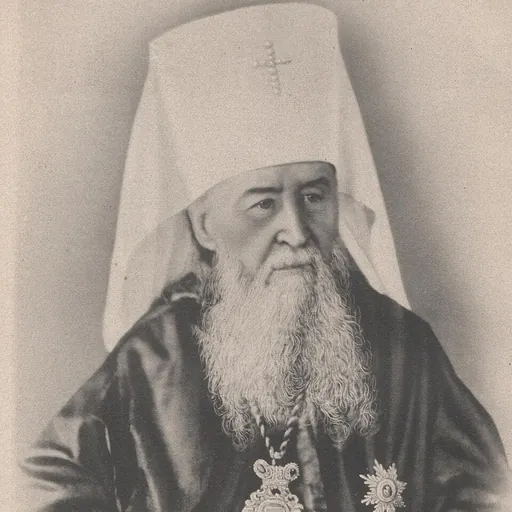
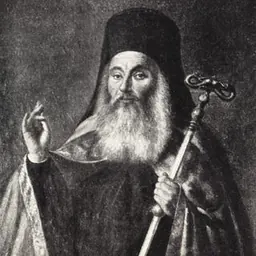
Yosyf Semashko
Uniate bishop and Orthodox Metropolitan
About Yosyf Semashko
Lived 1799 – 1868 (aged 69). Yosyf Semashko was an eastern Orthodox priest, catholic priest, catholic deacon and catholic bishop.
Joseph Semashko (; ; ; 25 December 1798 – 23 November 1868) was a Ukrainian Eastern Catholic priest and bishop who played a central role in the highly-controversial conversion of the Ruthenian Uniate Church of the western provinces of the Russian Empire to Russian Orthodoxy between 1837 and 1839. Subsequently, he became an archbishop in the Russian Orthodox hierarchy, elevated to the Metropolitan bishop of Vilnius and Lithuania in 1852.
Early life and education Semashko was born and raised in right-bank Ukraine, in Pavlivka near Illintsi in the Kiev Governorate (now in Vinnytsia Oblast of Ukraine). His father Yosyf (1776–1856) was originally a farmer and trader, then became a Uniate clergyman in 1811. As there were almost no Catholic churches in the region, Semashko attended Orthodox services more often than Catholic in his childhood. His mother tongue was Ukrainian and he acquired Polish at school. He graduated from the school in Nemyriv, and then from the Catholic Seminary in Vilnius. At the age of 21 he was ordained a Uniate priest.
In 1822, he became an assessor of the Roman Catholic Spiritual College (the church board of administration, responsible for religious affairs for Catholics of both rites) in St. Petersburg, working in the Uniate department of the College. This appointment was influenced by his relatively good command of the Russian language, By the mid-1820s, the Uniates remained a significant religious group, with nearly 1500 parishes and over 75 monasteries of the Basilian Order.
In 1827, Semashko wrote a memorandum advocating for the unification of remaining Uniate parishes in the Russian Empire with the Orthodox Church. The memorandum made the following suggestions: liquidation of two of the existing four Uniate dioceses, subordination of the affairs of the Uniate Church to the Holy Governing Synod, reorganization of the Basilian Order along the Orthodox model: the subordination of monasteries to the bishops of the dioceses in which they were located, creation of schools for children of Uniate clergy not led by Basilians.
The plan was read and enthusiastically approved by Emperor Nicholas I.
In 1835, Semashko was invited to join a secret government committee charged with bringing about the unification of the Uniate and Orthodox Church. The committee included Minister of Interior Affairs Dmitry Bludov, Procurator of the Holy Synod Stepan Nechaev, Moscow Metropolitan Filaret, Uniate Metropolitan Josaphat Bulhak, Semashko, and several other government officials and Orthodox clerics.
Afterward, Semashko declared of himself, "The Lord, having chosen his instrument for the completion of this noble deed, animated him with insuperable fervor and gave him powers to overcome all obstacles."
In 1847, Semashko became a member of the Holy Synod of the Orthodox Church. In that year, a diplomatic agreement between the Vatican and the Russian Empire was negotiated and enacted. This agreement codified the rights of the Catholic clergy and laity in the Empire. Semashko held negative views of the agreement, particularly because in his Lithuanian dioceses Roman Catholics outnumbered the Orthodox population three to one. She gave a detailed and graphic account of these events, causing outrage in Rome, while the account was further publicised by aristocratic Polish refugees in Paris. Within Polish Romantic literature, both Juliusz Słowacki and Stanisław Wyspiański made Mother Makrina the subject of immortal works of Polish poetry. Although Russian Foreign Office diplomats and Metropolitan bishop Yosyf Semashko himself adamantly denied Mother Makrina's story, it was widely believed, including by Pope Gregory XVI and his successor Pius IX. Over the course of the following decades, her story of the Nuns of Minsk was regularly reprinted as far as Ireland and North America. In 1923 the Jesuit scholar wrote a book in which he investigated the account of Mother Makrina Mieczyslavska and concluded that it was a fabrication and that Mother Makrina was, "an imposter."
In 1966, however, historian Wasyl Lencyk wrote, "In favor of her trustworthiness, Fr. Edmund Maykowski published some documents, namely her correspondence with Cardinal Ledochovski and the official report of the commission appointed by the Archbishop of Poznan Przyluski. Important in this matter is a medical report signed by two respected physicians of Poznan, Dr. Kramarkewicz and Dr. Jagielski, who gave her medical care after she escaped from Russia. The documents speak in favor of Mieczyslavska, nevertheless her story cannot be proved with certainty though it was very possible under the existing conditions in Russia."
Accounts of Metropolitan Yosyf Semashko's strained family ties were also circulated. In particular, Fr. Yosyf Semashko continued to offer Greek Catholic liturgy into the 1840s and only adopted Orthodox liturgical books after his famous son transferred him from his old Ukrainian parish to the parish of Dzikuški, close to the Metropolitan seat in Vilnius. It has been alleged that this transfer was not entirely voluntary and that Father Yosyf never approved of the anti-Catholicism of his famous son.
In the contemporary Belarusian exarchate of the Moscow Patriarchate, Semashko is a figure of veneration. The year 2018, the 220th anniversary of his birth, was declared to be the year of Metropolitan Yosyf. Moreover, it was stated that proceedings should begin to declare Metropolitan Yosyf a saint of the Belarusian Orthodox Church, though it is unclear at what stage are the proceedings at present.
After the collapse of the Soviet Union and the revivals of the Ukrainian Greek Catholic Church and the Ruthenian Greek Catholic Church, and to a lesser extent of the Belarusian Greek Catholic Church, the legacy of Semashko has also been reexamined by historians of the Eastern Catholic Churches. Within Eastern Catholic circles, and particularly among Belarusian and Ukrainian nationalist historians, Semashko is viewed as an enforcer of Caesaropapism, linguistic imperialism, and forced conversions of the Ruthenian people, and both his Russophilic views and his autocratic methods are widely decried by Catholics.
Don’t just read it —
keep it.
Full-length biographies made to live with: read them, listen on the way to work, watch them tonight.
- E-book
- Audio
- Video
Instant download · yours to keep · every purchase keeps this site free
Important facts
more
Joseph, Józef (Siemaszko)People in Yosyf Semashko's life
Named in this biography and alive at the same time


Related people
Same field, nearest in time



Contemporaries
People whose lives overlapped Yosyf Semashko's






Frequently asked questions
Who was Yosyf Semashko?
Uniate bishop and Orthodox Metropolitan
When was Yosyf Semashko born?
Yosyf Semashko was born on 7 January 1799 in Pavlivka.
When did Yosyf Semashko die?
Yosyf Semashko died on 5 December 1868 in Vilnius.
What was Yosyf Semashko's occupation?
Yosyf Semashko was an eastern Orthodox priest, catholic priest, catholic deacon and catholic bishop.
Sources & further reading
Cite this page
APA: Biography.guide. (2026). Yosyf Semashko. https://biography.guide/yosyf-semashko/
MLA: "Yosyf Semashko." Biography.guide, https://biography.guide/yosyf-semashko/.
Chicago: "Yosyf Semashko." Biography.guide. https://biography.guide/yosyf-semashko/.
Data last updated: 2026-09-22 · Spot an error? Report a correction.
Portrait: Wikimedia Commons · author & licence
Page generated 2026-09-27 05:02 UTC