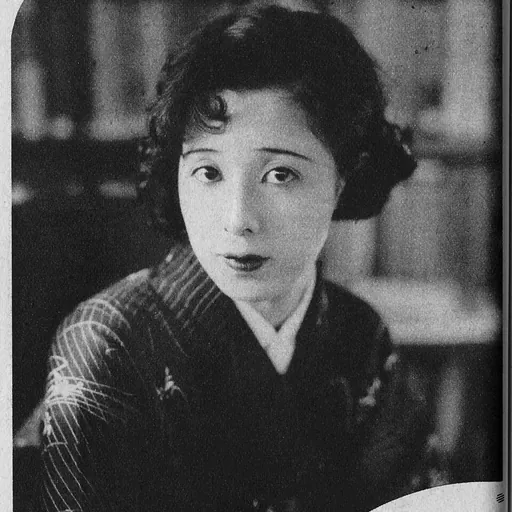
Yoshiko Okada
Japanese and Soviet actress, announcer, and left-wing theater performer
About Yoshiko Okada
Lived 1902 – 1992 (aged 89). Yoshiko Okada was a Japanese and Russian actor and film director.
was a Japanese stage and film actress who defected to the Soviet Union in the 1930s.
Childhood and youth
Yoshiko Okada was born in Hiroshima Prefecture on April 21, 1902. Her father was a newspaper reporter, her mother came from a farming family in Fukuoka prefecture; her maternal grandfather was one-quarter Dutch. Though the family moved several times, including to Busan in Korea, and she changed school eight times in her childhood, she received an excellent education. Her father's political leanings were very liberal (for instance, when her school visited the Imperial Palace he had her stay home) and this independent outlook remained with her throughout her life. In 1915 she entered the department of western painting at the Joshibi University of Art and Design. In 1917 her father became editor-in-chief of Hokumon Nippo, a Hokkaido newspaper, and upon graduation she joined him as a female reporter. Her beauty earned her some local attention and she was called on to act in amateur theatricals for charity. Her father was friends with Hogetsu Shimamura, founder of the revolutionary Geijutsu-za (Art Theater) and with the playwright Kichizo Nakamura , so in 1919, he took her to Tokyo to become Nakamura's apprentice.
Shingeki actress
The Geijitsu-za staged avant-garde Western plays with real women cast in the female roles, something that hadn't been seen on the Tokyo stage for almost three centuries. When founder Shimamura died in November 1918 in the influenza epidemic and his star actress Sumako Matsui committed suicide in despair two months later the theater was disbanded, but Nakamura partnered with Shochiku to launch the Shin-Geijutsuza (New Art Theater) and on March 1, 1919, Okada made her professional stage debut in a minor role in Carmen. This theater also disbanded and she toured the Tohoku region with the Shin-bungei Kyōkai (New Literary Association). She had a relationship with Yoshiharu Hattori, a member of the troupe and became pregnant; Hattori urged her to marry him but she refused and the child was registered at birth as her brother (he would become a doctor after the war and in Shanghai took care of deposed emperor Pu Yi's niece). She continued as a guest performer with many theater companies and rose to become a star of modern theater. While on tour, she became lovers with her co-star Takaya Yamada; A jealous Hattori would throw himself under a train in 1925.
Cinematic stardom
In the fledgling film industry as well women were only starting to be cast in female roles; in 1922, senior onnagata including the actor and director Teinosuke Kinugasa, transferred from Nikkatsu Mukojima Studio to Kokkatsu to protest the hiring of actresses by the company. To replace them Nikkatsu hired Okada and Shizue Natsukawa. Okada's first film role was in 1923's Eizō Tanaka's Dance of the Skull based on Hyakuzo Kurata's play Serenity and His Disciple; with the huge success of this film her star quickly rose. She continued to appear in movies in parallel with her stage career, but Nikkatsu Mukojima studios were destroyed in the Great Kanto Earthquake of the same year. She also found out that Yamada, whom she had wanted to marry, already had a wife and patroness 30 years his elder. Troubled by the situation she left Tokyo and made a contract with Nikkatsu Kyoto Film Studios.
In 1925 she starred in The Magician of the city. Though she felt Minoru Murata's detailed cuts had not made the most of her acting, her performance in this work was highly praised as "perfect". Her following film, the melodrama The Earth Smiles directed by Kenji Mizoguchi was also a major success. She appeared in a total of 9 films in 1925 and despite the scandal of being known as Yamada's common-law wife regularly topped public popularity polls, in both 1926 and 1927 was second in Kinema Junpō magazine's Top Ten and won a great reputation as a breath of a new cinematic era. Her parents left their newspaper in Karafuto (South Sakhalin Island) and came to Kyoto to be with her.
Scandal
In 1927, she was cast as the heroine of Tsubakihime, a big-budget adaptation of Dumas fils' La Dame aux Camélias. She began shooting highly motivated, but when violently scolded by Director Minoru Murata in front of the crowd at the location site, she ran off the set in embarrassment with co-star Ryoichi Takeguchi and disappeared; the newspapers wrote that she was in danger of committing suicide. Their romantic escape made them idols of the public but Okada, fired from Nikkatsu and blackballed by the film industry, had to return to the stage as her sole livelihood. The same year she and Takeguchi married but her beloved mother died of illness at the age of 46. In 1928 she launched the "Yoshiko Okada Theater Company" with the support of Sanjugo Naoki, a popular writer, and toured successfully throughout Japan and even China and Korea until April 1930 when the troupe disbanded.
Era of Struggling Talkies
She then returned to Tokyo and established her own production company, turning her attention to talkies, which had only just begun in Japan and in which she felt her stage experience would allow her to excel. With her as star and Takeguchi as director they produced and marketed more than a dozen films about traditional music and dance. Taking up Japanese dance in earnest, she became a disciple of Shizue Fujima, earning the right to the dancing stage name of Yoshiko Fujikage.
In 1932, she signed a contract with the leading studio of the day Shochiku Kamata on the condition that she would take over the debts of Nikkatsu. With the growing popularity of younger stars such as Sumiko Kurishima, Kinuyo Tanaka, Hiroko Kawasaki, Sanae Takasugi and Yumeko Aizome, Okada had to settle for more mature and usually lesser roles but was still capable of star performances, including in Yasujirō Ozu's and Hiroshi Shimizu's first talkies. Until the Day We Meet Again, with only musical interludes and sound effects but no dialogue, couldn't make the most of her stage skills but was still critically acclaimed, ranking 7th among Kinema Junpō's list for 1932. That film is considered lost but Ozu's Woman of Tokyo and Shimizu's A Woman Crying in Spring largely owe their masterpiece reputations to her lead roles. Both directors had praise for her acting but she was shunned as a difficult actress to work with, and she wanted to create works that she could devote herself to. Ironically her last great film role might have been in A Sword Comes on the Scene, the lost avant-garde masterpiece of Teinosuke Kinugasa, whose rebellion against women actresses led to Okada's first steps in cinema.
Escape to the Soviet Union
Alongside some minor film appearances she joined Masao Inoue's theater company and concentrated on stage appearances. Her relationship with Takeguchi was weakening and they had been living separately for a year. In August 1936, she fell in love with , a Russian-style method acting instructor who was directing the troupe. Sugimoto was married, and was a member of the Communist Party. In 1931 he unsuccessfully attempted to enter the Soviet Union under secret orders from the leadership of the Japanese Communist Party in order to restore contact with Comintern.
With the outbreak of the Second Sino-Japanese War in 1937, Okada's films were censored as part of militarist restrictions on freedom of expression and Sugimoto, on probation due to his proletarian activism, was in fear of being sent to prison. To escape their mounting problems in Japan the couple decided to defect to the Soviet Union. On December 27, 1937, they departed from Ueno Station headed via Hokkaido for Karafuto. Okada had some familiarity with the area as her parents had lived there. On December 31, they stayed at an inn in Shikuka (in the present-day Russian oblast of Poronaisk). On January 3, 1938 they headed for the border on the pretext of visiting the police and crossed into the Soviet Union in a severe snowstorm. It was reported in newspapers as an elopement incident and surprised all of Japan. On January 10, the Soviet authorities notified the Japanese Consul General in Ako (now Alexandrovsk Sakhalinsky) that the couple had been escorted to the continent. The consul general requested their return but, on January 13, Soviet officials informed him that, upon investigation, it was determined that both persons had entered the USSR voluntarily and by their own means. In reality, as they had entered the country illegally their reception was very harsh; they were separated just three days after entering the country and would never see each other again. The Soviet authorities of the time, seeing Japan as a potential threat, accused them of espionage regardless of their intentions. Tortured and threatened, on January 10, Okada confessed to crossing the border for the purpose of spying. Also under torture, Sugimoto confessed that he, Seki Sano and Yoshi Hijikata, Japanese dramatists living in Moscow, and also soviet playwright and director Vsevolod Meyerhold were all spies. Their confessions were among the pretexts used for the 1940 purge and execution of world-renowned director Meyerhold.
On September 27, 1939, a trial was held in Moscow where Okada fully admitted the indictment and was sentenced to 10 years deprivation of liberty. in a Moscow hospital at the age of 89.
Selected filmography 1932: No Blood Relation – dir. Mikio Naruse 1933: Woman of Tokyo – dir. Yasujirō Ozu 1934: Our Neighbor, Miss Yae – dir. Yasujirō Shimazu 1935: An Inn in Tokyo – dir. Yasujirō Ozu 1976: Tora-san's Sunrise and Sunset – dir. Yoji Yamada
Don’t just read it —
keep it.
Full-length biographies made to live with: read them, listen on the way to work, watch them tonight.
- E-book
- Audio
- Video
Instant download · yours to keep · every purchase keeps this site free
Important facts
People in Yoshiko Okada's life
Named in this biography and alive at the same time



Related people
Same field, nearest in time



Contemporaries
People whose lives overlapped Yoshiko Okada's



Frequently asked questions
Who was Yoshiko Okada?
Japanese and Soviet actress, announcer, and left-wing theater performer
When was Yoshiko Okada born?
Yoshiko Okada was born on 21 April 1902 in Hiroshima.
When did Yoshiko Okada die?
Yoshiko Okada died on 10 February 1992 in Moscow.
What was Yoshiko Okada's occupation?
Yoshiko Okada was an actor and film director.
What nationality was Yoshiko Okada?
Yoshiko Okada was Japanese and Russian.
Sources & further reading
Cite this page
APA: Biography.guide. (2026). Yoshiko Okada. https://biography.guide/yoshiko-okada/
MLA: "Yoshiko Okada." Biography.guide, https://biography.guide/yoshiko-okada/.
Chicago: "Yoshiko Okada." Biography.guide. https://biography.guide/yoshiko-okada/.
Data last updated: 2026-09-23 · Spot an error? Report a correction.
Portrait: Wikimedia Commons · author & licence
Page generated 2026-09-27 05:06 UTC