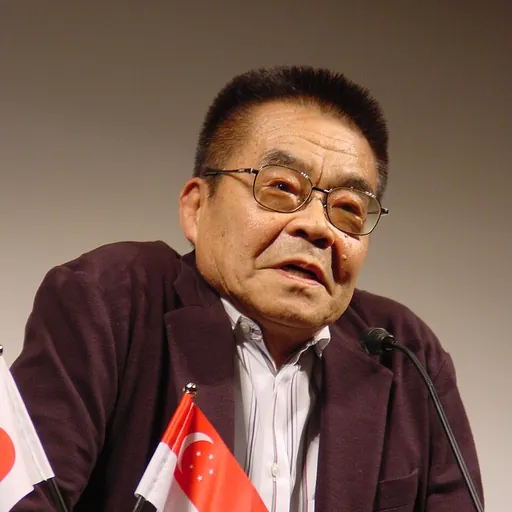
About Yoshihiro Tatsumi
Lived 1935 – 2015 (aged 79). Yoshihiro Tatsumi was a Japanese writer, mangaka, comics writer and draftsperson.
was a Japanese manga artist whose work was first published in his teens, and continued through the rest of his life. He is widely credited with starting the gekiga style of alternative manga in Japan, having allegedly coined the term in 1957. His work frequently illustrated the darker elements of life.
Biography Childhood and early work Tatsumi grew up in Osaka, near a U.S. military base called Itami Airfield.
Another well-known manga artist, , also gave Tatsumi feedback and advice. Ōshiro later asked to redraw and publish Tatsumi's immature work Happily Adrift, but did not end up doing so. Ōshiro offered Tatsumi a chance to live at his home "dojo" with other aspiring manga artists, but Tatsumi postponed the offer until he graduated from high school. One of the members of Ōshiro's dojo showed Tatsumi's Children's Island to the publisher Tsuru Shobō, which ended up publishing it in 1954.
Tatsumi eventually attended college instead of apprenticing with Ōshiro, studying for entrance exams, but purposefully didn't finish the exam. He met with the publisher Kenbunsha, which commissioned him to create a detective story similar to the fictional French thief Arsène Lupin, but the company reduced its payment offer so instead he published Thirteen Eyes with , with whom he would go on to publish many works. At this point, Tatsumi embarked on a three-year period of producing manga for the rental book market; during this period he produced seventeen book-length manga and several volumes of short stories.
Shadow and "anti-manga manga" Hinomaru Bunko's editor established a new monthly collection with its top authors titled . Although influenced by Tezuka's cinematic style, Tatsumi and his colleagues were not interested in making comics for children. They wanted to make comics for adults that were more graphic and showed more violence. Tatsumi explained, "Part of that was influenced by the newspaper stories I would read. I would have an emotional reaction of some kind and want to express that in my comics." and he pitched the idea of adapting Alexandre Dumas' The Count of Monte Cristo into a ten-volume Japanese period piece, but his boss did not feel he was skilled enough or had enough time.
The publisher put Tatsumi, Matsumoto, Takao Saito, and Kuroda in a "manga camp," an apartment in Tennōji-ku, Osaka. After his brother Okimasa's hospitalization, however, the 21-year-old Tatsumi left the "manga camp." Back home, he experienced a burst of creativity and created the manga he wanted to, titled Black Blizzard. Black Blizzard was created during a boom in short story magazines, so Tatsumi tried to come up with new forms of expression, such as conveying movement realistically, though his art was rough and used a lot of diagonal lines. Published in November 1956, Black Blizzard was well received by Tatsumi's fellow authors, with calling it "the manga of the future".
Gekiga
What I aimed to do was increase the age of the readership of comics. It wasn't that I was trying to create anything literary, but I did want to create an older audience. I didn't do that single-handedly, but I did succeed to a certain level. And, again, part of that was accomplished out of necessity. There was an incommensurable difference between what I wanted to express and what you could express in children's comics. — Yoshihiro Tatsumi, on being called the "grandfather of Japanese alternative manga." Tatsumi's work "Yūrei Taxi" was the first to be called gekiga when it was published at the end of 1957.
In 1959, the formed in Tokyo with eight members including Tatsumi, Matsumoto and Takao Saito.
The monthly magazine Garo, devoted to publishing gekiga, was founded in 1964. Tatsumi and other influential gekiga artists contributed to Garo.
Work of the late 1960s and early 1970s In the late 1960s, Tatsumi worked on a series of stories which were serialized in the manga magazine Gekiga Young as well as in self-published dōjinshi magazines. During this period, Tatsumi was running a publishing house for manga rental shops so he did not have time to work on his own manga; he felt like an outcast in the manga industry. His approach was to use a "bleak story" style without the gags and humor in mainstream manga. As a result, he started to tackle social issues in his gekiga work, and his editors gave him complete creative freedom. Due to Japan's political atmosphere at the time, Tatsumi felt disillusioned by his country's fascination with its own economic growth. One of his stories, "Hell," was inspired by a photograph Tatsumi saw of a shadow burnt into a wall by radiation heat of the nuclear bomb. "Hell" was published in the Japanese Playboy, which (happily) surprised Tatsumi because the usual manga publishers would not put out that kind of subject matter at the time. Nine of the stories he worked on during this period — which were created without assistants — were published in 2008 by Drawn & Quarterly in the collection Good-Bye, which was nominated for the 2009 Eisner Award for Best Archival Collection/Project—Comic Books.
Later work Tatsumi spent 11 years working on , and published as an 840-page single volume by Drawn & Quarterly in 2009. The book earned Tatsumi the Tezuka Osamu Cultural Prize, and won two Eisner Awards.
One of Tatsumi's last major works was , a collection of short stories published in 2009 by Basilico. (literally "Fallen Words") is a form of storytelling where the stories are retold for generations, unlike manga, and are humorous as opposed to , which drew Tatsumi to adapt the stories. Tatsumi attempted to combine the humor of the stories with the visual language of , two forms which he thought were incompatible, but he later realized that they both rely strongly on timing and that has much more depth and variety, forcing him to reevaluate the form and see that it was closer to than he thought. Publishers Weekly complimented the humor and relatable nature of the fables, concluding that Tatsumi's "flat yet expressive drawings" help move the stories smoothly. Garrett Martin of Paste called the manga "a slight work, but fascinating as a historical and cultural artifact", comparing it to as if Robert Crumb adapted traditional folk songs.
Death Tatsumi died of cancer at the age of 79 on March 7, 2015.
Legacy His work has been translated into many languages, and Canadian publisher Drawn & Quarterly took part in a project to publish an annual compendium of his works focusing each on the highlights of one year of his work (beginning with 1969) that produced three volumes, edited by American cartoonist Adrian Tomine. According to Tomine, this is one event in a seemingly coincidental rise to worldwide popularity along with: reissued collections of his stories in Japan, acquisition of translation rights in a number of European countries, and competition for the rights for Drawn & Quarterly.
A full-length animated feature on the life and short stories of Yoshihiro Tatsumi was released in 2011. The film, Tatsumi, is directed by Eric Khoo and The Match Factory handled world sales.
Awards Tatsumi received the Japan Cartoonists Association Award in 1972. In 2009, he was awarded the Tezuka Osamu Cultural Prize for his autobiography, A Drifting Life. The same work garnered him multiple Eisner awards (Best Reality-Based Work and Best U.S. Edition of International Material–Asia) in 2010 and the regards sur le monde award in Angoulême International Comics Festival in 2012.
Don’t just read it —
keep it.
Full-length biographies made to live with: read them, listen on the way to work, watch them tonight.
- E-book
- Audio
- Video
Instant download · yours to keep · every purchase keeps this site free
Important facts
People in Yoshihiro Tatsumi's life
Named in this biography and alive at the same time



Related people
Same field, nearest in time



Contemporaries
People whose lives overlapped Yoshihiro Tatsumi's



Frequently asked questions
Who was Yoshihiro Tatsumi?
Japanese manga artist (1935–2015)
When was Yoshihiro Tatsumi born?
Yoshihiro Tatsumi was born on 10 June 1935 in Osaka.
When did Yoshihiro Tatsumi die?
Yoshihiro Tatsumi died on 7 March 2015 in Tokyo.
What was Yoshihiro Tatsumi's occupation?
Yoshihiro Tatsumi was a writer, mangaka, comics writer and draftsperson.
What nationality was Yoshihiro Tatsumi?
Yoshihiro Tatsumi was Japanese.
Sources & further reading
· Wikipedia: Yoshihiro Tatsumi
Cite this page
APA: Biography.guide. (2026). Yoshihiro Tatsumi. https://biography.guide/yoshihiro-tatsumi/
MLA: "Yoshihiro Tatsumi." Biography.guide, https://biography.guide/yoshihiro-tatsumi/.
Chicago: "Yoshihiro Tatsumi." Biography.guide. https://biography.guide/yoshihiro-tatsumi/.
Data last updated: 2026-09-24 · Spot an error? Report a correction.
Portrait: Wikimedia Commons · author & licence
Page generated 2026-09-27 05:08 UTC