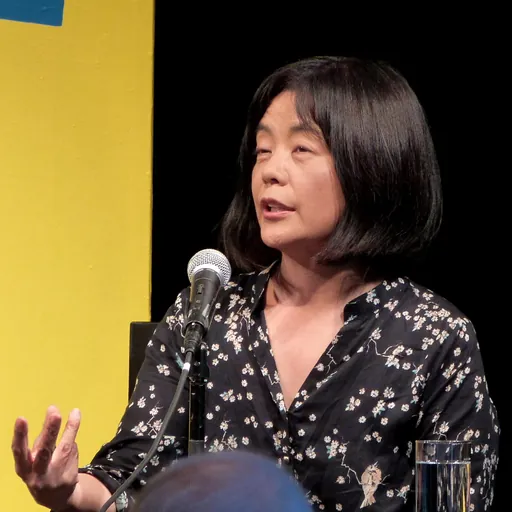
About Yoko Tawada
Born 1960. Yoko Tawada is a Japanese novelist, playwright, writer, essayist, germanist and literary scholar.
Yōko Tawada (多和田葉子 Tawada Yōko, born March 23, 1960) is a Japanese writer currently living in Berlin, Germany. She writes in both Japanese and German. She is a former writer-in-residence at MIT and Stanford University.
Tawada has won numerous literary awards, including the Akutagawa Prize, the Tanizaki Prize, the Noma Literary Prize, the Izumi Kyōka Prize for Literature, the Gunzo Prize for New Writers, the Goethe Medal, the Kleist Prize, and a National Book Award.
Early life and education
Tawada was born in Nakano, Tokyo. Her father was a translator and bookseller. She attended Tokyo Metropolitan Tachikawa High School. In 1979, at the age of 19, Tawada took the Trans-Siberian Railway to visit Germany. She received her undergraduate education at Waseda University in 1982 with a major in Russian literature, and upon graduation moved to Hamburg, Germany, where she started working with one of her father's business partners in a book distribution business. She left the business to study at Hamburg University, and in 1990 she received a master's degree in contemporary German literature. In 2000 she received her doctorate in German literature from the University of Zurich, where Sigrid Weigel, her thesis advisor, had been appointed to the faculty. In 2006 Tawada moved to Berlin, where she currently resides.
Career Tawada's writing career began in 1987 with the publication of Nur da wo du bist da ist nichts—Anata no iru tokoro dake nani mo nai (Nothing Only Where You Are), a collection of poems released in a German and Japanese bilingual edition. Her first novella, titled Kakato o nakushite (Missing Heels), received the Gunzo Prize for New Writers in 1991.
Several other books followed, including Seijo densetsu (Legend of a Saint) in 1996 and Futakuchi otoko (The Man With Two Mouths) in 1998. Portions of these books were translated into English by Margaret Mitsutani and collected in a 2009 book titled Facing the Bridge. Tawada won the 1996 Adelbert von Chamisso Prize, a German literary award for non-native speakers of German. She won the Izumi Kyōka Prize for Literature for her 2000 book Hinagiku no ocha no baai, The novel follows a Vietnamese girl who was kidnapped at a young age while in Germany for a youth conference. An English version, translated from the German manuscript by Susan Bernofsky, was published by New Directions Publishing in 2009 under the title The Naked Eye. In 2005, Tawada won the prestigious Goethe Medal from the Goethe-Institut for meritorious contributions to German culture by a non-German.
In 2011, inspired by the story of the orphaned polar bear Knut, Tawada wrote three interlocking short stories exploring the relationship between humans and animals from the perspective of three generations of captive polar bears. As with previous work, she wrote separate manuscripts in Japanese and German. In 2011 the Japanese version, titled Yuki no renshūsei, was published in Japan. It won the 2011 Noma Literary Prize It won the inaugural Warwick Prize for Women in Translation.
Tawada won the 2013 Erlanger Prize for her work translating poetry between Japanese and German. An English version, translated by Margaret Mitsutani, was published in the US by New Directions Publishing in 2018 under the title The Emissary. and as The Last Children of Tokyo by Portobello Books/Granta Books in the UK.
In 2016 she received the Kleist Prize, and in 2018 she was awarded the Carl Zuckmayer Medal for services to the German language.
Writing style
Tawada writes in Japanese and German. Scholars of her work have adopted her use of the term exophony to describe the condition of writing in a non-native language. Early in her career Tawada enlisted the help of a translator to produce German editions of her Japanese manuscripts, but later she simultaneously generated separate manuscripts in each language through a process she calls "continuous translation." Over time her work has diverged by genre as well as language, with Tawada tending to write longer works such as plays and novels in Japanese, and shorter works such as short stories and essays in German. She also tends to create more neologisms when writing in German than when writing in Japanese.
Tawada's writing highlights the strangeness of one language, or particular words in one language, when seen from the perspective of someone who speaks another language. Her writing uses unexpected words, alphabets, and ideograms to call attention to the need for translation in everyday life. She has said that language is not natural but rather "artificial and magical," and has encouraged translators of her work to replace word play in her manuscripts with new word play in their own languages.
A common theme in Tawada's work is the relationship between words and reality, and in particular the possibility that differences in languages may make assimilation into a different culture impossible. For example, Tawada has suggested that a native Japanese speaker understands different words for "pencil" in German and Japanese as referring to two different objects, with the Japanese word referring to a familiar pencil and the German word referring to a pencil that is foreign and "other." However, her work also challenges the connection between national language and nationalism, particularly the kokugo/kokutai relationship in Japanese culture.
Tawada's stories often involve traveling across boundaries. Her writing draws on Tawada's own experiences of traveling between countries and cultures, but it also explores more abstract boundaries, such as the boundary between waking life and dreams, between thoughts and emotions, or between the times before and after a disaster.
Tawada has cited Paul Celan and Franz Kafka as important literary influences.
Don’t just read it —
keep it.
Full-length biographies made to live with: read them, listen on the way to work, watch them tonight.
- E-book
- Audio
- Video
Instant download · yours to keep · every purchase keeps this site free
Important facts
People in Yoko Tawada's life
Named in this biography and alive at the same time


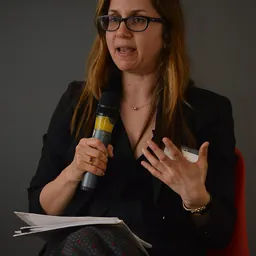
Related people
Same field, nearest in time
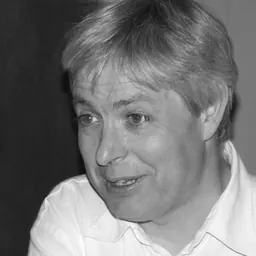





Contemporaries
People whose lives overlapped Yoko Tawada's



Frequently asked questions
Who is Yoko Tawada?
Japanese writer (1960-)
When was Yoko Tawada born?
Yoko Tawada was born on 23 March 1960 in Tokyo, Tokyo.
What is Yoko Tawada's occupation?
Yoko Tawada is a novelist, playwright, writer, essayist, germanist and literary scholar.
What nationality is Yoko Tawada?
Yoko Tawada is Japanese.
Sources & further reading
Cite this page
APA: Biography.guide. (2026). Yoko Tawada. https://biography.guide/yoko-tawada/
MLA: "Yoko Tawada." Biography.guide, https://biography.guide/yoko-tawada/.
Chicago: "Yoko Tawada." Biography.guide. https://biography.guide/yoko-tawada/.
Data last updated: 2026-09-22 · Spot an error? Report a correction.
Portrait: Wikimedia Commons · author & licence
Page generated 2026-09-27 05:02 UTC