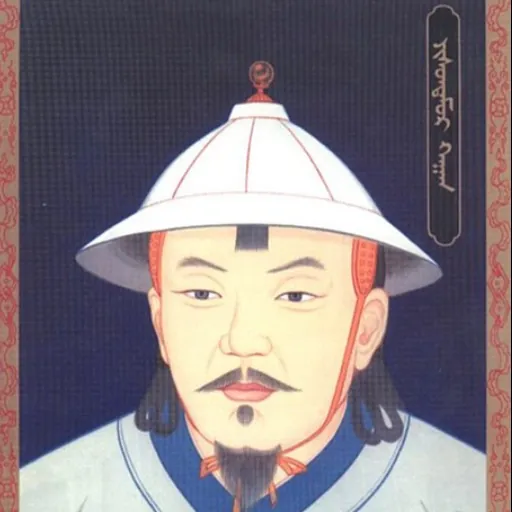
About Yesün Temür Khan
Lived 1293 – 1328 (aged 34). Yesün Temür Khan was a Chinese ruler.
Yesün Temür (Mongolian: Есөн Төмөр ; , 1293 – August 15, 1328) was a great-grandson of Kublai Khan and an emperor of the Yuan dynasty from 1323 to 1328. Apart from being Emperor of China, he is regarded as the 10th Khagan of the Mongol Empire, although it was only nominal due to the division of the empire. In Chinese historiography, Yesün Temür, who was very fond of the traditional ways of the Mongols, is commonly known as the Taiding Emperor of Yuan based on his first era name. His name means "nine iron" in the Mongolian language.
He was probably the emperor visited by the Franciscan friar Odoric, who left an excellent record of his travels.
Early life Yesün Temür was born in Mongolia in 1293 to Gammala, the eldest son of Zhenjin, who was presumed heir to his father Kublai Khan. Gammala was appointed as Jinong (jinwang, 晉王) in 1292 after Zhenjin's death, but he lost the race for successor to his younger brother Temür. Khanship was assumed by Temür, Darmabala, and their sons and grandson, so Gammala and his son Yesün Temür were out of the race. As Jinong, Gammala ruled the Mongolian steppe north of the Gobi Desert and enshrined Genghis Khan in the Four Great Ordo. In 1302 Gammala died and Yesün Temür took over as Jinong.
During the reigns of Kulug Khan, Ayurbarwada, and Gegeen Khan, Yesün Temür, who had a large fief and powerful army in the Mongolian steppe, became one of the princes most respected by the court and emerged as the undisputed leader of the princes in the steppe.
Yesün Temür was not merely the principal beneficiary of the conspiracy but was also very likely a participant. He sent troops to Dadu and Shangdu and had rebellious officers executed before he entered Dadu because he feared becoming their puppet. The five princes who had been involved were exiled to Yunnan, Hainan, and other distant places.
Chinese officials repeatedly urged Yesün Temür to extend the purge to all former allies of Temuder and Tegshi and their families, but Yesün Temür Khan refused. He issued an amnesty decree, and the confiscated properties of the executed conspirators were returned to their families.
Administration
"The Empire is a family of which the Emperor is the father." Yesün Temür Khan, c. 1324, The History of the Yuan
As a ruler who had seized the throne by intrigue and violence, Yesün Temür tried to win the widest possible support. To secure support as Emperor of China from the Han populace, he duly showed his respect for the Confucian tradition from the beginning of his reign. Nevertheless, Muslim and Mongol officials from the steppe constituted the majority of posts in the Yuan government during this period. Kumeijil and Tas Temur served as grand councillars of the right; Dawlat Shah served as the manager of the governmental affairs of the Central Secretariat (中書省), then as censor in chief, and finally as grand councillary of the left; and Andachu, the manager of the Bureau of Military Affairs.
In addition to Dawlat Shah, there were two Muslims, Ubaidullah and Bayanchar, who served as managers of governmental affairs in the Secretariat. Mahmud Shah and Hasan Khoja managed the Bureau of Military Affairs. In contrast with the Muslims, Han officials exerted little influence on the administration. The high point of the Mongol partner-merchants' operations came under Yesün Temür, whose administration exempted Christians and Muslims from any corvee payments and guaranteed huge payments promised by the Mongolian nobility in return for luxury goods (тансаг).
alt=White page with black Phagspa characters and two seals, one being in the middle of and one on the right sight of the text. All lines start at the top of the page
Yesün Temür Khan denounced the extravagance of the court in buying costly precious stones, imported by foreign merchants, and sold for ten times their value, while the poor were starving. In 1326, Ozbeg Khan of the Golden Horde sent cheetahs to Yesün Temür Khan who responded with grants of gold, silver, cash, and silks.
During his reign Yesün Temür Khan divided the empire into eighteen departments controlled by a board called "the Lords of the Provinces"; it had formerly been divided into twelve units. Reports were presented on the condition of the Yuan provinces were full of complaints about the Lamas who, armed with their golden seals, rode about the province making exaction and treating the people in a shameful way. They put up at private houses, drove out their masters, debauched their wives, and did pretty much as they wished. The fear of offending the Mongols and the Lamas prevented the Khan from doing anything effectual at first. Finally, he forbade the Lamas from entering China. Besides Buddhism, Yesün Temür Khan neglected the ancient worship of the sky of the Mongols.
Yesün Temür left the empire's governance to his Muslim aide Dawlat Shah and Khatun Babukhan when he suddenly died in Shangdu on August 15, 1328. His son Ragibagh was installed by Dawlat Shah, but he was defeated by his rival Tugh Temür three months later during the War of the Two Capitals.
Family Parents: Father: Gammala (甘麻剌;1263–8 February 1302), son of Zhenjin, posthumously awarded with the title of Emperor Renxiaoguangsheng (光圣仁孝皇帝) Mother: Buyan Kelmish (普顏怯里迷失王妃), posthumously awarded with the title of Empress Xuanyishusheng (宣懿淑圣皇后) Consorts and their respective issue(s) Empress Babukhan (八不罕皇后), of the Hongjila clan (弘吉剌氏) from Khonggirat Ragibagh Khan, Khagan (元天顺帝阿剌吉八), 1st son Empress Yilianzhenbala (亦怜真八剌皇后) Empress Sadabala, of the Khorchin Borjigin clan (撒答八剌皇后), niece of Yesün Temür Empress Bihan (必罕皇后), Hongjila clan (弘吉剌氏) from Khongirad Unknown: Batma Irgenbü, Prince of Jin (晋王 八的麻亦兒間卜), 2nd son Söse, Crown Prince (小薛 太子), 3rd son Yüdan Zanbü, Crown Prince (允丹藏卜太子), 4th son
Don’t just read it —
keep it.
Full-length biographies made to live with: read them, listen on the way to work, watch them tonight.
- E-book
- Audio
- Video
Instant download · yours to keep · every purchase keeps this site free
Important facts
Family & relationships
People in Yesün Temür Khan's life
Named in this biography and alive at the same time



Related people
Same field, nearest in time


Contemporaries
People whose lives overlapped Yesün Temür Khan's

Frequently asked questions
Who was Yesün Temür Khan?
emperor of the Yuan Dynasty
When was Yesün Temür Khan born?
Yesün Temür Khan was born on 28 November 1293 in Khanbaliq.
When did Yesün Temür Khan die?
Yesün Temür Khan died on 15 August 1328 in Xanadu.
What was Yesün Temür Khan's occupation?
Yesün Temür Khan was a ruler.
What nationality was Yesün Temür Khan?
Yesün Temür Khan was Chinese.
Sources & further reading
· DBpedia: Yesün Temür (Yuan dynasty)
Cite this page
APA: Biography.guide. (2026). Yesün Temür Khan. https://biography.guide/yesun-temur-khan/
MLA: "Yesün Temür Khan." Biography.guide, https://biography.guide/yesun-temur-khan/.
Chicago: "Yesün Temür Khan." Biography.guide. https://biography.guide/yesun-temur-khan/.
Data last updated: 2026-09-20 · Spot an error? Report a correction.
Portrait: Wikimedia Commons · author & licence
Page generated 2026-09-27 05:29 UTC