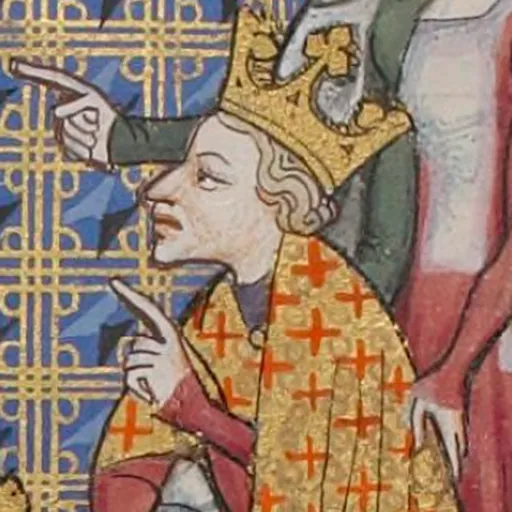
About Charles II of Navarre
Lived 1332 – 1387 (aged 54–55). Charles II of Navarre was a ruler.
Charles II (, , , 10 October 1332 – 1 January 1387), known as the Bad, was King of Navarre beginning in 1349, as well as Count of Évreux beginning in 1343, holding both titles until his death in 1387.
Besides the Kingdom of Navarre nestled in the Pyrenees, Charles had extensive lands in Normandy, inherited from his father, Count Philip of Évreux, and his mother, Queen Joan II of Navarre, who had received them as compensation for resigning her claims to France, Champagne, and Brie in 1328. Thus, in Northern France, he possessed Évreux, Mortain, parts of Vexin, and a portion of Cotentin. Charles was a major player at a critical juncture in the Hundred Years' War between France and England, repeatedly switching sides in order to further his own agenda. He was accidentally burned alive in 1387.
Life Early life Charles was born in Évreux, the son of Philip III and Joan II of Navarre. His father was first cousin to King Philip VI of France, while his mother, Joan, was the only daughter of Louis X of France. Charles was 'born of the fleur-de-lys on both sides', as he liked to point out, but he succeeded to a shrunken inheritance as far as his French lands were concerned. He was raised in France during childhood and up to the moment he was declared king at 17, so he probably had no command of the Romance language of Navarre at the moment of his coronation.
In October 1349, Charles' mother died. In order to take his coronation oath and be anointed, he visited his kingdom in summer 1350. For the first time, the oath was taken in a language other than the customary Latin or Occitan, i.e. Navarro-Aragonese. Apart from short visits paid the first 12 years of his reign, Charles spent his time almost entirely in France; he regarded Navarre principally as a source of manpower with which to advance his designs on the throne of France. He hoped for a long time for recognition of his claim to the crown of France (as the heir-general of Philip IV through his mother, and a Capetian through his father). However, he was unable to wrest the throne from his Valois cousins, who were senior to him by agnatic primogeniture. There are several versions of the story, varying in the details. This is Francis Blagdon's account from 1803:
John Cassell's moralistic version states:
Family tree
Don’t just read it —
keep it.
Full-length biographies made to live with: read them, listen on the way to work, watch them tonight.
- E-book
- Audio
- Video
Instant download · yours to keep · every purchase keeps this site free
Important facts
Family & relationships
Related people
Same field, nearest in time


Contemporaries
People whose lives overlapped Charles II of Navarre's

Frequently asked questions
Who was Charles II of Navarre?
King of Navarre 1349–1387 and Count of Évreux 1343–1387
When was Charles II of Navarre born?
Charles II of Navarre was born on 10 October 1332 in Évreux.
When did Charles II of Navarre die?
Charles II of Navarre died in 1387 in Navarreria.
What was Charles II of Navarre's occupation?
Charles II of Navarre was a ruler.
What nationality was Charles II of Navarre?
Charles II of Navarre's recorded nationality: Kingdom of Navarre.
Sources & further reading
· Wikipedia: Charles II of Navarre
· DBpedia: Charles II of Navarre
Cite this page
APA: Biography.guide. (2026). Charles II of Navarre. https://biography.guide/charles-ii-of-navarre/
MLA: "Charles II of Navarre." Biography.guide, https://biography.guide/charles-ii-of-navarre/.
Chicago: "Charles II of Navarre." Biography.guide. https://biography.guide/charles-ii-of-navarre/.
Data last updated: 2026-09-22 · Spot an error? Report a correction.
Portrait: Wikimedia Commons · author & licence
Page generated 2026-09-27 05:03 UTC