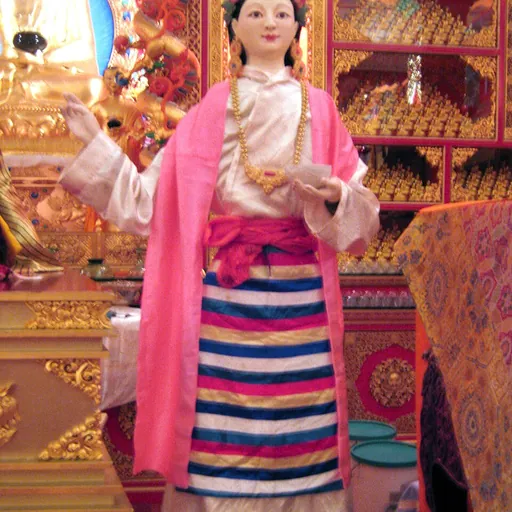
About Yeshe Tsogyel
Lived 757 – 817 (aged 59–60). Yeshe Tsogyel was a writer.
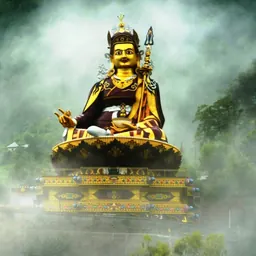
Yeshe Tsogyal (c. 757 or 777 – 817 CE), also known as "Victorious Ocean of Knowledge", "Knowledge Lake Empress" (, ཡེ་ཤེས་མཚོ་རྒྱལ), or by her Sanskrit name Jñānasāgarā "Knowledge Ocean", or by her clan name "Lady Kharchen", attained enlightenment in her lifetime and is considered the Mother of Tibetan Buddhism. Yeshe Tsogyal is the highest woman in the Nyingma Vajrayana lineage. Some sources say she, as Princess of Karchen, was either a wife or consort of Tri Songdetsen, emperor of Tibet, when she began studying Buddhism with Padmasambhava, who became her main karmamudrā consort. Padmasambhava is a founder-figure of the Nyingma tradition of Tibetan Buddhism, and is considered as a second buddha of our era. She is known to have revealed terma with Padmasambhava and was also the main scribe for these terma. Later, Yeshe Tsogyal also hid many of Padmasambhava's terma on her own, under the instructions of Padmasambhava for future generations.
Born a princess in the region of Kharchen, Tibet, in about 777 CE, she fled from arranged marriages until captured for Tri Songdetsen. Yeshe Tsogyal lived for approximately 99 years and is a preeminent figure in the Nyingma school of Tibetan Buddhism and a role model for contemporary spiritual practitioners. Although often referred to as being Padamasambhava's main consort, Yeshe Tsogyal was primarily a spiritual master and teacher in her own right.
Based on her spiritual accomplishments, the Nyingma and Karma Kagyu schools of Tibetan Buddhism recognize Yeshe Tsogyal as a female Buddha. The translators of Lady of the Lotus-Born, the namtar, or spiritual biography, that Yeshe Tsogyal left as a terma, observe:
Biography and historicity Given Yeshe Tsogyal's important place in the various schools of Tibetan Buddhism, there are questions about whether she is an actual historical figure. There are at least four translations of Yeshe Tsogyal's spiritual biography in English, and one in French. Yet,
Even so, in another publication, this same scholar writes,
So whether there is enough historical evidence to confirm or deny Yeshe Tsogyal as a historical figure, from the perspective of the spiritual traditions within which she is prominent, the details of her life are rich. Here are some of the details of Yeshe Tsogyal's conception and birth:
According to legend, Yeshe Tsogyal was born in the same manner as the Buddha, a mantra sounding as her mother gave birth painlessly. She is considered a reincarnation of the Buddha's own mother, Maya. Her name, "Wisdom Lake Queen" , derives from her birth causing a nearby lake to double in size.
Her spiritual inclinations were present from a very young age and Yeshe Tsogyal wanted to pursue a life of dharma practice rather than marry. She felt so strongly about this, that she ran away and had to be brought back by force. At the age of sixteen, she was compelled into an unwanted arranged marriage with the then-emperor of Tibet, Tri Songdetsen.
It was after their marriage, that Tri Songdetsen invited Padmasambhava to come to Tibet from India and propagate the Buddhist teachings. Yeshe Tsogyal was given by Tri Songdetsen to Padmasambhava as an offering. Padmasambhava freed Yeshe Tsogyal and she became Padmasambhava's main disciple and consort.
Spiritual life and attainments In the body of a woman
As to the question of the place of female practitioners in Tibetan Buddhism, Yeshe Tsogyal has been an important role model. When she herself asked about "her inferior female body" (a common theme in the biographies of female spiritual practitioners), Padmasambhava advised Yeshe Tsogyal that far from being a hindrance to enlightenment, as was generally accepted, a woman's body is an asset: "The basis for realizing enlightenment is a human body. Male or female, there is no great difference. But if she develops the mind bent on enlightenment the woman’s body is better."
After many years of serious study and meditative practice, Yeshe Tsogyal's level of spiritual awakening, enlightenment, was equal to that of Padmasambhava.
Her spiritual practices Yeshe Tsogyal is also known to have spent many years in isolated meditation retreat. She accomplished several different cycles of tantric spiritual practices that she received from Padmasambhava and various wisdom beings including the practices of Vajrakilaya, Zhitro, tummo (inner heat), and karmamudrā practice.
For example, one scholar relates how Yeshe Tsogyal received the empowerment to practice Zhitro from a wisdom being, a vidyādhara:
All of these practices brought Yeshe Tsogyal to awakening. Among lay Tibetans, she is understood as a fully enlightened Buddha who takes the form of an ordinary woman so as to be accessible to the average person, "who, for the time being, do not see her Vajravarahi form as a fully perfected deity."
Students At the time of her death, Yeshe Tsogyal is known to have had eleven main students, both women and men. Yeshe Tsogyal's Zur Lineage holders include:
Karchen Zhonnu Dronma Monmo Tashi Khyidren, or Tashi Children (of Bhutan) Shelkar Dorje Tsomo, or Dorje Tsomo (of Shelkar) Be Yeshe Nyingpo Ma Rinchen Chok Odren Zhonu Pel, or Odren Pelgyi Zhonnu Langlab Gyelwa Jangchub Dorje Lasum Gyelwa Jangjub, or Atsara Sale Darcha Dorje Pawo Ukyi Nyima, or Surya Tepa (of central Tibet) Queen Li-za Jangchub Dronma, or Jangchub Drolma (of Khotan), Queen of Tri Songdetsen
All of Yeshe Tsogyal's final teachings were given at the request of one of these eleven main disciples.
Other Tibetan lineage holders include King Mutri Tsenpo, Prince Murum Tsenpo, Princess Ngang-chung Pelgyi Gyelmo. Nepalese lineage holders include Jila Jhipa, Vasudhara, Śākya Dema, Gelong Namkhai Nyingpo (whom she taught in Bhutan), yoginī Demo or Dewamo or Chonema or Dechenmo, Selta, and Lodro Kyi.
Along with the eleven main lineage holders, there were approximately 79 other students present during the final teachings of Yeshe Tsogyal. Some sources say that there were no less than 100 people present for these final teachings.
Emanations Yeshe Tsogyal is also considered a manifestation of the Bodhisattva Tara. She is also considered to be an emanation of Samantabhadrī, Prajnaparamita, and Vajrayogini. In the Life of Yeshe Tsogyel, Padmasambhava predicted that Yeshe Tsogyel would be reborn as Machig Labdrön; her consort, Atsara Sale, would become Topabhadra, Machig’s husband; her assistant and another of Padmasambhava’s consorts, Tashi Khyidren, would be reborn as Machig’s only daughter, and so on. All of the important figures in Tsogyel’s life were to be reborn in the life of Machig Labdron, including Padmasambhava himself, who would become Dampa Sangye.
Don’t just read it —
keep it.
Full-length biographies made to live with: read them, listen on the way to work, watch them tonight.
- E-book
- Audio
- Video
Instant download · yours to keep · every purchase keeps this site free
Important facts
People in Yeshe Tsogyel's life
Named in this biography and alive at the same time

Related people
Same field, nearest in time


Contemporaries
People whose lives overlapped Yeshe Tsogyel's


Frequently asked questions
Who was Yeshe Tsogyel?
Semi-mythical female deity in Tibetan Buddhism
When was Yeshe Tsogyel born?
Yeshe Tsogyel was born in 757.
When did Yeshe Tsogyel die?
Yeshe Tsogyel died in 817.
What was Yeshe Tsogyel's occupation?
Yeshe Tsogyel was a writer.
Sources & further reading
Cite this page
APA: Biography.guide. (2026). Yeshe Tsogyel. https://biography.guide/yeshe-tsogyel/
MLA: "Yeshe Tsogyel." Biography.guide, https://biography.guide/yeshe-tsogyel/.
Chicago: "Yeshe Tsogyel." Biography.guide. https://biography.guide/yeshe-tsogyel/.
Data last updated: 2026-09-20 · Spot an error? Report a correction.
Page generated 2026-09-27 05:10 UTC