About Yehuda Alharizi
Lived 1165 – 1225 (aged 59–60). Yehuda Alharizi was a poet, translator, writer and rabbi.
Yehuda Alharizi, also Judah ben Solomon Harizi or al-Harizi (, ), was a rabbi, translator, poet, and traveler active in al-Andalus (mid-12th century Toledo, Spain? – 1225 in Aleppo, Ayyubid Syria). He was supported by wealthy patrons, to whom he wrote poems and dedicated compositions. He is known for his collection of tales, , sometimes known as the 'Hebrew Maqamat,' which is in the form of a maqama.
Life Yehuda al-Harizi was born in Toledo in the mid-12th century to a family originally from Jerez and was educated in Castile. An Arabic biographer and a contemporary, Ibn al-Sha’ar al-Mawsili (1197–1256), provided the only known physical description of al-Harizi: "a tall silver-haired man with a smooth face".
As was the practice for educated men of the period, he traveled extensively throughout the region, visiting Jewish communities and various centres of learning across the Mediterranean and the East. He was disappointed by the poor quality of Hebrew learning across the region.
He died in Aleppo, Syria in 1225. Alharizi was a rationalist, conveying the works of Maimonides and his approach to rationalistic Judaism. He translated Maimonides' The Guide for the Perplexed and some of his Commentary on the Mishnah, as well as the Mahbarot Iti'el of the Arab poet al-Hariri, from the Arabic to Hebrew.
Alharizi's poetic translation of the Guide for the Perplexed is considered by many to be more readable than that of Samuel ibn Tibbon. However, it has not been very widely used in Jewish scholarship, perhaps because it is less precise. It had some influence in the Christian world due to its translation into Latin.
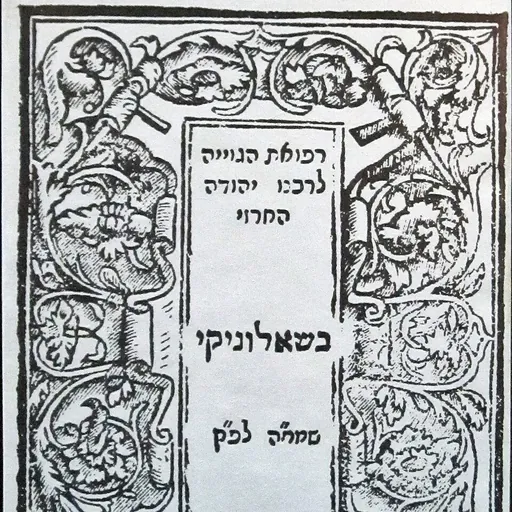
Alharizi's own works include the Tahkemoni, composed between 1218 and 1220, in the Arabic form known as maqama. This is written in Hebrew in unmetrical rhymes, in what is commonly termed rhymed prose. It is a series of humorous episodes, witty verses, and quaint applications of Scriptural texts. The episodes are bound together by the presence of the hero and of the narrator, who is also the author. Another collection of his poetry was devoted to preaching ethical self-discipline and fear of heaven.
Alharizi undertook long journeys in the lands of the Middle East. His works are suffused with his impressions from these journeys.
He not only brought to perfection the art of applying Hebrew to secular satire, but he was also a brilliant literary critic and his maqama on the Andalusian Hebrew poets is a fruitful source of information. 1899 edition of Tahkemoni in Hebrew Tahkemoni in Hebrew, Istanbul 1578 Saul Isaac Kaempf, Nichtandalusische Poesie andalusischer Dichter aus dem elften, zwölften und dreizehnten Jahrhundert: Ein Beitrag zur Geschichte der Poesie des Mittelalters, vol. 1 (Prague: Bellmann, 1858) (here a considerable section of the Tahkemoni is translated into German). Moses Gaster Hebrew MS 95, John Rylands Library, 14th-15th century Hebrew and Judeo-Arabic manuscript scanned folios,
Literature on Alharizi's influence in the Christian world
Don’t just read it —
keep it.
Full-length biographies made to live with: read them, listen on the way to work, watch them tonight.
- E-book
- Audio
- Video
Instant download · yours to keep · every purchase keeps this site free
Important facts
People in Yehuda Alharizi's life
Named in this biography and alive at the same time

Related people
Same field, nearest in time


Contemporaries
People whose lives overlapped Yehuda Alharizi's




Frequently asked questions
Who was Yehuda Alharizi?
Rabbi, translator, and poet
When was Yehuda Alharizi born?
Yehuda Alharizi was born in 1165 in Toledo, Barcelona.
When did Yehuda Alharizi die?
Yehuda Alharizi died in 1225 in Aleppo.
What was Yehuda Alharizi's occupation?
Yehuda Alharizi was a poet, translator, writer and rabbi.
What nationality was Yehuda Alharizi?
Yehuda Alharizi's recorded nationality: Crown of Aragon.
Sources & further reading
Cite this page
APA: Biography.guide. (2026). Yehuda Alharizi. https://biography.guide/yehuda-alharizi/
MLA: "Yehuda Alharizi." Biography.guide, https://biography.guide/yehuda-alharizi/.
Chicago: "Yehuda Alharizi." Biography.guide. https://biography.guide/yehuda-alharizi/.
Data last updated: 2026-09-24 · Spot an error? Report a correction.
Portrait: Wikimedia Commons · author & licence
Page generated 2026-09-27 05:09 UTC