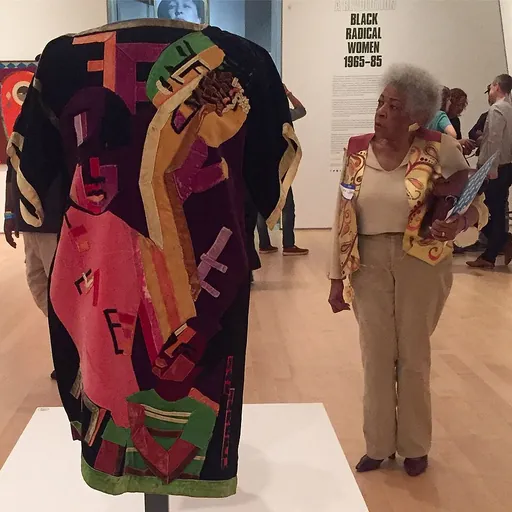
About Yasin Ali Artan
Born 1935. Yasin Ali Artan is an American visual artist, fashion designer and textile artist.
Elaine "Jae" Jarrell (born Elaine Annette Johnson, 1937) is an American artist and fashion designer associated with the Black Arts Movement of the 1960s. She is a co-founder of AfriCOBRA, an artist collective.
Early life and education Jarrell was raised in the Glenville neighborhood of Cleveland, Ohio, United States. She was exposed to fabrics and sewing through her grandparents. Her uncle owned a haberdashery that sold fabric and sewing supplies, which introduced her to fashion and business. Additionally, her mother introduced her to vintage shops and clothing construction. Reflecting on these experiences in a conversation with Rose Bouthillier, Jarrell stated:
"And so I always thought of making clothes in order to have something unique, and later I learned to sew very well and made it my business to always make my garments. And I also have a love for vintage, knowing that it has secrets of the past that I can unfold."
Jarrell attended Bowling Green State University in northwest Ohio before enrolling at the School of the Art Institute of Chicago (SAIC). She studied at SAIC during the 1950s and 1960s, alongside Wadsworth Jarrell, who later became her husband. They met in 1963, shortly after she opened a vintage boutique.
Career Chicago In her early years in Chicago, Jarrell worked briefly at Motorola. At the suggestion of a colleague, she began using the professional name "Jae", derived from her given names.
Following her involvement with AfriCOBRA in Chicago, Jarrell moved to Washington D.C., where she completed her BFA and graduate work at Howard University. Jarrell created much of her art as a member of AfriCOBRA, an African American artist collective that combined African artistic styles with political themes. It was formed after the dissolution of the Coalition of Black Revolutionary Artists (COBRA) and focused on Black pride and empowerment.
The manifesto also detailed specific aesthetic qualities valued by the collective: Expressive Awesomeness—the feeling "that one experiences in African art and life in the U.S.A."; Symmetry and Rhythm—"repetition with change, based on African music and African movement"; Mimesis—"the plus and the minus, the abstract and the concrete"; Organic looking—"We want the work to look like the creator made it through us"; Shine—"We want the things to shine, to have the rich luster of a just-washed 'fro, of spit-shined shoes, of de-ashened elbows and knees and noses"; Color—"color that shines, color that is free of rules and regulations…. Color that is expressively awesome". Scholar Rebecca Zorach notes that the group aimed to reject racialized stereotypes regarding the black family structure. Although the Jarrells eventually left the coalition, Jae Jarrell has stated that the collective continues to influence her work.
In an interview with Rebecca Zorach, Jarrell explained her relationship with the group: "It's like a family, you know, you could never divorce yourself from the family. You can only grow, and you could always understand those who have not moved in the same kind of direction you have, but there's a language you have, and an eye contact and a trust and a respect. It goes a long way."
Later work In recent years, Jarrell has shifted focus from design to sculpting and constructing furniture. Works displayed in the How to Remain Human exhibition at the Museum of Contemporary Art Cleveland include Maasai Collar Vest (2015), Shields and Candelabra Vest (2015), and Jazz Scramble Jacket (2015). The Maasai Collar Vest (2015) references the garments and jewelry of the Maasai people. Shields and Candelabra Vest (2015) incorporates inverted cactus plants as frames for African shields. In Jazz Scrabble Jacket (2015), Jarrell combines references to jazz and blues music with imagery from the board game Scrabble, intersecting the names of musicians to explore the influence of music on African American history and culture.
Exhibitions Jarrell's work has appeared in exhibitions including the Brooklyn Museum of Art's 2014 exhibition Witness: Art and Civil Rights in the Sixties and the Museum of Contemporary Art Cleveland's 2015 exhibition How to Remain Human. Her work was also featured in the 2015 exhibit The Freedom Principle: Experiments in Art and Music, 1965 to Now at the Museum of Contemporary Art Chicago (MCA). In 2019, her clothing designs were featured in the exhibition Soul of a Nation at The Broad in Los Angeles.
Her garments are held in private collections and in the permanent collection of the Brooklyn Museum of Art.
Don’t just read it —
keep it.
Full-length biographies made to live with: read them, listen on the way to work, watch them tonight.
- E-book
- Audio
- Video
Instant download · yours to keep · every purchase keeps this site free
Important facts
Family & relationships
People in Yasin Ali Artan's life
Named in this biography and alive at the same time



Related people
Same field, nearest in time


Contemporaries
People whose lives overlapped Yasin Ali Artan's



Frequently asked questions
Who is Yasin Ali Artan?
Somalia
When was Yasin Ali Artan born?
Yasin Ali Artan was born in 1935.
What is Yasin Ali Artan's occupation?
Yasin Ali Artan is a visual artist, fashion designer and textile artist.
What nationality is Yasin Ali Artan?
Yasin Ali Artan is American.
Sources & further reading
Cite this page
APA: Biography.guide. (2026). Yasin Ali Artan. https://biography.guide/yasin-ali-artan/
MLA: "Yasin Ali Artan." Biography.guide, https://biography.guide/yasin-ali-artan/.
Chicago: "Yasin Ali Artan." Biography.guide. https://biography.guide/yasin-ali-artan/.
Data last updated: 2026-09-22 · Spot an error? Report a correction.
Portrait: Wikimedia Commons · author & licence
Page generated 2026-09-27 05:02 UTC