
About Yan Keqiu
Lived 801 – 930. Yan Keqiu was a politician.
Yan Keqiu (嚴可求) (died November 19, 930 ) was a key official of the Chinese Five Dynasties and Ten Kingdoms period state Wu, as the chief strategist for the Wu regent Xu Wen and each of Wu's three rulers, Yang Wo, Yang Longyan, and Yang Pu.
Background It is not known when Yan Keqiu was born. His family was from Tong Prefecture (同州, in modern Weinan, Shaanxi), but his father Yan Shi had served as an assistant to a Tang dynasty director for Yangtze River-Huai River shipping, and therefore settled at the future Wu capital Guangling (廣陵, in modern Yangzhou, Jiangsu), which was then the capital of Tang's Huainan Circuit . It was said that Yan Keqiu was intelligent and capable of strategies in his youth, and became a guest of the Huainan officer Xu Wen, then serving under Huinan's military governor (Jiedushi) Yang Xingmi. Through Xu's relationship with Yang, Yan became a member of Yang's staff and often offered advice to Yang.
Service under Yang Xingmi Even though Yan Keqiu was directly serving under Yang Xingmi, he remained closely allied with Xu Wen. In 903, when Yang's brother-in-law and subordinate Zhu Yanshou the military governor of Fengguo Circuit (奉國, headquartered in modern Lu'an, Anhui) was planning to join the rebellion started by two other Yang subordinates, Tian Jun the military governor of Ningguo Circuit (寧國, headquartered in modern Xuancheng, Anhui) and An Renyi the military prefect (團練使, Tuanlianshi) of Run Prefecture (潤州, in modern Zhenjiang, Jiangsu), it was Yan who suggested to Xu a plan to trick Zhu into a trap, which Xu then suggested to Yang and which Yang then accepted After Zhu's death, Yang promoted both Xu and Yan.
Service under Yang Wo and in the aftermaths of Yang Wo's assassination In 907, the powerful warlord Zhu Quanzhong the military governor of Xuanwu Circuit (宣武, headquartered in modern Kaifeng, Henan) forced Tang's final emperor Emperor Ai to yield the throne to him, ending Tang and starting a new Later Liang as its Emperor Taizu. Yang Wo, along with several other regional warlords, refused to recognize the Later Liang emperor and continued to use the Tang era name of Tianyou, but by this point was effectively the ruler of his own domain, then known as Hongnong (as he carried the title of Prince of Hongnong) and later known as Wu (as Yang Xingmi carried the title of Prince of Wu). Nevertheless, by this point, his own powers were limited, as Xu Wen, who was then one of the headquarters guard commanders, as well as fellow guard commander Zhang Hao, had effectively taken over most of Hongnong's governance after killing a number of Yang Wo's associates in a coup earlier in 907. Yan Keqiu's role in the early parts of Yang Wo's administration, if any, is not clear.
In 908, fearing that Yang Wo would seize power back and act against them, Zhang and Xu assassinated Yang Wo, while claiming that Yang Wo had died of an illness. Their original plan was to divide Hongnong between themselves and then submit to Later Liang, but once the assassination occurred, Zhang postured at taking over the rule over Hongnong himself. Yan pointed out to him, however, that several senior generals posted away from Guangling, including Liu Wei , Tao Ya , Li Yu , and Li Jian , could hardly be expected to support his takeover, and therefore advocated having Yang Wo's younger brother Yang Longyan take over the Hongnong throne — and he subsequently made a public declaration, which he wrote in the name of Yang Wo's and Yang Longyan's mother Lady Dowager Shi, asking the generals and officials to support Yang Longyan. Zhang was depressed at this public display and acquiesced to Yang Longyan's taking the throne. It was said that the senior general Zhu Jin was so impressed by Yan's public display of bravery in standing up against Zhang that he honored Yan like an older brother.
Zhang, however, maintained control over the Hongnong governance, and soon made Xu the governor of Zhexi Circuit (浙西, headquartered at Run Prefecture). Yan pointed out to Xu, however, that once Xu left Guangling, Zhang would blame Yang Wo's death on him. Xu agreed with Yan's analysis and asked for Yan's help. Yan persuaded another senior general, Li Chengsi the deputy military governor of Huainan to meet with Zhang and Xu (persuading Li that once Xu left Guangling, Li himself would be isolated); at that meeting, Yan openly cursed at Xu for wanting to leave Guangling and not supporting Yang Longyan's new reign; Xu "apologized" and offered to stay at Guangling, and Zhang acquiesced. Zhang soon thereafter realized that Yan was working in league with Xu, and so sent an assassin to kill Yan. When the assassin arrived, Yan did not beg for his life, but instead begged to write a letter to Yang Longyan to bid farewell. After he did so, the assassin read the letter and was touched by it, and therefore spared him, taking only his treasure.
Wei's defeat left one semi-independent warlord in the Zhennan region — Lu Guangchou, who controlled the region around Qian Prefecture (虔州, in modern Ganzhou, Jiangxi), who, like Wei previously, was nominally submitting to both Hongnong (which became named Wu in 910 when Yang Longyan claimed the title of Prince of Wu that his father carried) and Later Liang. In 911, Lu died, and his son Lu Yanchang inherited his domain, still nominally submitting to both Wu and Later Liang. Yan proposed posting an army to Xingan (新淦, in modern Ji'an, Jiangxi) to plot an eventual campaign against Qian Prefecture, and that each time a new corps is rotated to the Xingan post, that a small increase be made in the number of soldiers. Yan's plan was carried out, and as the Wu army at Xingan gradually increased, the Qian Prefecture army did not realize Wu's intent.
In 918, Wu finally launched an operation to capture Qian Prefecture and the surrounding region, which by that point was controlled by Lu Guangchou's old associate Tan Quanbo, with the general Wang Qi in command. Prior to the attack's being launched, Yan hired engineers to open up the Gan River rapids at Ganshi (贛石, in modern Ji'an), allowing the Ganshi rapids to be navigated by the Wu fleet and allowing the Wu attack to quickly reach Qian Prefecture. (Wang Qi would subsequently be stymied by Tan's defense and would eventually die in illness while still sieging Qian, but the succeeding commander Liu Xin was able to defeat Tan and capture Qian Prefecture, allowing Wu to take over the region.)
While the Qian campaign was going on, though, another plot against Xu Zhixun was occurring at Guangling. Zhu, who had previously had a good relationship with Xu Zhixun, had drawn Xu Zhixun's jealousy for carrying a greater title than Xu Zhixun himself, as the deputy generalissimo of all circuits (with Yang Longyan himself as generalissimo). Xu Zhixun therefore wanted to eject Zhu from Guangling by making him the military governor of a new Jinghuai Circuit (靜淮, headquartered in modern Huai'an, Jiangsu). This drew Zhu's anger, but Zhu outwardly appeared to be still respectful to Xu Zhixun (who was also alienating the other generals and officials as he was arrogant and promiscuous). Zhu invited Xu Zhixun to his home for a farewell feast; at the feast, he assassinated Xu Zhixun, and then tried to ask Yang Longyan to cooperate with him; Yang Longyan, however, did not dare to be involved, and Zhu, who then came under attack by Xu Wen's associate Zhai Qian , committed suicide. Both Xu Zhixun's adoptive brother Xu Zhigao, who was then the military prefect of Run Prefecture, and Xu Wen himself subsequently arrived to control the situation at Guangling. Xu Wen immediately suspected the general Mi Zhicheng of acting in league with Zhu and wanted to kill Mi, but Yan was concerned that Mi might resist. He therefore falsely claimed that the Wu army at Yuan Prefecture (袁州, in modern Yichun) had just defeated a Chu army and summoned the generals and officials all to the headquarters to congratulate Yang Longyan on the victory. As the generals were arriving, Yan had soldiers that he posted at the headquarters gates seize Mi and then killed Mi and his sons. Xu Wen subsequently wanted to expand the reprisals, as he believed that many other generals were acting in concert with Zhu. Both Yan and Xu Zhigao pointed out to him that Xu Zhixun had brought disaster on himself through his unreasonable actions. Xu Wen's anger subsided gradually, and he did not carry out the large-scale reprisals that he initially was inclined to carry out. Yan continued to serve in the Wu government.
Service under Yang Pu In 923, Li Cunxu claimed imperial title as the emperor of a new Later Tang (as Emperor Zhuangzong), and was soon set to make a final confrontation with Later Liang after gaining a foothold south of the Yellow River (which had generally defined the boundary between his former Jin state and Later Liang) at Yun Prefecture (鄆州, in modern Tai'an, Shandong). He sent emissaries to Wu, requesting that Wu jointly attack Later Liang with him. Xu Wen considered launching a fleet north but not actually commit to attacking Later Liang — instead, having the fleet observe the campaign and aid the winning side. Yan Keqiu opposed, pointing out that the Wu fleet could be caught in the middle if Later Liang requested aid, so Xu did not do so.
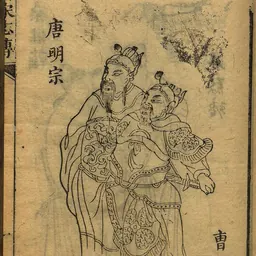
Later in the year, Emperor Zhuangzong was killed in a mutiny and succeeded by adoptive brother Li Siyuan (as Emperor Mingzong). When the news arrived at Wu, Xu became even more respectful of Yan for his correct predictions.
Despite Xu Zhigao's previous attempts to make peace with Yan, Yan, along with Xu Jie, continued to make suggestions to Xu Wen over the years to replace Xu Zhigao with the younger Xu Zhixun. Xu Wen continually refused because Xu Zhigao was filially pious and careful, but by 927 became resolved to do so. He was ready to head to Guangling himself to advise Yang Pu to take imperial title, and then reassign Xu Zhigao and the younger Xu Zhixun. However, as he was getting ready to depart Sheng Prefecture, he became ill, so he instead sent the younger Xu Zhixun to submit his petition to Yang Pu, with directions to stay at Guangling after submitting the petition. Xu Zhigao, hearing the news, was prepared to resign his post as junior regent and request a post as the military governor of Zhennan Circuit, but while the younger Xu Zhixun was still on the way, Xu Wen died, causing the younger Xu Zhixun to immediately return to Sheng Prefecture, so Xu Zhigao never actually submitted his resignation. Shortly after Xu Wen's death, Yang Pu, in accordance with his petition, claimed imperial title. Yan himself died in 930, while serving as Zuo Pushe and chancellor.
Notes and references
Spring and Autumn Annals of the Ten Kingdoms , vol. 10. Zizhi Tongjian, vols. 265, 266, 267, 269, 270, 272, 274, 275, 276, 277.
Don’t just read it —
keep it.
Full-length biographies made to live with: read them, listen on the way to work, watch them tonight.
- E-book
- Audio
- Video
Instant download · yours to keep · every purchase keeps this site free
Important facts
People in Yan Keqiu's life
Named in this biography and alive at the same time



Related people
Same field, nearest in time



Contemporaries
People whose lives overlapped Yan Keqiu's



Frequently asked questions
Who was Yan Keqiu?
chancellor
When was Yan Keqiu born?
Yan Keqiu was born in 801 in Tang dynasty.
When did Yan Keqiu die?
Yan Keqiu died on 19 November 930.
What was Yan Keqiu's occupation?
Yan Keqiu was a politician.
Sources & further reading
Cite this page
APA: Biography.guide. (2026). Yan Keqiu. https://biography.guide/yan-keqiu/
MLA: "Yan Keqiu." Biography.guide, https://biography.guide/yan-keqiu/.
Chicago: "Yan Keqiu." Biography.guide. https://biography.guide/yan-keqiu/.
Data last updated: 2026-09-20 · Spot an error? Report a correction.
Page generated 2026-09-27 05:21 UTC