
About Yang Pu
Lived 900 – 939. Yang Pu was a ruler.
Yang Pu (; 900 – January 21, 939), also known by his posthumous name as the Emperor Rui of Yang Wu , was the last ruler of China's Yang Wu dynasty during the Five Dynasties and Ten Kingdoms period, and the only one that claimed the title of emperor. During his reign, the state was in effective control of the regents Xu Wen and Xu Wen's adopted son and successor Xu Zhigao (Li Bian). In 938, Xu Zhigao forced Yang Pu to yield the throne to him. Xu Zhigao then established the Southern Tang dynasty.
Background Yang Pu was born in 900, during the reign of Emperor Zhaozong of Tang, as the fourth son of the major late-Tang warlord Yang Xingmi the military governor (Jiedushi) of Huainan Circuit (淮南, headquartered in modern Yangzhou, Jiangsu), whose domain would become Wu eventually. In 919, during the reign of his older brother Yang Longyan (King Xuan, Yang Xingmi's second son, who in turn succeeded another older brother, Yang Wo (Prince Wei of Hongnong)), Yang Pu was created the Duke of Danyang.
In 920, Yang Longyan fell ill, and the regent Xu Wen, who was effectively the ruler of the Wu government, arrived at the capital Jiangdu (江都, i.e., modern Yangzhou) to discuss with the officials there (including his adopted son, the junior regent Xu Zhigao) how to deal with the situation. Some of Xu Wen's followers encouraged him to take the throne himself. Xu, however, disavowing any such intent, proclaimed that he would surely find another son of the Yangs to succeed Yang Longyan.
Later in the year, Emperor Zhuangzong, in a surprise attack, captured the Later Liang capital Daliang. Later Liang's emperor Zhu Zhen committed suicide before the city fell, ending Later Liang, and Later Tang took over Later Liang's territory. Xu, in fear of what the Later Tang emperor might do next, blamed Yan for dissuading him from sending the fleet, but Yan pointed out that Emperor Zhuangzong had become arrogant in his victory and was not ruling his state well, predicting that within a few years his state would be in turmoil. Meanwhile, Later Tang's emissary to Wu initially delivered an edict from Emperor Zhuangzong, but Wu, not viewing itself as a Later Tang subject, refused to accept it. Emperor Zhuangzong rewrote his communication as a letter (thus showing equality between the states), but slightly displayed superiority by addressing the letter, "The letter from the Emperor of the Great Tang to the Lord of Wu." Yang Pu responded, also with a letter (thus also showing equality) but also showed deference by addressing the letter, "The respectful letter from the Lord of the Great Wu to the Emperor of the Great Tang." Shortly after, he also sent the official Lu Ping as an emissary to Later Tang. Upon Lu's return, he confirmed Yan's observations – that Emperor Zhuangzong was wasting his time on tours and games, and was stingy with his funds, not willing to dispense them to soldiers, and thus causing discontent.
In 925, Qian Liu, the king of Wu's southeastern neighbor Wuyue (formally a vassal of Later Tang's), sent an emissary to Wu to inform Wu that he had been created the King of Wuyue by Emperor Zhuangzong. Wu, under the rationale that Wuyue was having designs on its own territory by accepting a title that included "Wu" in its name, refused to receive the emissary, and further cut off diplomatic and trade relations with Wuyue.
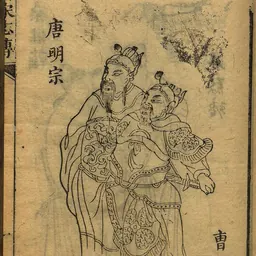
In 926, Emperor Zhuangzong was killed in a mutiny at the Later Tang capital Luoyang. His adoptive brother Li Siyuan, who led another mutiny and who shortly after arrived at Luoyang, declared himself emperor (as Emperor Mingzong) to succeed him. Yang sent an emissary to him to establish friendly relations (and offering fresh tea leaves as a tribute), but also internally declared a period for Emperor Zhuangzong.
In 927 there was an incident when the senior general Chai Zaiyong came to pay homage to the emperor, but was wearing his armor – which was inappropriate, and he was indicted by an imperial censor. Chai, however, citing his battlefield accomplishments, refused to accept the punishment. However, Xu Zhigao then tried to restore discipline by intentionally "accidentally" intruding into the palace, and then immediately withdrawing and submitting a petition asking to be punished for this intrusion. Yang issued an edict declining any punishment, but Xu Zhigao insisted on being punished by being stripped of one month's salary. It was said that this move restored discipline among the Wu officials.
Meanwhile, as the years went by, Xu Wen's biological son Xu Zhixun was repeatedly trying to persuade Xu Wen to have him replace Xu Zhigao as the overseer of the Wu government, and Xu Wen's associates Yan and Xu Jie were advocating the same, but Xu Wen was hesitant because Xu Zhigao was filially pious and careful, and his concubine Lady Chen also argued against it, pointing out that Xu Zhigao had been a son to him ever since the time that he was of low position, and should not now be abandoned. However, by late 927 he had resolved to do so, so he was preparing to go to Jiangdu from Jinling to urge Yang Pu to declare himself as emperor, and then use that opportunity to reassign both Xu Zhixun and Xu Zhigao. As he was about to depart Jinling, however, he became ill, and so he sent Xu Zhixun in his stead. Xu Zhigao, hearing the news, prepared to resign and request the post of military governor of Zhennan Circuit (鎮南, headquartered in modern Nanchang, Jiangxi), but while Xu Zhixun was on the way, Xu Wen died. Xu Zhixun rushed back to Jinling to take care of the aftermaths of his father's death, and Xu Zhigao remained as junior regent. Yang posthumously created Xu Wen the Prince of Qi.
Late reign as emperor In 933, Song Qiqiu advocated that Wu's capital be moved from Jiangdu to Jinling. Xu Zhigao thereafter began to build palaces there. He also built a mansion for himself, preparing to welcome Yang Pu to Jinling. (The project was eventually abandoned in 934 when Xu Zhigao's associate Zhou Zong pointed out that given the importance of both Jinling and Jiangdu, if the Wu capital were moved to Jinling, Xu Zhigao himself would have to head to Jiangdu to take up post there, which would merely mean additional expense, and that this capital movement lacked popular support.)
Also in 933, Yang Pu created his wife Consort Wang, who had previously carried the title of Defei , empress. Shortly after, there was an incident where Later Tang's emissary to Wuyue, Zhang Wenbao , who was going by the sea route to Wuyue, suffered a shipwreck, and his lifeboat, on which only five of his delegation of 200 survived, floated all the way into Wu territory, to Tianchang (天長, in modern Chuzhou, Anhui), where they were taken by Wu forces. Yang treated Zhang and the other survivors well, giving him gifts and also notified Wuyue to send a delegation to receive Zhang and his followers on Wu and Wuyue's border. Zhang, however, would only accept food and not the other gifts, stating, "My government had long not had communications with Wu. We are not subject and lord, nor are we guest and host. If I accept the gifts, what can I give in return?" Yang much appreciated his honesty. (Xu Jingqian would die of his illness in spring 937.) In winter 936, Yang formally permitted Xu's Principality of Qi to maintain all the governmental offices that an imperial government would have, and declared Jinling the western capital. (Xu Zhigao implemented this edict in spring 937, and also renamed himself Xu Gao.)
In fall 937, Yang Meng, believing that Xu Gao was about to take the throne, decided to take one last chance to save Wu. He assassinated the commander of the guard corps left to guard him, Wang Hong , and then fled to the territory of the senior Wu general Zhou Ben the military governor of Desheng Circuit (德勝, headquartered in modern Hefei). Zhou initially wanted to receive Yang Meng, but Zhou Ben's son Zhou Hongzuo detained Zhou Ben and arrested Yang Meng. Xu Gao, in Yang Pu's name, ordered Yang Meng demoted to commoner rank and executed.
Shortly after, Yang Pu issued an edict passing the throne to Xu Gao. In winter 937, Xu Gao accepted, establishing Southern Tang (as its Emperor Liezu).
After yielding the throne to Southern Tang Instead of the usual dynastic transitions, where the new emperor would create the old emperor a noble title, the new Southern Tang emperor submitted a petition (i.e., still acting as if he were a subject) to Yang Pu, stating:
Yang Pu, finding it untenable for the Southern Tang emperor to still be claiming to be his subject, wrote a letter back declining this humility. The Southern Tang emperor wrote another submission (i.e., still in the form of a subject) thanking him, but continued to use the formality of a subject.
Apparently to ward off any beliefs that he would have designs on taking power back, Yang Pu often wore robes made of feathers and spent his time studying Taoist disciplines that purportedly would lead to divinity. He, however, was still fearful of the situation, and he repeatedly asked to move out of the old Wu palace. With Li Decheng also advocating the same before the Southern Tang emperor, in summer 938, Emperor Liezu converted the inner city of Run Prefecture (潤州, in modern Zhenjiang, Jiangsu) into Danyang Palace, and moved Yang Pu there. Shortly after, all members of the imperial Yang clan were also moved into the Danyang Palace, which was then put under heavy guard.
Around new year 939, Yang Pu died. Emperor Liezu declared a lengthy mourning period for him, and honored him posthumously as Emperor Rui. (Due to the quickness of his death after yielding the throne, it was commonly believed that he was killed on the new emperor's orders, although definitive proof was lacking.)
Personal information Father Yang Xingmi, posthumously honored Emperor Wu Mother Lady Wang, Yang Xingmi's concubine Wife Empress Wang (created 933) Children Yang Lian , initially the Prince of Jiangdu (created 928), later Crown Prince (created 930), later the Duke of Hongnong during Southern Tang (created 938, d. 940), posthumously honored Prince Jing of Hongnong Yang Lin , the Prince of Jiangxia (created 928), later the Duke of Jiangxia during Southern Tang Yang Qiu , the Prince of Yichun (created 928) Son, died at 4, presumably killed by eunuch emissary of Southern Tang Princess Shangrao, wife of Xu Jingqian, son of Xu Zhigao, posthumously honored Lady Zhenzhuang of Yan
Notes and references
Spring and Autumn Annals of the Ten Kingdoms , vol. 3. History of the Five Dynasties, vol. 134. New History of the Five Dynasties, vol. 61. Zizhi Tongjian, vols. 270, 271, 272, 273, 275, 276, 277, 278, 279, 280, 281.
Don’t just read it —
keep it.
Full-length biographies made to live with: read them, listen on the way to work, watch them tonight.
- E-book
- Audio
- Video
Instant download · yours to keep · every purchase keeps this site free
Important facts
People in Yang Pu's life
Named in this biography and alive at the same time



Related people
Same field, nearest in time
Contemporaries
People whose lives overlapped Yang Pu's



Frequently asked questions
Who was Yang Pu?
emperor of Wu
When was Yang Pu born?
Yang Pu was born in 900.
When did Yang Pu die?
Yang Pu died in 939.
What was Yang Pu's occupation?
Yang Pu was a ruler.
What nationality was Yang Pu?
Yang Pu's recorded nationality: Yang Wu.
Sources & further reading
Cite this page
APA: Biography.guide. (2026). Yang Pu. https://biography.guide/yang-pu-ruler/
MLA: "Yang Pu." Biography.guide, https://biography.guide/yang-pu-ruler/.
Chicago: "Yang Pu." Biography.guide. https://biography.guide/yang-pu-ruler/.
Data last updated: 2026-09-20 · Spot an error? Report a correction.
Page generated 2026-09-27 05:09 UTC