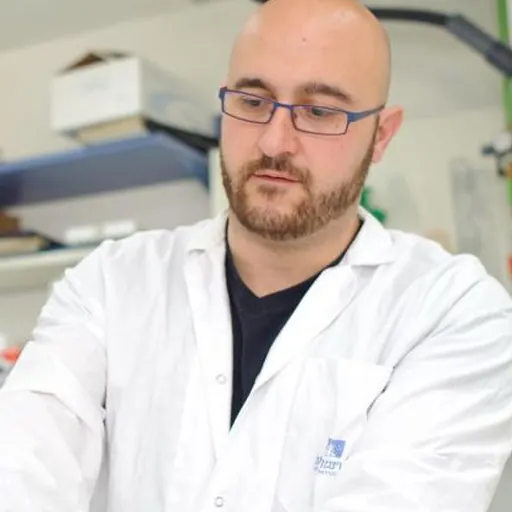
About Yakoub Hanna
Born 1979. Yakoub Hanna is a biologist.
Jacob (Yaqub) H. Hanna (Arabic: Yaqub or Yaoub; born 26 August 1979) is a Palestinian biologist, born with Israeli citizenship, who is working as a Full Professor in the Department of Molecular Genetics at the Weizmann Institute of Science in Rehovot, Israel. An expert in embryonic stem cell research, he is most recognized for developing the first bona fide Structured Stem cell-derived Synthetic Embryo Models (SEMs) in the petri dish in mice and humans.
To achieve this, he first developed a technique for extended culturing mouse embryos outside the uterus (ex utero) in 2021 capturing normal development from before gastrulation until late organogenesis outside the uterus, subsequently applying his technique for making the first high-fidelity stem cell-derived whole embryo models of mice in 2022 (SEMs), and then of human in 2023 that can be made solely from embryonic pluripotent stem cells, without using egg or sperm and generated entirely outside the womb. SEMs are also known as "Stem-Cell-Based complete Embryo Models - SCBEMs", "Synthetic Embryos" or "High Fidelity Whole Embryo Models").
Hanna pioneered the extended static and dynamic post-implantation ex utero whole embryo growth platform To train in stem cell research, he worked from 2007 to 2011 as a Helen Hay Whitney - Novartis postdoctoral fellow and a Genzyme postdoctoral fellow at the Whitehead Institute for Biomedical Research at MIT, Cambridge, Massachusetts, under Rudolf Jaenisch.
Hanna was listed in 2014 among top 40 under 40 leading international scientists by Cell journal Human complete stem-cell derived embryo model generated by Hanna was selected by TIME in its featured list of inventions in 2023, and the generation of synthetic embryo models of development through using stem cells was selected as the method of the year 2023 by Nature Methods. He is the recipient of the 2025 Nakasone Award by the Human Frontiers Science Program – HFSP for " developing synthetic embryo models from naïve pluripotent stem cells, which provides a new foundation for developmental biology and regenerative medicine strategies."(Hanna's 2025 Nakasone Award Lecture)
Early life Hanna was born in Rameh, an Arab village in the Galilee region of Israel to a Palestinian Christian family. He studied medical science at the Hebrew University of Jerusalem, obtaining a B.Sc. degree summa cum laude in 2001, and then continued to do an M.D.-Ph.D. degree at the same institute. He indicated in his interviews that his decision to undertake a career in research was heavily influenced and inspired by the success of his uncle, Nabil Hanna, who invented the first FDA-approved antibody therapy in humans (Rituxan, a blockbuster anti-CD20 mAb drug for treatment of non-Hodgkin lymphoma) while serving as chief scientific office of IDEC Pharmaceuticals. His Ph.D. research was supervised by and was on the roles of natural killer cells. In 2007, the Hebrew University awarded him both Ph.D. in microbiology and immunology and M.D. in clinical medicine summa cum laude. His supervisor, Jaenisch was awarded the Masri Prize and the Wolf Prize in 2011 for this research innovation, as the award citation read: "For demonstration that iPS cells can be used to cure genetic disease in a mammal, thus establishing their therapeutic potential".
Hanna made scientific contributions to understanding the iPSC phenomenon in its early days. He developed a novel inducible "reprogrammable mouse" transgenic models with drug controlled over expression of the Yamanaka reprogramming factors. This technique allowed him to create reprogrammed B lymphocytes carrying endogenous genetic rearrangements of the B-cell receptor (BCR) into iPSCs, thus providing definitive proof for the feasibility of reprogramming terminally differentiated cells to iPSCs that carried the original genetic rearrangement mark of the BCR.
Epigenetic reprogramming and naive pluripotency Initially, his independent group identified a number of key epigenetic regulators influencing iPSC derivation efficiency such as the role of H3K27 demethylase Utx in iPS formation, and first demonstrated the deterministic reprogramming efficiencies (up to 100% within 8 days) via optimized depletion of Gatad2a/Mbd3 core member-axis of the NuRD co-repressor complex. The latter work set the stage for others to show alternative methods to obtain deterministic reprogramming. For example, Thomas Graf group showed that transient activation of C/EBPα, previously highlighted by Hanna and Jaenisch as a booster for B cell reprogramming, can yield up to 100% deterministic iPSC reprogramming from B cells within 8 days. Hanna also identified SUMOylation of linker H1 histone as a major determinant for transition between totipotency and naïve pluripotency states.
From 2013, Hanna worked as the Robertson Stem Cell Investigator of The New York Stem Cell Foundation. His first major achievement under the NYSCF research was the demonstration that human naïve-like ES/iPS cell state tin NHSM naive-like conditions that he discovered (and later also in HENSM naive conditions), has additional unique functional properties compared to conventional primed iPS cells, which is the creation of sperm and egg stem cells from human skin cell derived naive-like iPSCs, which has not been possible thus far with conventional human iPSCs. The experiment, done in collaboration with Azim Surani's team at the University of Cambridge, was published in the journal Cell in 2015. David Cyranoski reported in Nature as "A feat achieved for the first time in humans".
In 2014, Hanna criticized Jaenisch, his former postdoctoral mentor at the Whitehead Institute - MIT, accusing his team of publishing unreliable "false" negative experimental results on inability to generate any cross-species mouse-human chimerism in a paper published by Jaenisch on the pluripotency of human embryonic stem cells in the journal Cell Stem Cell. Surprisingly, in 2016, Jaenisch and his team reported positive results on the same topic in the Proceedings of the National Academy of Sciences (PNAS) and reporting the ability to create chimeric embryo from a mixture of mouse and human cells. In light of the latter, Hanna again raised the same critical comments in PubMed, suggesting retraction of a section of the previous 2014 Jaenisch paper in Cell Stem Cell that reported negative results, in contrast to the newly reported 2016 PNAS positive results by the same team led by Jaenisch. Later findings independently reported by Jun Wu group and others supported mouse-human cross-species chimerism with human pluripotent cells as originally reported by Hanna in 2013 thus solidifying the earlier claims by Hanna and refuting those published by Jaenisch in 2014.
Hanna's lab also focused on deciphering the principles regulating naive pluripotency in different species and in 2013 his team was the first to derive human genetically unmodified MEK/ERK independent naïve-like pluripotent cells (termed NHSM conditions that were commercialized as RSeT by Stemcell Technologies). Hanna next developed engineered systems to screen for enhanced NHSM conditions that maintain human pluripotent ES cells that can tolerate removal of RNA or DNA methylation enzymes (by ablating METTL3 or DNMT1 genes, respectively), and identified enhanced NHSM conditions (termed HENSM), subsequently allowing him to make the first synthetic complete and bona fide mouse embryo models derived only from naïve pluripotent stem cells in 2022, and that can execute gastrulation and early organogenesis. In September 2023, Nature accepted Hanna's, previously preprinted article on bioRxiv on 14 June 2023, Hanna's complete human stem cell-derived embryo model (SEM) can generate extra-embryonic trophoblast stem cells, mesoderm cells and primitive endoderm cells without genetic modification, transgene or transcription factor over-expression, and has structural and morphological uncanny similarity to day 14 human embryo inside the womb. It was reported by Philip Ball that Dr. Bailey Weatherbee from the University of Cambridge who tried to generate human embryo models "is impressed by the embryo-like structures reported by Hanna's team, and agrees that their own don't have these structures." Prof Robin Lovell Badge, who researches embryo development at the Francis Crick Institute, told the BBC that Hanna's human embryo models "do look pretty good" and "do look pretty normal". He also said "I think it's good, I thinks it's done very well, it's all making sense and I'm pretty impressed with it". When Hanna announced the creation of the first human synthetic embryo models in a preprinted manuscript on bioRxiv and "groundbreaking advance" in science. But Hanna's scientific feat raised further the discussions surrounding ethical and legal controversies. The International Society for Stem Cell Research (ISSCR) has instituted guidelines for maintaining human embryos that are followed in most countries. However, the guidelines or any other legislations do not cover stem cell-derived embryo models, as the embryo models are made from ordinary cells.
Rivron, Martinez Arias and others, writing on the ethical issues in Cell in 2023, expressed a possible need to open discussions about revising the definition of an embryo since certain embryo models can theoretically become functional embryos and produce babies. Robin Lovell-Badge, at the Francis Crick Institute and member of the ISSCR guidelines preparation, also agreed that both natural and synthetic human embryo models should be regulated equally, saying, "These models do challenge the need to stick to the 14-day rule", referring the ISSCR's relaxation in 2021 the limit of growing human embryos up to 14 days. The International Society for Stem Cell Research publicly announced support for the research and highlighted to the public that such complete embryo models are only models of embryogenesis and should not be considered as embryos. British science writer, Philip Ball, alleviated concern related to this line of research by emphasizing that "None [of the embryo models] has the potential to grow into a human being, nor is there any reason why scientists would want them to." Upon publication of Hanna's ground breaking paper on human complete stem cell-derived embryo models (termed SEMs) in Nature in 2023,
Personal life Hanna openly identifies as non-binary. He was born as a Protestant, although he states that his family is not particularly religious.
Awards and honors The Nakasone Award by the Human Frontiers Science Program – HFSP (2025) Hanna's Nakasone Award Lecture ISF Breakthrough Award (Israeli Science Foundation equivalent to NIH Director's Pioneer Award) Named on the 2024 STATUS List by STAT news, a prestigious list with most influential individuals in healthcare, medicine, & life sciences Human complete synthetic embryo model generated by Hanna was selected by the Time as invention breakthrough of the year 2023 , The generation of synthetic embryo models was selected as the method of the year 2023 by Nature Methods journal on behalf of Nature publishing group. The 2022 paper on stem cell-derived (synthetic) embryogenesis listed among top scientific breakthroughs of the year 2022 by The Atlantic magazine and The Week Magazine (2023) A Paul Harris Fellow by the Rotary International Foundation in recognition for scientific achievements (2022) Selected as top thinker for the year 2021 by Prospect magazine, UK for his work on stem cells and synthetic embryology (2021) Paper on ex utero embryogenesis listed among top scientific breakthroughs of the year by Science journal (2021) Robert Edwards honorary lecture and lifetime achievement award by the COGI meeting in Berlin (2021) Research on ex utero embryogenesis was covered in a dedicated Nature Outlook article (2021) Elected a member of the European Molecular Biology Organization (EMBO) (2018) Research Professorship Award by the Israel Cancer Research Fund (ICRF) (2017) The Segal Family Award for Excellence in Stem Cell Biology, University of Michigan, USA (2016) The Kimmel Prize for outstanding scientist at the Weizmann Institute of Science (2015) Selected among "40 under 40" most innovative young scientists by Cell journal (2014) Elected member of the Israeli Young Academy of Science (2014) Robertson Innovator Award in Stem Cell Research by the New York Stem Cell Foundation (NYSCF) (2013) Krill Prize for outstanding early career scientists by the Wolf Foundation (2013) The Rappaport Prize for a Young Researcher in Biomedicine by the Bruce and Ruth Rappaport Foundation (2013) Elected member of the European Molecular Biology Organization Young Investigator Program (EMBO-YIP) (2012) Inaugural Award for Excellence in Biomedical Research by the Palestinian Society for Biomedical Research (2011) Alon Foundation Scholar for distinguished junior faculty in Israeli academia (2011) The Clore Prize for an outstanding new scientist at the Weizmann Institute of Science (2011) TR35 Young Innovator Award for international innovators under the age of 35 by MIT Technology Review magazine (2010) Genzyme Postdoctoral Prize and Fellowship for Outstanding Postdoc at the Whitehead Institute (2010) Novartis Postdoctoral Fellowship by the Helen Hay Whitney Foundation – Novartis Fellow (2007) Hebrew University Medical School Excellence Award for graduating M.D.-Ph.D. students, Hebrew University of Jerusalem (2007) Max Schlomiuk Award for Ph.D. students graduating with distinction (summa cum laude), Hebrew University of Jerusalem (2007) Gertrude Kohn Award for outstanding scientific work in human genetics, Hebrew University of Jerusalem (2005) Foulkes Foundation Award and Scholarship for M.D.- Ph.D. students (2004) Wolf Foundation Award and Fellowship for Outstanding Ph.D. students (2003)
Don’t just read it —
keep it.
Full-length biographies made to live with: read them, listen on the way to work, watch them tonight.
- E-book
- Audio
- Video
Instant download · yours to keep · every purchase keeps this site free
Important facts
People in Yakoub Hanna's life
Named in this biography and alive at the same time





Related people
Same field, nearest in time

Contemporaries
People whose lives overlapped Yakoub Hanna's




Frequently asked questions
Who is Yakoub Hanna?
Palestinian researcher in molecular biochemistry
When was Yakoub Hanna born?
Yakoub Hanna was born on 26 August 1979 in Rameh.
What is Yakoub Hanna's occupation?
Yakoub Hanna is a biologist.
What nationality is Yakoub Hanna?
Yakoub Hanna's recorded nationality: Palestine.
Sources & further reading
Cite this page
APA: Biography.guide. (2026). Yakoub Hanna. https://biography.guide/yakoub-hanna/
MLA: "Yakoub Hanna." Biography.guide, https://biography.guide/yakoub-hanna/.
Chicago: "Yakoub Hanna." Biography.guide. https://biography.guide/yakoub-hanna/.
Data last updated: 2026-09-23 · Spot an error? Report a correction.
Portrait: Wikimedia Commons · author & licence
Page generated 2026-09-27 05:07 UTC