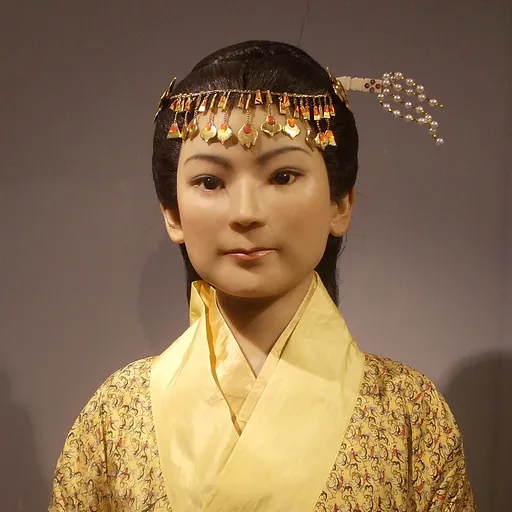
Xin Zhui
Well-preserved ancient body found in China
About Xin Zhui
Lived 217 BC – 163 BC (aged 53–54). Xin Zhui was a Chinese.
Xin Zhui (; ; – 169 or 168 BC), also known as Lady Dai or the Marchioness of Dai, was a Chinese noblewoman. She was the wife of Li Cang , the Marquis of Dai and chancellor of the Changsha Kingdom, during the Western Han dynasty. Her tomb, containing her well-preserved remains and 1,400 artifacts, was discovered in 1971 at Mawangdui, Changsha. Her body and belongings are currently under the care of the Hunan Museum; artifacts from her tomb were displayed in Santa Barbara and New York City in 2009. Her body is notable as being one of the best-preserved mummies ever found. As a noble, Xin Zhui also had access to a variety of imperial foods, including various types of meat, which were reserved for the royal family and members of the ruling class. Most of her clothing was made of silk and other valuable textiles, and she owned many cosmetics.
A total of 130 melon seeds were found in Xin Zhui's stomach, intestines, and esophagus; researchers believed she consumed the melon very quickly.
Xin Zhui died at approximately 50 years of age in 169 or 168 BC. With the assistance of over 1,500 local high school students, archaeologists began a large excavation of the site beginning in January 1972. Xin Zhui's body was found within four rectangular pine constructs that sat inside one another which were buried beneath layers of charcoal and white clay. The corpse was wrapped in twenty layers of clothing bound with silk ribbons.
In the tomb of Xin Zhui, four coffins of decreasing sizes enclose one another. The first and outermost coffin is painted black, the color of death and the underworld. All painted images sealed inside this coffin were thus designed not for an outside viewer but for the deceased and concern the themes of death and rebirth, protection in the afterlife, and immortality. The second coffin has a black background but is painted with a pattern of stylized clouds and with protective deities and auspicious animals roaming an empty universe. A tiny figure, the deceased woman, is emerging at the bottom center of the head end. Only her upper body is shown, indicating she is about to enter a new world. The third coffin exhibits a different color scheme and iconography. It is shining red, the color of immortality, and the decorative motifs include divine animals and a winged immortal flanking three-peaked Mount Kunlun, which is a prime symbol of eternal happiness. Inside this tomb on top of the fourth and innermost coffin, the excavators found a painted silk banner about two meters long.
Yellow and black feathers are stuck on the cover board of the coffin. The feathers stuck to the coffin were expressing the hopes that Xin Zhui would grow feathers on the body and enter the heavens to become immortal.
Xin Zhui's body was remarkably well preserved. Her skin was soft and moist, with muscles that still allowed for her arms and legs to flex at the joints. All her organs and blood vessels were also intact, with small amounts of Type A blood being found in her veins. There was hair on her head, with a wig pinned with a hair clasp on the back of her head. There was skin on her face, and her eyelashes and nose hair remained intact. The tympanic membrane of her left ear was also intact, and her finger and toe prints were distinct. This preservation allowed doctors at Hunan Provincial Medical Institute to perform an autopsy on 14 December 1972. The importance of filial piety during that time also resulted in a lavish burial with many artifacts. More than 1,400 precious artifacts were found with Xin Zhui's body When the autopsy on Xin Zhui's remains was done, contact with the fluid caused a rash on the hands of the scientists conducting it. The rash persisted on their skin for three months.
Significance Besides having some of the best preserved human remains ever discovered in China, the contents of Xin Zhui's tomb revealed much information about life in the Han dynasty that was previously unknown. The discovery continues to advance the fields of archaeology and science in the 21st century, particularly in the area of preservation of ancient human remains. Scientists in 2003 developed a "secret compound" that was injected into Xin Zhui's still existing blood vessels to assure her preservation. The woman on the top is possibly Xin Zhui herself drawn in imitation of Nüwa or the snake-like spirits next to her who could have been inspired by Nüwa, in the process of becoming a xian.
Don’t just read it —
keep it.
Full-length biographies made to live with: read them, listen on the way to work, watch them tonight.
- E-book
- Audio
- Video
Instant download · yours to keep · every purchase keeps this site free
Important facts
Family & relationships
Contemporaries
People whose lives overlapped Xin Zhui's


Frequently asked questions
Who was Xin Zhui?
well-preserved ancient body found in China
When was Xin Zhui born?
Xin Zhui was born in 217 BC.
When did Xin Zhui die?
Xin Zhui died in 163 BC.
What nationality was Xin Zhui?
Xin Zhui was Chinese.
Sources & further reading
Cite this page
APA: Biography.guide. (2026). Xin Zhui. https://biography.guide/xin-zhui/
MLA: "Xin Zhui." Biography.guide, https://biography.guide/xin-zhui/.
Chicago: "Xin Zhui." Biography.guide. https://biography.guide/xin-zhui/.
Data last updated: 2026-09-20 · Spot an error? Report a correction.
Page generated 2026-09-27 05:09 UTC