
About Wynn Bullock
Lived 1902 – 1975 (aged 73). Wynn Bullock was an American photographer.
Wynn Bullock (April 18, 1902 – November 16, 1975) was an American photographer whose work is included in over 90 major museum collections around the world.
Life and career
Early career in music
Bullock was born in Chicago and raised in South Pasadena, California. As a boy, his passions were singing and athletics (football, baseball, swimming and tennis). After high school graduation, he moved to New York to pursue a musical career and was hired as a chorus member in Irving Berlin’s Music Box Revue. He occasionally sang the primary tenor role when headliner John Steele was unable to appear and then was given a major role with the Music Box Review Road Company. During the mid-1920s, he furthered his career in Europe, studying voice and giving concerts in France, Germany and Italy.
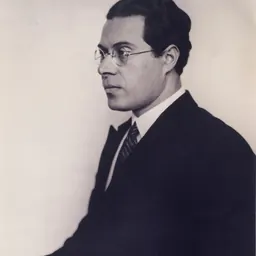
While living in Paris, Bullock became fascinated with the work of the Impressionists and post-Impressionists. He then discovered the work of Man Ray and László Moholy-Nagy and experienced an immediate affinity with photography, not only as an art form uniquely based on light, but also as a vehicle through which he could more creatively engage with the world. He bought his first camera and began taking pictures. had studied law. Completely dissatisfied after a few weeks, he left USC and became a student of photography at the nearby Art Center School.
From 1938 to 1940, Bullock became deeply involved in exploring alternative processes such as solarization and bas relief. After graduation from Art Center, his experimental work was exhibited in one of L.A. County Museum's early solo photographic exhibitions. During the early 40s, he worked as a commercial photographer and then enlisted in the Army. Released from the military to photograph for the aircraft industry, he was first employed at Lockheed and then headed the photographic department of Connors-Joyce until the end of the war.
The Family of Man
In the mid-1950s, Bullock's artistry came into the public spotlight when Edward Steichen chose two of his photographs to include in the 1955 The Family of Man exhibition at the Museum of Modern Art. At the Corcoran Gallery in Washington, DC, his photograph "Let There Be Light," was voted the most popular of the show. The second, "Child in Forest," became one of the exhibition's most memorable images. For him, these photographs represented an in-depth exploration of light, manifesting his belief that light is a great force at the heart of all being, "perhaps," as he said, "the most profound truth in the universe."
Philosophical explorations late in life
In the mid-1960s, frustrated by the limitations of color printing technology, Bullock returned to making black-and-white photographs, continuing to expand his vision to create innovative images that reflected his philosophical nature. Differentiating what he termed "reality", the visible and the known, from "existence", the underlying truth of things, he was ceaseless in his attempts to expand his own faculties of perception and understanding so he could come ever closer in his experiences to the essence of things. Finding the means to more fully evoke that essence was also a key part of his quest. Although he included several different alternative processes (extremely long time exposures, multiple images, up-side-down and negative printing) in his repertoire of techniques, each was always used in the service of symbolizing new ways of relating to and knowing the world. He wrote,
"Searching is everything – going beyond what you know. And the test of the search is really in the things themselves, the things you seek to understand. What is important is not what you think about them, but how they enlarge you." His work may also be found in the permanent collections of over 90 major institutions throughout the world as well as in numerous publications. on their work.
Education
Bullock took courses at Columbia University, 1925, and University of West Virginia, mid-1930s; attended and graduated from Art Center School in Los Angeles, 1938-1940. He was a lifelong student of philosophy, physics, general semantics, psychology, theology, spirituality and art.
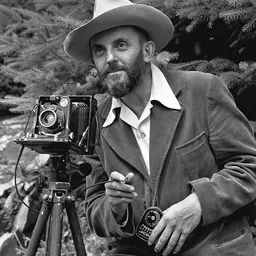
Along with Ansel Adams, Harry Callahan, Aaron Siskind and Frederick Sommer, he became part of the founding group of photographers whose archives established the Center for Creative Photography at the University of Arizona in 1975. Bullock taught advanced photography courses at the Institute of Design in Chicago during Aaron Siskind's sabbatical and at San Francisco State College at the invitation of John Gutmann. He was a guest instructor for the Ansel Adams Yosemite Workshops. Throughout the 1960s and early 1970s, he lectured widely, led photographic workshops, and participated in many seminars and symposia on various topics and issues in photography.
Quotes by Bullock
I didn't want to tell the tree or weed what it was. I wanted it to tell me something and through me express its meaning in nature. Light to me is perhaps the most profound truth in the universe. My thinking has been deeply affected by the belief everything is some form of radiant energy. I love the medium of photography, for with its unique realism it gives me the power to go beyond conventional ways of seeing and understanding and say, "This is real, too." I feel all things as dynamic events, being, changing, and interacting with each other in space and time even as I photograph them. As sounds in a musical composition can be used not to express physical objects but ideas, emotions, harmonies, rhythmic orders and most any expression of the human mind and spirit, so light can be used visually to express the mind and spirit. Light used in its own right, as in light pictures, gives to photography the wonderful plasticity that paint gives to painting without loss of the unmatched reality of straight photography. What you see is real - but only on the particular level to which you've developed your sense of seeing. You can expand your reality by developing new ways of perceiving. Mysteries lie all around us, even in the most familiar things, waiting only to be perceived.
Don’t just read it —
keep it.
Full-length biographies made to live with: read them, listen on the way to work, watch them tonight.
- E-book
- Audio
- Video
Instant download · yours to keep · every purchase keeps this site free
Important facts
People in Wynn Bullock's life
Named in this biography and alive at the same time






Related people
Same field, nearest in time


Contemporaries
People whose lives overlapped Wynn Bullock's



Frequently asked questions
Who was Wynn Bullock?
American photographer (1902-1975)
When was Wynn Bullock born?
Wynn Bullock was born on 18 April 1902 in Chicago.
When did Wynn Bullock die?
Wynn Bullock died on 16 November 1975 in Monterey.
What was Wynn Bullock's occupation?
Wynn Bullock was a photographer.
What nationality was Wynn Bullock?
Wynn Bullock was American.
Sources & further reading
Cite this page
APA: Biography.guide. (2026). Wynn Bullock. https://biography.guide/wynn-bullock/
MLA: "Wynn Bullock." Biography.guide, https://biography.guide/wynn-bullock/.
Chicago: "Wynn Bullock." Biography.guide. https://biography.guide/wynn-bullock/.
Data last updated: 2026-09-20 · Spot an error? Report a correction.
Page generated 2026-09-27 05:08 UTC