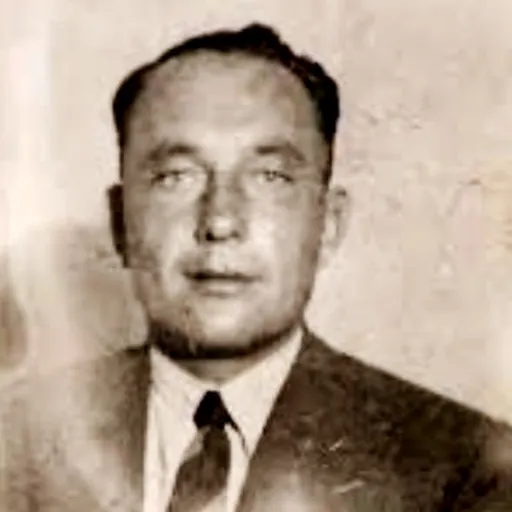
Władysław Łukasiuk
Polish army captain
About Władysław Łukasiuk
Lived 1906 – 1949 (aged 43). Władysław Łukasiuk was a captain.
Władysław Łukasiuk (16 February 1906 - 27 June 1949) (nom de guerre "Młot" or "Młot II" - "The Hammer" or "Hammer II") was a captain of the Polish Army, of the Home Army (AK), and the anti-communist underground.
Early life He was born in Tokary In 1929 he joined the military where he quickly advanced to the rank of platoon commander. and he was released from the army. His unit also took part in several skirmishes with the Germans and other military actions, including the blowing up of the rail bridge on the Siedlce-Czeremha rail line Subsequently a plan was formed to unite all the local AK groupings and march to Warsaw to help in the Warsaw Uprising. Due to arrests and persecution of AK members by the Soviets however, the plan was not realized.
In September 1945 "Szumny" was killed and his unit disbanded.
During this time the UB arrested Łukasiuk's sister, Maria Sobolewska, after she was reported to the communist authorities by a neighbor. While arrested, she was tortured and beaten for three months but did not reveal any information about the whereabouts of her brother and refused to cooperate with the communist secret police. In 1945 she was tried for "treason against the People's Republic of Poland" and sentenced to ten years in prison, of which she served six. Because the UB knew that Łukasiuk was lame in the left leg, they resorted to arresting and torturing random people with the same handicap in the region in the hopes of catching him by accident. Even though he had trouble moving about due to his paralyzed leg, he would always march at the head of his unit, using his SWT-40 carbine as a crutch (even though the unit possessed several wagons for transport). He was characterized by his careful and respectful approach to the civilian population of the area, regardless of their ethnicity, class or religion and on many occasions responded to appeals from locals to combat common bandits and thieves who were plentiful in the post-war chaos. This, in addition to his continued struggle against first the Nazis and then the repressive communist authorities, made "Młot" a legend of Podlasie in his lifetime. During the communist era in Poland, however, he was officially vilified and defamed.
On 11 November 2007, the president of Poland Lech Kaczyński posthumously awarded Władysław Łukasiuk the Grand Cross of Polonia Restituta.
Don’t just read it —
keep it.
Full-length biographies made to live with: read them, listen on the way to work, watch them tonight.
- E-book
- Audio
- Video
Instant download · yours to keep · every purchase keeps this site free
Important facts
Related people
Same field, nearest in time




Contemporaries
People whose lives overlapped Władysław Łukasiuk's


Frequently asked questions
Who was Władysław Łukasiuk?
Polish army captain
When was Władysław Łukasiuk born?
Władysław Łukasiuk was born on 16 February 1906 in Tokary.
When did Władysław Łukasiuk die?
Władysław Łukasiuk died on 27 June 1949 in Czaje-Wólka.
What was Władysław Łukasiuk's occupation?
Władysław Łukasiuk was a captain.
Sources & further reading
· Wikipedia: Władysław Łukasiuk
Cite this page
APA: Biography.guide. (2026). Władysław Łukasiuk. https://biography.guide/wladyslaw-lukasiuk/
MLA: "Władysław Łukasiuk." Biography.guide, https://biography.guide/wladyslaw-lukasiuk/.
Chicago: "Władysław Łukasiuk." Biography.guide. https://biography.guide/wladyslaw-lukasiuk/.
Data last updated: 2026-09-22 · Spot an error? Report a correction.
Portrait: Wikimedia Commons · author & licence
Page generated 2026-09-27 05:04 UTC