Wilmatte Porter Cockerell
American entomologist, botanist, scientific collector and teacher
About Wilmatte Porter Cockerell
Lived 1870 – 1957 (aged 86). Wilmatte Porter Cockerell was an American entomologist, botanist, teacher, scientific collector, botanical collector and university teacher.
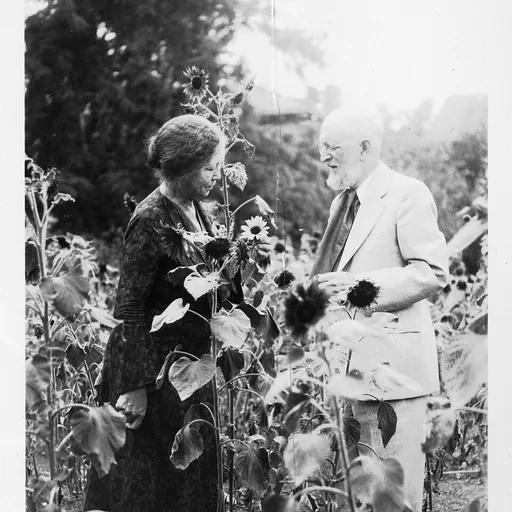
Wilmatte Porter Cockerell (July 28, 1869 – March 15, 1957) was an American entomologist and high school biology teacher who discovered and collected a large number of insect specimens and other organisms. She participated in numerous research and collecting field trips including the Cockerell-Mackie-Ogilvie expedition. She wrote several scientific articles in her own right, co-authored more with her husband, Theodore Dru Alison Cockerell, and assisted him with his prolific scientific output. She discovered and cultivated red sunflowers, eventually selling the seeds to commercial seed companies. Her husband and her entomological colleagues named a number of taxa in her honor.
Biography Cockerell was born Wilmatte Porter in Leon, Iowa, in 1869. She attended Stanford University and graduated from there in 1898.
From 1899, she was employed as a professor of biology at the New Mexico Normal University in Las Vegas, New Mexico. There she met Theodore Dru Alison Cockerell, a self-taught entomologist from England specialising in Hymenoptera, who was also employed at that college.
Theodore had established the New Mexico biological station at the Agricultural Experiment Station in Mesilla a few years earlier, but in 1899 he moved it to Las Vegas, where he used the facilities of the New Mexico Normal University (he was employed there himself the following year). Theodore used the biological station to teach summer classes in applied biology to mostly public school teachers. By 1900 Cockerell was the assistant director of the station with Theodore being the director.
Porter married Theodore Cockerell on June 19, 1900. As well as accompanying her husband on field trips, she collaborated with him on his scientific research and writing. She was much better than her husband at catching insects, on some field trips out-collecting him nine to one. Both Cockerells were badly paid, and it is known Wilmatte sometimes supplemented the family income by selling specimens she obtained while on her field trips to professional full-time insect collectors, who in some cases altered the collection locality on the labels to make the insects appear more exotic and increase their value.
In 1910 Cockerell discovered a red sunflower across the road from her home in a field. This sunflower was a mutant that she and Theodore transferred to their garden. Cockerell proceeded cultivate it further, developing the mutation to the point where it could be sold to commercial seed companies. Seed companies such as Peter Henderson & Co, Sutton & Sons, and Burpee marketed the red sunflower seeds throughout the world. The Cockerells were awarded a medal for their work on these sunflowers at the Panama–Pacific International Exposition at San Francisco in 1915.
In 1906, the Cockerells visited the Florissant Fossil Beds with Sievert Allen Rohwer and W. M. Wheeler, and with them collected specimens and published various articles about the fossil insects found at this site. Also in 1912, while traveling in Guatemala, Cockerell collected three specimens of cacti for National Herbarium at the Smithsonian. These were sent to the botanists Nathaniel Lord Britton and Joseph Nelson Rose. They reclassified their just described Hylocereus minutiflorus as a monotypic species in the genus Wilmattea in her honor, although this change has since been rescinded.
In August 1918, Cockerell and her husband went on a field trip to Peaceful Valley, Colorado, where again she collected specimens of numerous species previously unknown to science.
Cockerell and her husband traveled to the United Kingdom in 1921, and visited the Royal Botanic Garden Edinburgh.
In 1923, Cockerell and Theodore undertook a trip to Japan. They traveled on the steamer Aleut. While in Japan they had a narrow escape in the Great Kantō earthquake. The Denver Times reported that Cockerell and her husband were believed lost in the catastrophe.
In the later half of 1931 into 1932 the Cockerells went to Africa on what they christened the "Cockerell-Mackie-Ogilvie Expedition". They were accompanied by the naturalist Alice Barringer Mackie. The expedition visited many areas of Africa including the Congo where the group collected over 16,000 specimens, especially of bees. Once again numerous specimens of various species were collected by them that up until then had been unknown to science.
After Theodore retired, Cockerell spent her winters with her husband in California. They both worked as volunteer curators at the Desert Museum in Palm Springs, California, from 1941. They were not paid for this work but did receive housing as part compensation until 1945. In 1946 Cockerell and her husband began working at Escuela Agricola Panamericana in Tegucigalpa, Honduras. Castilleja x porterae Cockerell, 1904 Nyctaginia cockerelliae E.Nelson, 1903 Senegalia cockerelliae Britton & Rose, 1928 = Acacia cockerelliae (Britton & Rose) Lundell, 1940 Glyphomitrium cockerelleae Britton & Hollick (now known as Plagiopodopsis cockerelliae (Britton & Hollick)). A fossilised moss named in honour of Cockerell in recognition of her devotion to science and her assistance in collecting specimens. Populus wilmattae Cockerell, 1926 Wilmattea Britton & Rose, 1920
Animals Mollusks Ashmunella thomsoniana ssp. porterae Pilsbry & Cockerell, 1899
Sea slugs Felimare porterae (Cockerell, 1901)
Bees Andrena porterae Cockerell, 1900 Arachnophroctonus cockerellae Rohwer, S. A. 1914. Proceedings of the United States National Museum. 47: 515. Bombus lateralis wilmattae Cockerell, T. D. A. 1912. Annals and Magazine of Natural History. Ser. 8 10: 21. Coelioxys wilmattae Cockerell, T. D. A. 1949. Proceedings of the United States National Museum. 98 (3233): 451. Exomalopsis wilmattae Cockerell, T. D. A. 1949. Proceedings of the United States National Museum. 98 (3233): 454. Hesperapis wilmattae Cockerell, 1933. Perdita wilmattae Cockerell, T. D. A. 1906. Bulletin of the American Museum of Natural History. 22: 441. Ptiloglossa wilmattae Cockerell, 1949 Teucholabis cockerellae Alexander, C. P. 1915. Proceedings of the United States National Museum. 48: 442
Hemiptera Ripersia cockerellae King, 1902 (now recognised as a synonym of Chnaurococcus trifolii)
Don’t just read it —
keep it.
Full-length biographies made to live with: read them, listen on the way to work, watch them tonight.
- E-book
- Audio
- Video
Instant download · yours to keep · every purchase keeps this site free
Important facts
more
Williamette Porter Cockerell, Martha Willomatte Porter, Wilmatte CockerellPeople in Wilmatte Porter Cockerell's life
Named in this biography and alive at the same time



Related people
Same field, nearest in time




Contemporaries
People whose lives overlapped Wilmatte Porter Cockerell's




Frequently asked questions
Who was Wilmatte Porter Cockerell?
American entomologist, botanist, scientific collector and teacher (1870-1957)
When was Wilmatte Porter Cockerell born?
Wilmatte Porter Cockerell was born on 28 July 1870 in Leon.
When did Wilmatte Porter Cockerell die?
Wilmatte Porter Cockerell died on 5 March 1957 in Los Angeles.
What was Wilmatte Porter Cockerell's occupation?
Wilmatte Porter Cockerell was an entomologist, botanist, teacher, scientific collector, botanical collector and university teacher.
What nationality was Wilmatte Porter Cockerell?
Wilmatte Porter Cockerell was American.
Sources & further reading
· Wikipedia: Wilmatte Porter Cockerell
· DBpedia: Wilmatte P. Cockerell
Cite this page
APA: Biography.guide. (2026). Wilmatte Porter Cockerell. https://biography.guide/wilmatte-porter-cockerell/
MLA: "Wilmatte Porter Cockerell." Biography.guide, https://biography.guide/wilmatte-porter-cockerell/.
Chicago: "Wilmatte Porter Cockerell." Biography.guide. https://biography.guide/wilmatte-porter-cockerell/.
Data last updated: 2026-09-23 · Spot an error? Report a correction.
Portrait: Wikimedia Commons · author & licence
Page generated 2026-09-27 05:07 UTC