
William Zeckendorf
American real estate developer
About William Zeckendorf
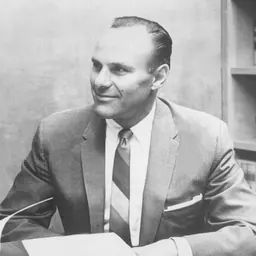
Lived 1905 – 1976 (aged 71). William Zeckendorf was an American real estate developer, businessperson, art collector and real estate entrepreneur, known for Place Ville Marie.
Early life Zeckendorf was born to a Jewish family in Paris, Illinois, the son of a hardware store manager. His family moved to New York City when he was three years old.
Zeckendorf also owned New York's famous Chrysler Building and the venerable Hotel Astor in Times Square as well as the Commodore Hotel, the Drake Hotel, Hotel Manhattan and the Chatham Hotel. He purchased Chicago's famous Robie House in 1958, before transferring ownership to the University of Chicago. He developed two of I. M. Pei's early skyscrapers — the Mile High Center (now part of Wells Fargo Center) in downtown Denver, and Place Ville Marie in downtown Montreal.
Zeckendorf also partnered with Chicago real estate titan Arthur Rubloff to develop a stretch of Michigan Avenue into what Rubloff dubbed the Magnificent Mile. The Rubloff Company was eventually acquired by Prudential and subsequently has become a division of Berkshire Hathaway.
The real estate tycoon and his company, Webb & Knapp, also were involved in theme park investment following the successful debut of Disneyland. Zeckendorf came to know C.V. Wood, who first helped build Disneyland as a Disney employee and then developed theme parks in Colorado, Massachusetts, New York (on Zeckendorf's property) and Texas under his own Marco Engineering company. Zeckendorf and his company enjoyed various connections to the Marco Engineering parks.
In New York, Wood created and built Freedomland U.S.A. on marshland that had been owned by Zeckendorf since the early 1950s. The property was located in The Bronx, a borough of New York City. The park lasted just five years (1960–1964) and it was under various layers of management that included Zeckendorf and his son. According to Zeckendorf in a newspaper article that appeared during 1970, the theme park, unknown to the public at the time, served as a "placeholder" for the land to obtain variances that permitted the construction on the marshland of the world's largest co-operative housing project known as Co-op City. Zeckendorf's ownership of the land and his role in Freedomland are documented in the book Freedomland U.S.A.: The Definitive History (Theme Park Press, 2019).
Deal with Spyros Skouras In December 1958, Zeckendorf entered into a deal with Spyros Skouras, head of 20th Century-Fox, to purchase Fox's project to develop of its historic backlot in Los Angeles, California, into a proposed Century City. The studio had suffered a string of expensive flops, culminating in the box-office disaster Cleopatra (1963) and was in dire need of money. The project, conceived under the direction of Edmund Herrscher, the studio's director of property development, had been announced the first week of 1958, with construction said to begin in July 1958.
However, construction did not start as promised, and rumors, later confirmed, circulated that developer Zeckendorf would take over the project by purchasing 20th's interest in the project for . The following March it was announced that construction would begin that month on the new headquarters for architect Welton Becket, chief architect on the project That did not occur either. Zeckendorf hired New York public relations executive Tex McCrary to lend new life and visibility to the project. McCrary, in turn contracted with Los Angeles publicist Charles A. Pomerantz, well known in the entertainment industry, to come up with a campaign and execute it.
Pomerantz turned to a young publicist he had hired, Worley Thorne, the only other publicist in the small firm, for suggestions. Thorne said he'd call friends in the press to assess their attitudes. Thorne learned that there was deep skepticism that the project would ever be built. 20th did not have the money, which is why they brought in Zeckendorf, but apparently Zeckendorf was unable to deliver even the $53-million purchase price, let alone $400 million. The California papers had already given a lot of publicity to Century City and, for them, any more coverage would just be re-hash in which they were not interested.
Thorne reported to Pomerantz his opinion that the only way to restore credibility to the project was to actually "begin" construction, and Pomerantz went for the plan. Thorne called Herrscher and asked if there was some small building they could demolish with a bulldozer, to begin to "break ground" for the Becket building. Herrscher said there was a tin shack that was expendable and he'd make it available, as well as the bulldozer. McCrary and William Zeckendorf, Jr., vice-president of Webb & Knapp, also approved. Thorne said that it should be a large affair with the mayors of Los Angeles, Beverly Hills, and Santa Monica, plus politicians and other dignitaries, invited, as well as all the Southern California press. He and Pomerantz would find a star to "launch" the project by breaking a bottle of champagne on the shack prior to its being demolished. Later, they secured Mary Pickford for that task. It was all purely symbolic, since construction did not actually begin, but no one stated that openly, it was dramatic, and very successful. The Los Angeles Times devoted almost three full pages to its coverage of the event.
Still lacking sufficient money, Zeckendorf was forced to make per day penalty payments to Fox. In 1960, Zeckendorf solved his problem by partnering with Alcoa in a joint-venture relationship to finally build Century City, which by now had escalated to a project. The new owners embraced the studio's conception of Century City as "a city within a city" with the arc-shaped, 19-story Century Plaza Hotel to be the centerpiece. This joint-venture marked an increasing interest by large corporations with land "surplus" in order to create housing communities, industrial parks and office buildings; marking the first movement from traditional industry into real estate investing.
Bankruptcy Before Webb and Knapp's bankruptcy in 1965, Zeckendorf became the embodiment of glamorous real-estate dealmaking, which included developing Roosevelt Airfield, where Charles Lindbergh began his transatlantic flight, and helping to advance and develop Long Island University. From the start of his career Zeckendorf had been able to use his dealmaking skills to acquire or build projects for which he lacked the funds, but in time the under-funding caught up with him, and "his overextended company crashed in a spectacular bankruptcy." He then worked for his son, William Jr., with his wages garnished in order to settle his debts. His second wife was Marion Griffin who died in 1968. In 1972, he married Alice Odenheimer Bache, widow of Harold L. Bache. They subsequently divorced and he married Louise Betterly Malcolm in 1975.
On September 30, 1976, William Zeckendorf died in bankruptcy
Don’t just read it —
keep it.
Full-length biographies made to live with: read them, listen on the way to work, watch them tonight.
- E-book
- Audio
- Video
Instant download · yours to keep · every purchase keeps this site free
Important facts
Family & relationships
People in William Zeckendorf's life
Named in this biography and alive at the same time





Related people
Same field, nearest in time


Contemporaries
People whose lives overlapped William Zeckendorf's





Frequently asked questions
Who was William Zeckendorf?
American real estate developer (1905–1976)
When was William Zeckendorf born?
William Zeckendorf was born on 30 June 1905 in Paris.
When did William Zeckendorf die?
William Zeckendorf died on 30 September 1976 in Lenox Hill.
What was William Zeckendorf's occupation?
William Zeckendorf was a real estate developer, businessperson, art collector and real estate entrepreneur.
What was William Zeckendorf known for?
William Zeckendorf was known for Place Ville Marie.
What nationality was William Zeckendorf?
William Zeckendorf was American.
Sources & further reading
· Wikipedia: William Zeckendorf
Cite this page
APA: Biography.guide. (2026). William Zeckendorf. https://biography.guide/william-zeckendorf/
MLA: "William Zeckendorf." Biography.guide, https://biography.guide/william-zeckendorf/.
Chicago: "William Zeckendorf." Biography.guide. https://biography.guide/william-zeckendorf/.
Data last updated: 2026-09-22 · Spot an error? Report a correction.
Page generated 2026-09-27 05:21 UTC