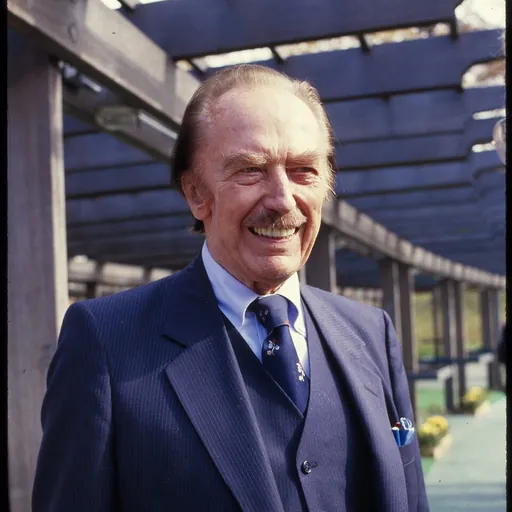
Fred Trump
American real estate developer; father of Donald Trump
About Fred Trump
Lived 1905 – 1999 (aged 93). Fred Trump was an American real estate developer, investor, entrepreneur and the Trump Organization.
Frederick Christ Trump (October 11, 1905 – June 25, 1999) was an American real estate developer and businessman. He was the father of Donald Trump, the 45th and 47th president of the United States, along with four other children.
Born in the Bronx in New York City to German immigrant parents, Trump began working in home construction and sales in the 1920s before heading the real-estate business started by his parents (later known as the Trump Organization). From World War II onward, to avoid associations with Nazism, Trump denied his German ancestry and also supported Jewish causes.Efn|name="sam"|Several fraternity brothers at the historically Jewish Sigma Alpha Mu claimed that fellow member Fred Trump Jr. said his father was Jewish. In 2018, psychoanalyst Justin A. Frank asserted that Fred Jr. joined such a fraternity to rebel against his father, whom Frank alleges was . Fred Jr.'s daughter, Mary L. Trump, later also claimed her grandfather was "quite ". The family returned to New York on July 1, 1905, and moved to the Bronx, where Frederick Christ Trump was born on October 11, 1905. Fred's younger brother, John G. Trump, was born in 1907. All three children were raised speaking German at home. In September 1908, the family moved to Woodhaven, Queens.
Many details of Trump's childhood come from autobiographical accounts and emphasize independence, learning and especially hard workto the point of being somewhat fictionalized. At the age of 10, Trump worked as a delivery boy for a butcher. About two years later, on Memorial Day, his father died in the 1918 flu pandemic, quite suddenly according to Fred. From 1918 to 1923, Fred attended Richmond Hill High School in Queens, while working as a caddy, curb whitewasher, delivery boy, and newspaper hawker. Meanwhile, his mother continued the real-estate business Friedrich had begun. Interested in becoming a builder, Fred put up a garage for a neighbor and took night classes in carpentry and reading blueprints; he reputedly studied plumbing, masonry, and electrical wiring via correspondence courses, although other biographical sources limit his construction education to the period after high school when he was also working in the field. by which year Trump ostensibly used an $800 loan from his mother to complete and sell his first house. Public records, however, do not support him building until 1927, the year the company was incorporated (and following Trump's 21st birthday). Trump purportedly built 19 more homes by 1926 in Hollis, Queens, selling some before they were finished to finance others. Investigative journalist Wayne Barrett posits that Trump exaggerated the length of his career in 1934 while arguing to a federal court why he should deserve to obtain a dissolved company's mortgage servicer and respective assets.
In 1927, Trump was arrested at a Ku Klux Klan demonstration, although there is no conclusive evidence that he supported the organization.
Rise to success
In 1933, Trump built one of New York City's first modern supermarkets, called Trump Market, in Woodhaven, Queens. It was modeled on Long Island's King Kullen, a self-service supermarket chain. Trump's store advertised "Serve Yourself and Save!" and quickly became popular. After six months, Trump sold it to King Kullen.
Trump made use of loan subsidies created by the Federal Housing Administration (FHA) not long after the program was initiated via the National Housing Act of 1934, By 1936, Trump had 400 workers digging foundations for houses that would be sold at prices ranging from $3,000 to $6,250. Trump used his father's psychological tactic of listing properties at prices ending in "... 9.99". During this period, Trump predicted that he would profit from World War II. By 1942, he had built 2,000 homes in Brooklyn using FHA funds.
During the war, the federal Office of Production Management (established in 1941) allowed the use of FHA funding for defense housing in Bensonhurst, Brooklyn, owing to the proximity of the Brooklyn Navy Yard. Trump planned to build 700 houses there, which would have been both his and the state FHA office's biggest project to date, but following the attack on Pearl Harbor and the United States's declaration of war on Japan, the project was dissolved in favor of defense housing at the East Coast's naval nexus, Hampton Roads by Norfolk, Virginia, where Trump was already working on an apartment complex. Congress added a provision to the National Housing Act generating mortgage insurance for defense apartments, through which Trump was allowed to own the properties he built for war workers. By 1944, he had constructed 1,360 wartime apartments, almost 10% of the total created in Norfolk. He also built barracks and garden apartments for U.S. Navy personnel near major shipyards in Norfolk and Newport News, Virginia, as well as Chester, Pennsylvania. which frequently featured him and his company.
Decades after hiring PR man Howard Rubenstein to generate press about his life story mirroring the rags-to-riches novels of 19th-century author Horatio Alger, in 1985, Fred was awarded the Horatio Alger Award (for "distinguished Americans"). Radio and television personality Art Linkletter introduced Trump at the ceremony, with Protestant minister Norman Vincent Peale's wife (and previous award recipient), Ruth Peale, presenting him the award. During his speech, Trump stated that the key to his success was enthusiasm for his work and that he "used to watch other successful people ... that did good and that did bad and ... followed the good qualities that they had". He then (apparently erroneously) attributed to William Shakespeare the saying "Never follow an empty wagon because", pointing to his cranium, "nothing ever falls off". He went on to introduce his surviving family. In addition to money, Trump may have worked with Tomasello to avoid problems with the mafia or unions. From 1959 to 1961, Tomasello sued Trump in the New York Supreme Court as a stockholder of 25% of ten of Trump's corporations, as well as 14 subsidiaries and 4 sub-subsidiaries. were cited as examples of how profits were made by builders using the FHA. The two paid $34,200 for a piece of land which they rented to their corporation for $76,960 annually in a 99-year lease, so that if the apartment they built on it ever defaulted, the FHA would owe them $1.924 million. Trump and Tomasello evidently obtained loans for $3.5 million more than Beach Haven Apartments had cost. The project was constructed in 1963–64 for $70 million. It was one of Trump's biggest and last major projects, and the only one to bear his name. The next year, he announced plans for a enclosed dome with recreational facilities and a convention center. At a highly publicized ceremony in September 1966, Trump demolished the park's Pavilion of Fun, a large glass-enclosed amusement center. He reportedly sold bricks to ceremony guests to smash the remaining glass panels, which included an iconic representation of the park's mascot, the "Funny Face". The next month, New York City announced plans to acquire the former park grounds for recreational use. Trump filed a series of court cases related to the proposed rezoning, ultimately winning $1.3 million.
In July 2016, the Coney Island History Project held a special exhibit for the "50th Anniversary of Fred Trump's Demolition of Steeplechase Pavilion".
Son becomes company president
alt=On the left, a decrepit old man with an unusual jawbone deformation underlying his mildly baggy skin. He wears a blue lined suit and vest with a blue tie and puckers an expression of interest at the younger man at his right, who leans forward as if offering a cunning suggestion. The youth, seen in profile, wears a red tie and woollike coat with a lined shirt underneath. Behind them is a passerby, above them rafters.
Fred's son Donald joined his father's real-estate business around 1968, initially working in Brooklyn. That year, Fred reputedly secured Donald a deferment from the Vietnam War by prioritizing maintenance for a tenant who (ostensibly in exchange) diagnosed Donald with bone spurs. In 1971, Donald became president of the company, with Fred becoming chairman. The younger Trump entered the real-estate business in Manhattan, while his father operated primarily in Brooklyn, Queens, and Staten Island.
According to some sources, Fred himself planned the expansion to Manhattan. His granddaughter Mary L. Trump states that he was "intimately involved in all aspects of Donald's early forays into the Manhattan market". Louise Sunshine (organization vice president from 1973 to 1985) claims Fred was "behind [Donald] in every way, shape and form [including] financing". According to another source, Fred came to work "every day until ... he went to the hospital".
In the mid-1970s, Donald received loans from his father exceeding $14 million. In 2015–16, during his campaign for U.S. president, Donald claimed that his father had given him "a small loan of a million dollars" which he used to build "a company that's worth more than $10 billion". An October 2018 New York Times exposé on Fred and Donald Trump's finances revealed that Fred created 295 income streams for Donald and concludes that the latter "was a millionaire by age 8", receiving $413 million (adjusted for inflation; $483.6 million in 2023 currency) from Fred's business empire over his lifetime, including over $60.7 million (unadjusted for inflation; $163.9 million in 2023 currency) in loans, which were largely unreimbursed.
According to Trump construction vice president Barbara Res, Fred seated business guests in an off-balance chair and advised Donald to arrange his office so that adversaries could be forced to face the sun.
Federal civil rights lawsuit Minority applicants turned away from renting apartments complained to the New York City Commission on Human Rights and the Urban League, leading these groups to send test applicants to Trump-owned complexes in July 1972. They found that white people were offered apartments, while black people were generally turned away (by being told there were no vacancies); (Mary L.) Trump wrote in 2020 that Fred called people of color who wished to rent from him "die Schwarze" ('the Black'). Both of the aforementioned advocacy organizations then raised the issue with the Justice Department. In October 1973, the Civil Rights Division of the U.S. Department of Justice (DoJ) filed a civil rights lawsuit against the Trump Organization (Fred Trump, chair, and Donald Trump, president) for infringing the Fair Housing Act of 1968.
The FBI interviewed about three dozen former Trump employees. Former employees were asked whether Jewish applicants were shown preference; one former employee felt that such applicants "had an easier time of getting an apartment than anyone else". One former employee testified that a codewhich he believed was used throughout the Brooklyn branch of the companyreferred to "low lifes" such as "blacks, Puerto Ricans, apparent drug users, or any other type of undesirable applicant", and nine times out of ten it meant the applicant was black; blacks were also falsely told there were no vacancies. but after asking again, he was instructed "not to rent to blacks", and was further advised to:
Meanwhile, Trump acquired up to 20% of Brooklyn's Starrett City, a large, federally subsidized housing complex which opened in 1974 with the stated desegregation goal of renting 70% of its units to white people and the rest to minorities.
A consent decree between the DoJ and the Trump Organization was signed on June 10, 1975, with both sides claiming victorythe Trump Organization because the settlement did not require them "to accept persons on welfare as tenants", and the head of DoJ's housing division for the decree being "one of the most far-reaching ever negotiated".
Later legal trespasses In 1975, tenants of two of Trump's Norfolk tower complexes held a monthlong rent strike due to rodent and insect infestations, as well as problems with water heating, air conditioning, and elevator service. In early 1976, Trump was ordered by a county judge to correct code violations in a 504-unit property in Seat Pleasant, Maryland. According to the county's housing department investigator, violations included broken windows, dilapidated gutters, and missing fire extinguishers. In October 1991, Trump was diagnosed with "mild senile dementia", with his physician citing symptoms of "obvious memory decline in recent years" and "significant memory impairment". A few months later, another physician reported that Trump "did not know his birth date [or] age", amongst other difficulties. Mary L. Trump recounted that as her grandfather's dementia progressed, he failed to recognize people he had known for decades, including her and Donald. Efn|Having taken heavy losses by this time, Donald asked his siblings to lend him $10 million from their shares, and soon asked for $20 million more. which was attended by over 600 people. (In his eulogy, Donald Trump promoted his own business success.) Upon his death, Trump's estate was estimated by his family at $250 million to $300 million,
In December 2003, it was reported that Trump's four surviving children would sell the apartments they acquired in 1997 to an investment group led by Rubin Schron, priced at $600 million; the sale occurred in May 2004. The 2016 leak of Donald Trump's tax information from 2005, which showed an income of $153 million, prompted The New York Times to investigate, leading to the 2018 exposé. The Times reported that the properties sold in 2004 were valued over 16 times their previously declared worth. By February 1, 2019, Maryanne Trump Barry was being investigated for possible judicial misconduct regarding the schemes, but this was mooted later in the month due to her retirement.
Personal life
A group of defiant Ku Klux Klan members is accosted by police in Queens on Memorial Day 1927; others stand by. alt=A black-and-white photograph showing several hooded Ku Klux Klan members, one of whom is carrying an American flag. A few policemen are near the Klansmen, and more officers stand in a nearby car. To the right, a sashed Klansman is elevated. Civilians are intermixed and looking upon the scene. The letters "PEA" appear at bottom right.
In May 1927, over 1,000 robed members of the Ku Klux Klan (KKK) and 400 non-robed KKK supporters infiltrated a Memorial Day parade in Queens, prompting stern police intervention. Eight men were arrested, Another man, arrested on the same charge, was released on the basis of having been a bystander (whose foot was injured by a police car). Despite this arrest, there is no incontrovertible evidence that Trump was a supporter of the KKK.
Trump met his future wife, Mary Anne MacLeod, an immigrant from Tong, Lewis, Scotland, at a dance party in the early to mid-1930s. Trump told his mother the same evening that he had met his future wife. Trump, a Lutheran, married Mary, a Presbyterian, on January 11, 1936, at the Madison Avenue Presbyterian Church with George Arthur Buttrick officiating. A wedding reception was held at the Carlyle Hotel in Manhattan, and they had a single-night honeymoon in Atlantic City. The couple settled in Jamaica, Queens, and had five children: Maryanne Trump Barry (1937–2023), Fred Trump Jr. (1938–1981; an airline pilot with Trans World Airlines), Elizabeth Trump Grau (born 1942; a retired executive of Chase Manhattan Bank), Donald Trump (born 1946), and Robert Trump (1948–2020; a top executive of his father's property management company until his retirement).
multiple image total_width=350 image4=Fred Trump c. 1950.jpg|caption4=|alt4=Black-and-white photographic portrait of a smiling man with slicked-back hair and a fuzzy shadow under his nose, plus a sharp one over half of his chin. He dons a bowtie. footer=Some midcentury portraits of Trump evidence photograph manipulation. He also omitted the "h" from his middle name (sidestepping the potential implication he could be antisemitic as a Christian). Trump later falsely claimed that he was of Swedish descent During the 1980s, Fred became friends with the Israeli ambassador to the United Nations, Benjamin Netanyahu, later the prime minister of Israel.
After Elizabeth's birth, and with the U.S. becoming more involved in the war, Trump moved his family to Hampton Roads's Virginia Beach. The couple was also given an apartment on the 55th (labelled the 63rd) floor of Donald's Trump Tower , which they rarely if ever used. At the end of his day, Trump would receive a report from Mary on the children's behavior and, if necessary, decide upon disciplinary actions. Additionally, the mansion featured a surveillance system and an intercom, which Trump used to censure his children. He took his children to building sites to collect empty bottles to return for the deposits. The boys had paper routes, but in bad weather he would let them make their deliveries in a limousine. Trump discouraged interests such as playing music. According to Fred Jr.'s daughter, Mary L. Trump, Fred Sr. wanted his oldest son to be "invulnerable" in personality so he could take over the family business, but Fred Jr. was the opposite. Trump instead coached Donald to become his business heir, telling him to "be a killer" and "You are a king." In 1981, Fred Jr. died at age 42 from complications of alcoholism.
According to Donald Trump, while his mother was watching the 1953 coronation of Elizabeth II on television, Fred said while pacing around, "For Christ's sake, Mary. Enough is enough, turn it off. They're all a bunch of con artists." Also in the 1950s, Fred became an admirer of Norman Vincent Peale, the author of The Power of Positive Thinking (1952), due to his businesslike approach to life and Christianity. (Peale was involved in various right-wing political groups, including a coalition of ministers and industrialists opposed to the New Deal and associated with the America First policy opposing U.S.) entry into World War II. Peale was also an associate of Republican presidents Richard Nixon and Ronald Reagan.
alt=Black-and-white newspaper photograph of five suited men smiling jubilantly; the middle man eyes the camera. The man at the far left has a toothbrush mustache. On the wall behind them, a vision of faded backwards writing bleeds through from another page of the paper.
Philanthropy Fred and Mary Trump supported medical charities by donating buildings. After Mary received medical care at the Jamaica Hospital Medical Center, they donated the Trump Pavilion rehabilitation building; Fred was also a trustee of the hospital. The couple donated a two-building complex in Brooklyn as a home for "functionally retarded adults", a New Jersey building valued at $4.75 million to United Cerebral Palsy (which Donald took credit for), and other buildings to the National Kidney Foundation (NKF). purchasing Israel Bonds (introduced in 1951) and serving as the treasurer of a 1952 Israel benefit concert featuring American easy-listening performers.
Fred supported the private Kew-Forest School,
Although he was registered as a Republican Party voter, Trump developed ties with the Democratic Party in New York, In his unrecorded song "Old Man Trump", he complains about the rent and accused Trump of stirring up racial hate "in the bloodpot of human hearts".
Trump was indirectly claimed as a relative of Republican politician Fred J. Trump, a candidate in the 1956 Arizona gubernatorial election and correspondent of Richard Nixon during his 1960 presidential campaign against John F. Kennedy.
Jerome Tuccille's 1985 biography of Donald Trump repeats Fred's fabrication that he was born in New Jersey and erroneously states that his middle name was Charles (not Christ). Donald's The Art of the Deal (1987) also claims that Fred was born in New Jersey as the son of an immigrant from Sweden (not Germany). According to a 2021 book about the last year of Donald's first presidency, he once spoke disparagingly of German Chancellor Angela Merkel, stating, "I know the fucking krauts", and pointing to his father's portrait, continued, "I was raised by the biggest kraut of them all." During his second presidency, Donald contended that German Chancellor Friedrich Merz "knows all about my father".
During Donald Trump's 2016 presidential campaign, his father's 1927 arrest at a KKK march resurfaced. In mid-February 2017, a liberal Israeli newspaper asserted that both Donald Trump (who had called Fred his only 'hero') and Israeli Prime Minister Benjamin Netanyahu had learned racism from their fathers, Trump against brown people and Netanyahu against Arabs. Three days later, the FBI declassified 389 pages from its early 1970s investigation of alleged racial discrimination by the Trump Organization.
In May 2016, in an article about Donald Trump's pseudonyms, Fortune reported that his father had used the false name "Mr. Green" to anonymously inquire about property values. In October 2016, in response to numerous Freedom of Information Act requests, the FBI released a small file it had on Fred; it includes a 1986 news article concerning political donations by Trump Management, a highly redacted 1991 memo concerning rumors of ties to organized crime, and a background report on Trump Construction Corp. In 2018, writing for New York magazine in response to the New York Times exposé, Jonathan Chait opined that many of Fred's contributions to Donald were by definition criminal in nature.
In mid-2020, liberal political action committee (PAC) MeidasTouch cited the "empty wagon" quote from Trump's Horatio Alger Association speech in arguing that Donald both squandered the fortune he inherited from his father and the "booming economy" left to him by the Obama administration. The Art of the Deal ghostwriter Tony Schwartz stated in 2020 that the "brutal" Fred lacked emotional intelligence, which affected his sons. In her 2020 book, Too Much and Never Enough, Mary L. Trump (a clinical psychologist) asserts that Fred was a high-functioning sociopath who impaired Donald's emotional development. According to a 2024 article in the psychohistorical journal Clio's Psyche, the "cruel" and deceptive Fred deprived Donald of "basic, life-affirming emotional nourishment" (while calling him a "killer", etc.), resulting in Donald's "absence of moral responsibility".
Following Donald Trump's arrest in New York in 2023, some media outlets pointed out that his father had been arrested twice.
In popular culture In the 2011 Comedy Central Roast of Donald Trump, the American comedian Seth MacFarlane credited Donald's fortune to his father, mocking the former's "self-starter bullshit" and comparing their relationship to that of Jaden and Will Smith.
In late 2016, Nell Scovell wrote about an unsuccessful attempt to visit Trump's grave in Esquire, noting that an online photograph implied it to be surprisingly modest. After asking for directions, Scovell was elusively jawboned by the cemetery president.
In 2018, Nylon.com invoked a photograph of the elderly Trump with a pronounced depression behind one cheek (from a mandibulectomy) to opine that the New York Times exposé "led people to know, perhaps for the first time, what Fred Trump looks like—and it turns out he bears resemblance to no shortage of fictional villains". Since 2018, Trump has been portrayed in various media.
In 2019, the American journalist and conspiracy theorist Wayne Madsen accused Fred of being a Nazi sympathizer on the basis of the German American Bund's presence in New York. In mid-2020, fact-checking company Logically concluded that there was a lack of clear evidence that Trump was a Nazi supporter. During his 2024 U.S. presidential campaign, Donald Trump said that his father had told him never to say the word "Nazi" or mention Adolf Hitler.
Don’t just read it —
keep it.
Full-length biographies made to live with: read them, listen on the way to work, watch them tonight.
- E-book
- Audio
- Video
Instant download · yours to keep · every purchase keeps this site free
Important facts
Family & relationships
People in Fred Trump's life
Named in this biography and alive at the same time




Related people
Same field, nearest in time




Contemporaries
People whose lives overlapped Fred Trump's




Frequently asked questions
Who was Fred Trump?
American real estate developer; father of Donald Trump (1905–1999)
When was Fred Trump born?
Fred Trump was born on 11 October 1905 in The Bronx.
When did Fred Trump die?
Fred Trump died on 25 June 1999 in New Hyde Park.
What was Fred Trump's occupation?
Fred Trump was a real estate developer, investor, entrepreneur and the Trump Organization.
What nationality was Fred Trump?
Fred Trump was American.
Sources & further reading
Cite this page
APA: Biography.guide. (2026). Fred Trump. https://biography.guide/fred-trump-real-estate-developer/
MLA: "Fred Trump." Biography.guide, https://biography.guide/fred-trump-real-estate-developer/.
Chicago: "Fred Trump." Biography.guide. https://biography.guide/fred-trump-real-estate-developer/.
Data last updated: 2026-09-22 · Spot an error? Report a correction.
Portrait: Wikimedia Commons · author & licence
Page generated 2026-09-27 05:00 UTC