
About William Winwood Reade
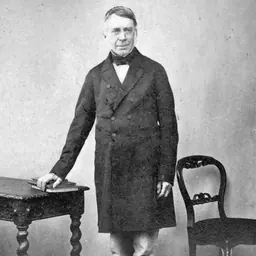
Lived 1838 – 1875 (aged 36). William Winwood Reade was a British philosopher, explorer, anthropologist, historian and writer.
William Winwood Reade (26 December 1838 – 24 April 1875) was a British historian, explorer, novelist and philosopher. His two best-known books, the universal history The Martyrdom of Man and the novel The Outcast (1875), were included in the Thinker's Library. Reade published one novel under the pseudonym Francesco Abati.
Biography
Early life Born in Perthshire, Scotland in 1838, William Winwood Reade was a "scion of a wealthy, landed family". He took after his uncle, Charles Reade, who was a novelist. Having failed at Oxford University and, despite having composed two novels, "failed in any conventional sense as a novelist", Reade decided to begin geographical exploration.
In 1863 Reade became a member of the newly created Anthropological Society of London (ASL), led by James Hunt, a conservative Christian and defender of slavery. Reade was attracted to Hunt's goal to further a "science of man", but he soon found himself debating Hunt during meetings on a number of important issues. Most notably, Reade challenged Hunt’s thesis that black Africans ought to be classified as a distinct species ("polygenism"), and he argued that the degenerate state of the African people was due to disease and climate. Reade also questioned the feasibility of converting Africans to orthodox Christianity, citing the African practice of polygamy as a major barrier. The rift between Reade and Hunt ultimately led to him being forced to resign from the Council of the ASL in 1865. Undaunted, Reade went back along his previous route and this time got permission to enter the Ashanti Empire. He traveled along the Niger, but as the source was inaccessible due to native wars, he went to the "gold mines of the Bouri", an area never explored by a European. Darwin subsequently used information given by Reade for his publication The Descent of Man (1871).
Soon after Reade's return, he published his The African Sketch-Book (1873), an account of his travels that also recommended greater British involvement in West Africa. Reade returned to Africa in 1873 to serve as a correspondent for the Ashanti War, but died not long after. He was buried in Ipsden churchyard, Oxfordshire, close to the family home.
The Martyrdom Of Man (1872) The Martyrdom of Man (1872)—- whose summary line reads "From Nebula to Nation"—- is a secular, "universal" history of the Western world. Structurally, it is divided into four "chapters" of approximately 150 pages each: the first chapter, "War", discusses the imprisonment of men's bodies, the second, "Religion", that of their minds, the third, "Liberty", is the closest to a conventional European political and intellectual history, and the fourth, "Intellect", discusses the cosmogony characteristic of a "universal history". He uses it to advance the philosophy of political liberalism and social Darwinism. The final section of the book provoked enormous controversy due to Reade's "outspoken attack on Christian dogma" and the book was condemned by several magazines. In 1872 William Gladstone, the British Prime Minister, denounced The Martyrdom of Man as one of several "irreligious works" (the others included work by Auguste Comte, Herbert Spencer, and David Friedrich Strauss).
Reception and influence The book's initial reception was negative.
Cecil Rhodes, an English-born South African politician and businessman, said that the book "made me what I am". Harry Johnston, George Orwell, Susan Isaacs, A. A. Milne and his son Christopher Robin, and Michael Foot. Reade is also referenced in C. S. Lewis's third novel of his Space trilogy, That Hideous Strength, and is linked by the narrator rather disparagingly to "ideas which were out of date and had been crude even in their prime" of other writers and thinkers such as Ernst Haeckel and Joseph McCabe. In Alaisdair Gray's Poor Things, Bella Baxter is told that Martyrdom of Man proves the view that "cruelty to the helpless will never end as the healthy live by trampling these down".
Works (1859). Charlotte and Myra: A Puzzle in Six Bits. (1860). Liberty Hall, Oxon. (A Novel) (1861). The Veil of Isis or Mysteries of the Druids. The Druids. Druidism in Rustic Folklore. Druidism in the Emblems of Freemasonry. Druidism in the Ceremonies of the Church Of Rome. Rites And Ceremonies Of The Druids. Vestiges Of Druidism. The Destruction Of The Druids. Priestesses Of The Druids – Pamphlet. (1864). Savage Africa. (1865). See-Saw: A Novel (Written under the pseudonym Francesco Abati). (1872). The Martyrdom of Man. (1873). African Sketch-Book. (1874). The Story of the Ashantee Campaign. (1875). The Outcast. (1972). Religion in History.
Don’t just read it —
keep it.
Full-length biographies made to live with: read them, listen on the way to work, watch them tonight.
- E-book
- Audio
- Video
Instant download · yours to keep · every purchase keeps this site free
Important facts
People in William Winwood Reade's life
Named in this biography and alive at the same time




Related people
Same field, nearest in time


Contemporaries
People whose lives overlapped William Winwood Reade's
Frequently asked questions
Who was William Winwood Reade?
British historian (1838–1875)
When was William Winwood Reade born?
William Winwood Reade was born on 26 December 1838 in Scotland.
When did William Winwood Reade die?
William Winwood Reade died on 24 April 1875.
What was William Winwood Reade's occupation?
William Winwood Reade was a philosopher, explorer, anthropologist, historian and writer.
What nationality was William Winwood Reade?
William Winwood Reade was British.
Sources & further reading
· Wikipedia: William Winwood Reade
· DBpedia: William Winwood Reade
Cite this page
APA: Biography.guide. (2026). William Winwood Reade. https://biography.guide/william-winwood-reade/
MLA: "William Winwood Reade." Biography.guide, https://biography.guide/william-winwood-reade/.
Chicago: "William Winwood Reade." Biography.guide. https://biography.guide/william-winwood-reade/.
Data last updated: 2026-09-20 · Spot an error? Report a correction.
Page generated 2026-09-27 05:21 UTC