
About William Winniett
Lived 1793 – 1850 (aged 57). William Winniett was a naval officer.
Sir William Robert Wolseley Winniett (2 March 1793 4 December 1850) was a Royal Navy officer and colonial administrator who served as the governor general of Gold Coast at Cape Coast Castle. He worked to abolish the Atlantic slave trade on the Slave Coast of West Africa.
Royal Navy
Winniett joined the Royal Navy at Halifax, Nova Scotia in 1807 on . While aboard Cleopatra, under the command of Samuel Pechell, Winniett fought in the action of 22 January 1809 and the Invasion of Martinique (1809).
He also served on the flagship under Sir Alexander Cochrane, Commander-in-Chief, North American Station (1814-1815). During that time, Winniett was involved in the Battle of Lake Borgne, in Louisiana in December 1814 and the Battle of New Orleans on 8 January 1815. Cochrane created a proclamation that invited Black slaves to freedom by joining the crews of the Royal Navy.
On 24 December 1818, he was assigned to Morgiana, which was on the African coastal patrol to suppress the slave trade. He commanded (1837), Firefly (1839) and Lightning (1842). He went to the capital of Abomey (Benin) to try to abolish the slave trade (1847). (The Slave Trade Act 1807 outlawed the slave trade in the British Empire and the Slavery Abolition Act 1833 outlawed slavery altogether.)
In 1848 he led the West India Regiments and others to stop the murdering of Africans and Europeans by deposing Kaku Aka, the king of Amanahia [Apollonia] (also known as Kwaku Akka).
With Thomas Birch Freeman as his secretary, that same year, he went to persuade Ghezo, King of the Dahomey, in present-day Benin to stop the slave trade and abolish human sacrifice. (At the time Dahomey exported 8,000 slaves a year.) In September 1848, he visited the Ashanti Empire to convince Asantehene Kwaku Dua I to abolish human sacrifice.
He was knighted by Queen Victoria on 29 June 1849 at Buckingham Palace.
He died 4 December 1850 at Jamestown/Usshertown, Accra and was interred in the cemetery at Fort Christiansborg (Ebenezer Presbyterian Church, Osu).
Family Winniett was the grandchild of Joseph Winniett (d. 1789) and the son of William Winniett (d.1824), both of Annapolis Royal, Nova Scotia. His family had seven boys and six girls. His great aunt Anne Cosby was married to Nova Scotia Council member Major Alexander Cosby. She freed her three black slaves in 1788.
He was the son-in-law of William Fenwick Williams.
Winniett was also the maternal grandson of New York Loyalist Joseph Totten, from whose family Tottenville, Staten Island was named.
Legacy The Royal Nova Scotia Historical Society placed a memorial at Sir Winniett's home in Annapolis Royal, Nova Scotia in 1880.
Don’t just read it —
keep it.
Full-length biographies made to live with: read them, listen on the way to work, watch them tonight.
- E-book
- Audio
- Video
Instant download · yours to keep · every purchase keeps this site free
Important facts
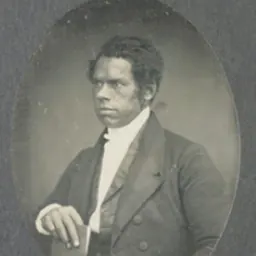
People in William Winniett's life
Named in this biography and alive at the same time




Related people
Same field, nearest in time




Contemporaries
People whose lives overlapped William Winniett's




Frequently asked questions
Who was William Winniett?
Royal Navy officer and colonial administrator
When was William Winniett born?
William Winniett was born on 2 March 1793.
When did William Winniett die?
William Winniett died on 4 December 1850.
What was William Winniett's occupation?
William Winniett was a naval officer.
Sources & further reading
· DBpedia: William Robert Wolseley Winniett
Cite this page
APA: Biography.guide. (2026). William Winniett. https://biography.guide/william-winniett/
MLA: "William Winniett." Biography.guide, https://biography.guide/william-winniett/.
Chicago: "William Winniett." Biography.guide. https://biography.guide/william-winniett/.
Data last updated: 2026-09-20 · Spot an error? Report a correction.
Page generated 2026-09-27 05:22 UTC