
William Williams
Federal commissioner of immigration for the Port of New York
About William Williams
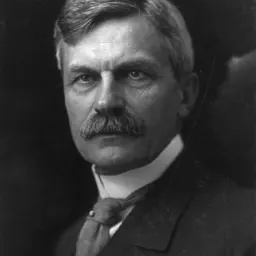
Lived 1862 – 1947 (aged 84). William Williams was an American civil servant and lawyer.
William Williams (June 2, 1862 – February 8, 1947) was the federal commissioner of immigration for the Port of New York, from 1902 to 1905 and again, from 1909 to 1914. His office was on Ellis Island, which was the location of the nation's most important immigrant inspection station.
Early life The son of Charles Augustus Williams (1829-1899), a prominent merchant in the whaling industry, and Elizabeth Hoyt Williams, William C. Williams was born New London, Connecticut, on June 2, 1862. He had one sister, Mary Hoyt Williams Crozier (1864-1955), who became the wife of Gen. William Crozier, the noted artillerist and inventor. Williams grew up in Connecticut, Hawaii, Japan and Germany. He attended college in Germany and the United States. He graduated from Yale University with a bachelor's degree and earned a law degree from Harvard University.
Career In the 1890s, he briefly served the United States in the consular service, and served as a soldier during the Spanish–American War until he contracted typhoid fever in 1898. The Act specifically prohibited any "lunatic, idiot, or any person unable to take care of himself or herself without becoming a public charge." The public charge clause was intentionally vague to allow the examining officer's to discriminate at their own discretion. As the eugenics movement and popular fears regarding race escalated, a new law was passed (Immigration Act of 1891) that rephrased the public charge clause to be a matter of likelihood of becoming a public charge (or LPC). When William Williams began his position as Commissioner of Ellis Island, he found that the surgeon general had only assigned eight U.S. PHS physicians and a single steward to conduct the physical examination of the 497,791 steerage passengers and 68,192 cabin passengers. Even by 1905, this number only increased to sixteen physicians at Ellis Island. These physicians conducted the line examinations, operated the immigrant hospital, and conducted the examinations of cabin passengers aboard incoming ships. Despite this, PHS physicians prided themselves on conducting medical exams with efficiency and impartiality.
alt=Williams (right) with President William Howard Taft (middle) and Secretary of Commerce Charles Nagel (left) on Ellis Island in 1910. Williams (right) with President William Howard Taft (middle) and Secretary of Commerce Charles Nagel (left) on Ellis Island in 1910. Williams was quite vocal about his goals for immigration policy at Ellis Island. In his Annual Report of 1904, he expressed his belief that the U.S. was "receiving too many immigrants whose physical condition is poor." He argued that the LPC clause did not exclude enough, saying that "it is obviously impossible to exclude on this ground all persons whose physical condition is poor" and he urged officials to exclude all cases of immigrants with "poor physique".
Such measures were bitterly opposed by immigrants' rights organizations and by those who favored less restrictive immigration policy. Groups such as the Jewish Immigrant Aid Society in New York proved to be direct opponents for Williams' administrative goals by appealing every case in which a Jewish immigrant was excluded. Many more societies focuses on appealing to Congress to make immigration inspections more lax. Occasionally, charges would be made against immigration inspectors such as Williams, bringing allegations of cruelty and misfeasance against them, an action taken by the New York Journal. Williams was unimpeded however, being completely exonerated from such charges.
While the above charges proved fruitless, Williams' goal of enhancing administrative efficiency and science-based social control was more frequently undermined by the PHS officials working for him at Ellis Island, who often refused to be agents of exclusion. At Ellis Island and many other ports, these physicians were very reluctant to go beyond the role of physicians making medical diagnoses by involving themselves in the decision to debar certain types of immigrants.
William Williams died in New York City on February 8, 1947.
Don’t just read it —
keep it.
Full-length biographies made to live with: read them, listen on the way to work, watch them tonight.
- E-book
- Audio
- Video
Instant download · yours to keep · every purchase keeps this site free
Important facts
People in William Williams's life
Named in this biography and alive at the same time

Related people
Same field, nearest in time





Contemporaries
People whose lives overlapped William Williams's


Frequently asked questions
Who was William Williams?
federal commissioner of immigration for the Port of New York (1862–1947)
When was William Williams born?
William Williams was born on 2 June 1862 in New London.
When did William Williams die?
William Williams died on 8 February 1947 in New York City.
What was William Williams's occupation?
William Williams was a civil servant and lawyer.
What nationality was William Williams?
William Williams was American.
Sources & further reading
· DBpedia: William Williams (commissioner)
Cite this page
APA: Biography.guide. (2026). William Williams. https://biography.guide/william-williams-civil-servant/
MLA: "William Williams." Biography.guide, https://biography.guide/william-williams-civil-servant/.
Chicago: "William Williams." Biography.guide. https://biography.guide/william-williams-civil-servant/.
Data last updated: 2026-09-26 · Spot an error? Report a correction.
Page generated 2026-09-27 05:15 UTC