
William Warrington
British stained glass artist
About William Warrington
Lived 1796 – 1869 (aged 72–73). William Warrington was a glass artist.
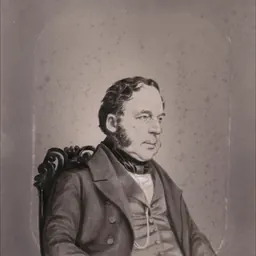
William Warrington (1796–1869) was an English maker of stained glass windows. His firm, operating from 1832 to 1875, was one of the earliest of the English Medieval revival and served clients such as Norwich and Peterborough Cathedrals. Warrington was a historian of medieval glass and published an illustrated book The History of Stained Glass.
Biographical Window from St Mary's Church, Westwell, Kent, depicting three saints and demonstrating Warrington's distinctive painting. Signed and dated 1858 William was one of at least five children born to William Warrington (born 1768, New Romney) and his wife Sarah Wren. He was baptised at New Romney on 4 Mar 1796. One of his nephews married a sister of John Surtees's patrilineal great-grandfather.
In his youth, Warrington first trained with his father as a painter of armorial shields. He then moved for a time into the stained glass workshop of Thomas Willement, one of the earliest such workshops to be of high renown. In 1832 Warrington established his own stained glass company, where he produced windows that well satisfied the rising fashion of Gothic Revival and in which his own skills as an armorial painter were utilised in the production of domestic as well as ecclesiastical windows.
From studying existent ancient windows and emulation of the leading techniques of the master Thomas Willement, Warrington developed a style which allowed him to create windows strongly resembling those of the 13th and 14th centuries in appearance. His windows became the preferred choice of the architect Augustus Welby Northmore Pugin who used them in most of his earliest churches, between 1838 and 1842.
But Pugin was soon to fall out with Warrington, claiming “The Glass-Painters will shorten my days, they are the greatest plague I have. The reason I did not give Warrington the window at the hospital is this. He has lately become so conceited and got nearly as expensive as Willement.” Warrington produced drawings of windows to be used by Pugin in the Houses of Parliament, but the firms that Pugin employed were Ballantine and Allen and Hardman & Co.
In 1848 Warrington published The History of Stained Glass, from the Earliest Period of the Art to the Present Time . The book came out in a folio edition with coloured lithographs illustrating British stained glass windows from the 11th to the 15th centuries. However Warrington expressed his dislike of the glass of the centuries that followed as being "a misconception and misapplication of this art."
Among Warrington's significant commissions was the tiered arrangement of windows for the Eastern Apse of Norwich Cathedral. He also designed for Ely Cathedral, where his work may still be seen, both installed and on display in the Stained Glass Museum.
After Warrington's death in 1869, the firm continued until 1875.
Style
Warrington was able to reproduce closely the geometric and foliate backgrounds of the 13th century and create pictorial rondels composed of small pieces of glass that gave a similar impression to the Medieval originals, though tending to let through more light and have less luminosity, because the nature of the glass was less flawed and therefore less refractive. Warrington's windows often contain a background comprising a distinctive pattern of little red and blue diagonal checks which was copied from medieval originals. Many of Warrington's Gothic Revival windows have a pleasant simplicity about them, the stylised foliage which takes up much of the window space being less heavy in appearance than some of his rivals, such as Clutterbuck, and based more closely upon recognisable plants.
The balance and arrangements of pictorial scenes within their formal background shows Warrington as a much more skilful designer than his teacher Willement, in whose windows the overall arrangement has a fairly arbitrary quality. Warrington's figurative painting strives towards the Medieval in its forms, which are somewhat elongated and elegant, with simply-painted drapery falling in deep folds in such a way that line and movement is emphasised in the pictorial composition. His painting of the details, particularly of faces, is both masterly and exquisite. Towards the end of his career he also designed windows in a more painterly and less Gothic manner to suit changing tastes.
List of works
England Thornton Hall, Thornton, Buckinghamshire Ely Cathedral, Ely, Cambridgeshire St Peter's, Heversham, Cumbria St George's Church, Brede, East Sussex St Andrew's Church, Hove, East Sussex (Raising of Lazarus and Jairus' daughter) St Mary's Church, Salehurst, East Sussex (The Gospel) St John's Church, Deptford, Greater London (Presentation of Christ) St Margaret's Church, Addington, Kent (Ascension of Jesus) Mount St Bernard Abbey, Coalville, Leicestershire St Andrew's Church, Field Dalling, Norfolk Norwich Cathedral, Norwich, Norfolk Church of St Mary Magdalene, Albrighton, near Bridgnorth, Shropshire St John the Divine, Horninglow, Staffordshire (Life of Saint John the Evangelist) All Saints' Church, Leamington Spa, Warwickshire (Saint James and John the Evangelist, 1900) St Mary's College, New Oscott, Warwickshire (1838) St Mary's RC Church, Sutton Coldfield, Warwickshire (1838) All Saints' Church, Lindfield, West Sussex
Canada St Anne's Chapel, Fredericton, New Brunswick Basilica of St. John the Baptist, St John's, Newfoundland and Labrador Presentation Convent, St John's, Newfoundland and Labrador
Republic of Ireland Lissadell House, Lissadell, County Sligo
Other early 19th-century studios
Thomas Willement William Wailes Charles Edmund Clutterbuck Hardman & Co.
Don’t just read it —
keep it.
Full-length biographies made to live with: read them, listen on the way to work, watch them tonight.
- E-book
- Audio
- Video
Instant download · yours to keep · every purchase keeps this site free
Important facts
People in William Warrington's life
Named in this biography and alive at the same time



Related people
Same field, nearest in time


Contemporaries
People whose lives overlapped William Warrington's






Frequently asked questions
Who was William Warrington?
British stained glass artist
When was William Warrington born?
William Warrington was born in 1796.
When did William Warrington die?
William Warrington died in 1869.
What was William Warrington's occupation?
William Warrington was a glass artist.
Sources & further reading
· Wikipedia: William Warrington
Cite this page
APA: Biography.guide. (2026). William Warrington. https://biography.guide/william-warrington/
MLA: "William Warrington." Biography.guide, https://biography.guide/william-warrington/.
Chicago: "William Warrington." Biography.guide. https://biography.guide/william-warrington/.
Data last updated: 2026-09-20 · Spot an error? Report a correction.
Page generated 2026-09-27 05:30 UTC