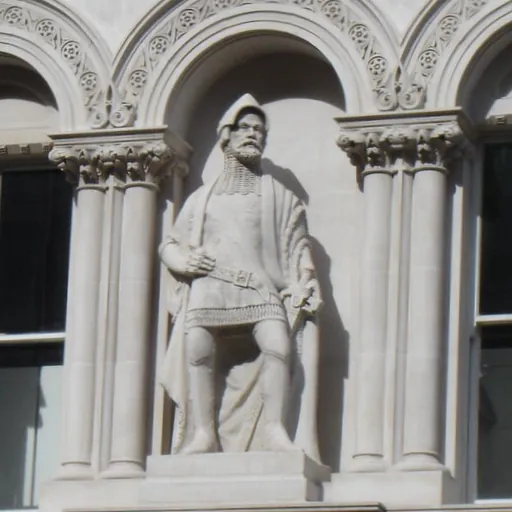
About William Walworth
Lived 1322 – 1385 (aged 62–63). William Walworth was a British politician.
Sir William Walworth (died in 1385) was an English nobleman, politician, and a member of the Fishmonger's Guild in London. During his years as a political figure, he served twice as Lord Mayor of London (1374–75 and 1380–81) which led to much of his fame from today as the man who killed Wat Tyler (Leader of the Peasants' Revolt of 1381). This act was responsible for massively hindering the revolt.
Career
Guild career William Walworth was a member of the Fishmongers Guild in London before he entered politics. We know that he would have been well off due to this position as a fishmonger. A fishmonger is not someone who fishes, but rather, they are in control of the sale of fish which makes them comparable to a modern grocer. The guild had a monopoly on selling fish which would have proven to be lucrative for many. Additionally, because the medieval church did not allow eating meat on many Fridays of the year for fasting purposes, they would get significantly more sales on these days.
Walworth's career as a fishmonger is a setup for his life after. Here, he gained a lot of power as a successful merchant which would put him in a gray area between being upper class and lower class. There is not a clear way to describe who he was which complicates the traditional medieval narrative of the upper class vs. the lower class.
Political career Walworth was an apprentice under John Lovekyn (also a member of the Fishmongers Guild) whom he succeeded as Alderman of Bridge ward in 1368 after his death. This opportunity is allowing Walworth to gain power beyond his career as a fishmonger. One side effect of this was Walworth's marriage to Lovekyn's widow. Whether this was a financial decision or not is unclear, but this is a possibility due to both of their situations — she would have been left Lovekyn's business after his death and Walworth was a growing member of the economy who would seek an opportunity like that.
This rise in the ranks made him a more prominent figure in London politics. Walworth became Sheriff of London in 1370 and Lord Mayor of London in 1374. He was a Member of Parliament for the City of London in 1371, 1376, 1377, and 1383, as one of the two aldermanic representatives of the city. As Lord Mayor of London, Walworth would have had more power than he did as a fishmonger and his wealth would have grown with this power. What some scholars would consider the origins of the modern state were beginning to form and with that was a growing focus on a centralized set of powers. Additionally, the Plague had swept through Europe in the middle of the 14th century and caused quite a few issues. The population was a fraction of what it used to be which meant that those in power needed more money from each individual person to fund their various wars, buildings, etc. This led to Walworth's most famous exploit — his encounter with Wat Tyler (the leader of the revolt) during the English peasants' revolt of 1381 in his second term as Lord Mayor.
Assassination of Wat Tyler In June of that year, when Tyler and his followers entered South London, Walworth defended London Bridge against their revolt. During this encounter, Walworth killed Tyler in front of his people, but the method that Walworth used to kill Tyler is debated because the accounts are messy to the point that one scholar went on to compare it to the assassination of John F. Kennedy. JFK's assassination is notorious for multiple, contradicting accounts and a number of unanswered questions. Some scholars would suggest that Walworth slashed him heroically and he fell over half dead while others would suggest an alternate story that portrays Tyler and the other peasants as the heroes.
Walworth Memorabilia The Fishmongers Guild considers him to be a hero and uses his legacy to their benefit, and he invariably figured in the pageants prepared by them when one of their members attained the mayoralty. Additionally, there were a number of references and commemorative artpieces made in his honor years after his death in 1385:
1592 — Walworth becomes a favorite hero in popular tales, and appeared in Richard Johnson's Nine Worthies of London 1603 — A survey of London and Westminster was written which depicts him as a hero 1868 — A statue is erected of him at the Holborn Viaduct that has him posed heroically 1914 — One of the six houses at the Kingston Grammar School bears Walworth's name Unknown Year — A statue of William Walworth is erected in the Fishmonger's Guild Hall that has him posed with the knife that he used to kill Wat Tyler
Don’t just read it —
keep it.
Full-length biographies made to live with: read them, listen on the way to work, watch them tonight.
- E-book
- Audio
- Video
Instant download · yours to keep · every purchase keeps this site free
Important facts
People in William Walworth's life
Named in this biography and alive at the same time

Related people
Same field, nearest in time



Contemporaries
People whose lives overlapped William Walworth's


Frequently asked questions
Who was William Walworth?
Lord Mayor of London (1322-1385)
When was William Walworth born?
William Walworth was born in 1322 in London.
When did William Walworth die?
William Walworth died in 1385 in London.
What was William Walworth's occupation?
William Walworth was a politician.
What nationality was William Walworth?
William Walworth was British.
Sources & further reading
Cite this page
APA: Biography.guide. (2026). William Walworth. https://biography.guide/william-walworth/
MLA: "William Walworth." Biography.guide, https://biography.guide/william-walworth/.
Chicago: "William Walworth." Biography.guide. https://biography.guide/william-walworth/.
Data last updated: 2026-09-23 · Spot an error? Report a correction.
Portrait: Wikimedia Commons · author & licence
Page generated 2026-09-27 05:04 UTC