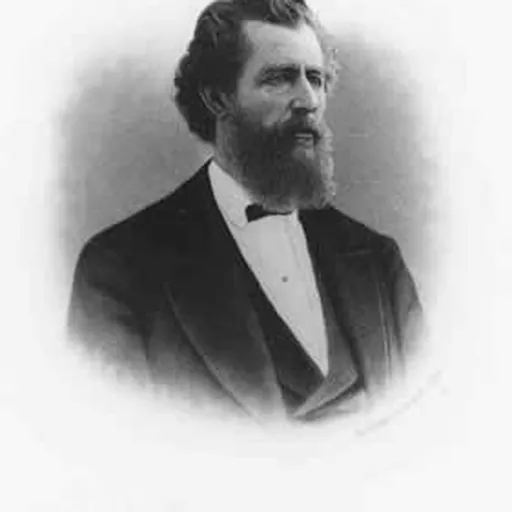
About William W. Boyington
Lived 1818 – 1898 (aged 80). William W. Boyington was an American architect and politician.
William Warren Boyington (July 22, 1818 – October 16, 1898) was an American architect who designed several notable structures in and around Chicago, Illinois. He was also mayor of Highland Park, Illinois.
History Originally from Massachusetts, W.W. Boyington studied engineering and architecture in the State of New York. After this, he practiced there and served in the New York State Legislature before he decided to settle and work in the emerging metropolis of Chicago, Illinois, in 1853. Many of his buildings were constructed before the Great Chicago Fire of 1871 and destroyed by it; however, the Chicago Water Tower and pumping station of 1869 survived and have become well-loved landmarks.
Works Works accredited to W.W. Boyington include: The First LaSalle Street Station, 1867-71 (cost $225,000 Chicago Water Tower and pumping station, 1869 Second Presbyterian Church, 1888 (since 1987 the Cornerstone Building) in Peoria Illinois (cost $50,000) The New State Capitol Building in Springfield, Illinois the first University of Chicago located at 34th Street and Cottage Grove Avenue (1859, 1863, 1865* all demolished) the first Sherman House located at Clark and Randolph Streets 1859, (demolished in 1910) residence for Washington and Jane Smith, 1870 (cost $75,000 ), demolished the entrance gate of Rosehill Cemetery the old Second Baptist Church of Chicago (now the Aiken Institute) the 1864 Democratic Convention Hall the old Chicago Board of Trade Building at the Head of LaSalle Street, 1885 (demolished in 1928 for construction of the present Holabird and Root Building) and the Windsor Hotel of Denver, Colorado the Terrace Hill Homestead (Iowa's Governor's Mansion) the Hegeler Carus Mansion of LaSalle, Illinois Heaney's Block in Rochester, Minnesota, 1866 (destroyed by fire 1917)\ the Milikin Bank Building (demolished) in Decatur, Illinois the Illinois State Building for the 1893 Chicago World's Columbian Exposition (demolished at the end of the fair) the Transfer House, 1896 in Decatur and the Joliet Prison. His Grand Pacific Hotel, 1871, was destroyed by the Great Chicago Fire as it was being completed but was rebuilt according to the original plans in 1873.
Death Boyington died on October 16, 1898, in Highland Park, where he had moved in 1874 after having lost two residences in Chicago to fire in quick succession (the first one as a result of the Great Chicago Fire). While in Highland Park he served two successive terms as mayor. He is buried at Rosehill Cemetery on Chicago's north side.
Gallery
Don’t just read it —
keep it.
Full-length biographies made to live with: read them, listen on the way to work, watch them tonight.
- E-book
- Audio
- Video
Instant download · yours to keep · every purchase keeps this site free
Important facts
People in William W. Boyington's life
Named in this biography and alive at the same time

Related people
Same field, nearest in time



Contemporaries
People whose lives overlapped William W. Boyington's





Frequently asked questions
Who was William W. Boyington?
American politician and architect (1818—1898)
When was William W. Boyington born?
William W. Boyington was born on 22 July 1818 in Southwick.
When did William W. Boyington die?
William W. Boyington died on 16 October 1898 in Highland Park.
What was William W. Boyington's occupation?
William W. Boyington was an architect and politician.
What nationality was William W. Boyington?
William W. Boyington was American.
Sources & further reading
· Wikipedia: William W. Boyington
· DBpedia: William W. Boyington
Cite this page
APA: Biography.guide. (2026). William W. Boyington. https://biography.guide/william-w-boyington/
MLA: "William W. Boyington." Biography.guide, https://biography.guide/william-w-boyington/.
Chicago: "William W. Boyington." Biography.guide. https://biography.guide/william-w-boyington/.
Data last updated: 2026-09-21 · Spot an error? Report a correction.
Portrait: Wikimedia Commons · author & licence
Page generated 2026-09-27 05:00 UTC