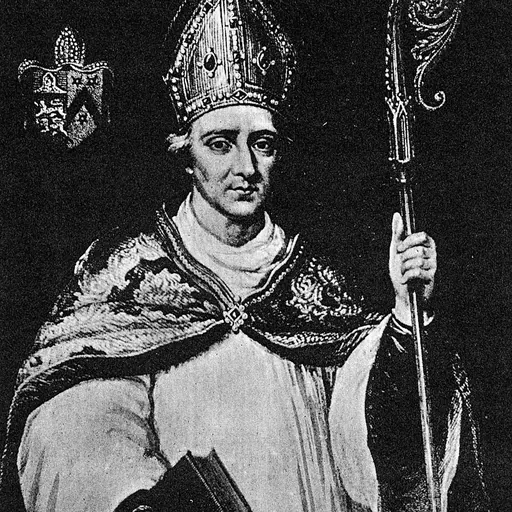
About William Smyth
Lived 1460 – 1514 (aged 53–54). William Smyth was a catholic priest and catholic bishop.
William Smyth (or Smith) ( – 2 January 1514) was Bishop of Coventry and Lichfield from 1493 to 1496 and then Bishop of Lincoln until his death. He held political offices, the most important being Lord President of the Council of Wales and the Marches. He became very wealthy and was a benefactor of a number of institutions. He was a co-founder of Brasenose College, Oxford and endowed a grammar school in the village of his birth in Lancashire.
Early life and education Smyth was born in the south Lancashire village of Farnworth in the parish of Prescot, which now falls within the town of Widnes in the Borough of Halton. Smyth was the fourth son of Robert Smyth of Peel Hall. He was allegedly brought up during his youth at nearby Knowsley Hall, the home of Thomas Stanley, 1st Earl of Derby. At this time Stanley was married to his second wife Lady Margaret, Countess of Richmond. Lady Margaret was the mother of the future Henry VII by her previous marriage to Edmund Tudor, 1st Earl of Richmond, and she was to have an important influence in Smyth's life.
Smyth went to the University of Oxford. His college is uncertain, being either Oriel or Lincoln, or both in succession. In 1476 he gained the degree of bachelor of canon law and by 1492 he had received the degree of bachelor of civil law. and on 14 June 1492 he was instituted as rector of Cheshunt, Hertfordshire. It is not possible to be sure about all his preferments because of his common name.
Political life On 20 September 1485 Smyth gained a place in the Court of Chancery as keeper of the hanaper which gave him a salary for life. In 1486 he obtained a grant for the custody of the daughters of Edward IV. from which the renowned Captain John Smith also claimed his lineage. He purchased land including a footpath from the village to the church to allow entry for his tenants by a separate door to avoid contact with the residents of Farnworth at the time of the plague. In 1507 he made an endowment of £350 to found a grammar school in Farnworth, the village of his birth.
Also in 1507 Smyth founded a fellowship in Oriel College, Oxford, and gave manors to Lincoln College. Around the same time he and Sir Richard Sutton set out to found a new college in Oxford. They rebuilt Brasenose Hall, added other existing halls to it, and having obtained a charter in 1512, called it "The King's haule and college of Brasennose". This is now Brasenose College. Smyth's intention at the college was to benefit clergy from the north of England. The twelve fellows of the college were to have been born in the diocese of Coventry and Lichfield, or to have come from Lancashire, and particularly from the area of his birthplace. He gave to the college his lands of Cold Norton and, by his will, a considerable legacy of lands, plate, vestments, manuscripts and books.
Reputation and legacy Smyth's ecclesiastical, legal and political duties resulted in his having a very busy life, only at times being resident in his diocese. He was very wealthy and was described by Hugh Latimer as being one of the "unpreaching prelates"; no sermons by him survive. He indulged in nepotism. Matthew Smyth was the first principal of Brasenose College, a William Smyth was archdeacon of Northampton and then of Lincoln and another William Smyth was appointed to St John's Hospital at Lichfield.
William Smyth died on 2 January 1514 at Buckden Palace, now in Cambridgeshire, one of the residences of the bishops of Lincoln. In addition to bequests to Brasenose College and Lincoln Cathedral, he made provision for a hospital at Banbury. He is buried in Lincoln Cathedral.
Don’t just read it —
keep it.
Full-length biographies made to live with: read them, listen on the way to work, watch them tonight.
- E-book
- Audio
- Video
Instant download · yours to keep · every purchase keeps this site free
Important facts
People in William Smyth's life
Named in this biography and alive at the same time


Related people
Same field, nearest in time


Contemporaries
People whose lives overlapped William Smyth's


Frequently asked questions
Who was William Smyth?
Bishop of Coventry and Lichfield
When was William Smyth born?
William Smyth was born in 1460 in Farnworth.
When did William Smyth die?
William Smyth died on 2 January 1514 in Buckden Towers.
What was William Smyth's occupation?
William Smyth was a catholic priest and catholic bishop.
Sources & further reading
Cite this page
APA: Biography.guide. (2026). William Smyth. https://biography.guide/william-smyth-catholic-priest/
MLA: "William Smyth." Biography.guide, https://biography.guide/william-smyth-catholic-priest/.
Chicago: "William Smyth." Biography.guide. https://biography.guide/william-smyth-catholic-priest/.
Data last updated: 2026-09-22 · Spot an error? Report a correction.
Portrait: Wikimedia Commons · author & licence
Page generated 2026-09-27 05:04 UTC