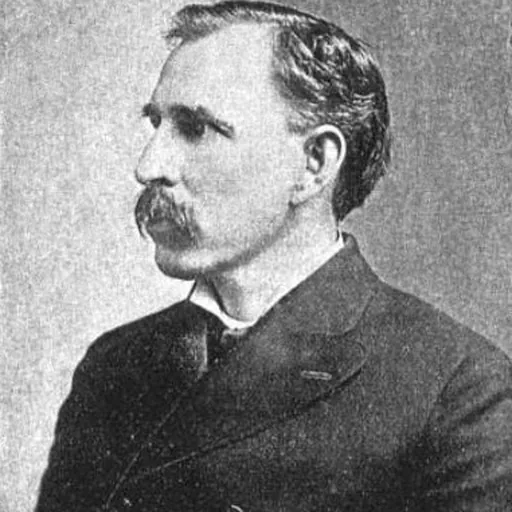
About William S. Taylor
Lived 1853 – 1928 (aged 74). William S. Taylor was an American politician, judge and lawyer.
William Sylvester Taylor (October 10, 1853 – August 2, 1928) was an American politician who was the 33rd governor of Kentucky. He was initially declared the winner of the disputed gubernatorial election of 1899, but the Kentucky General Assembly, dominated by the Democrats, reversed the election results, giving the victory to his Democratic opponent, William Goebel. Thus, Taylor served only 50 days as governor.
A poorly educated but politically astute lawyer, Taylor began climbing the political ladder by holding local offices in his native Butler County. Though he was a Republican in an overwhelmingly Democratic state, divisions in the majority party resulted in his election as Attorney General of Kentucky on a ticket with the Commonwealth's first Republican governor, William O. Bradley. Four years later, Taylor was elected in 1899 to the governorship.
When the General Assembly reversed the election results after a dispute, incensed Republicans armed themselves and descended on Frankfort. Taylor's Democratic opponent, William Goebel, was shot and died after being sworn in on his deathbed. Taylor exhausted his finances in a legal battle with Goebel's running mate J. C. W. Beckham over the governorship. Taylor ultimately lost the battle, and was implicated in Goebel's assassination. He fled to neighboring Indiana. Despite eventually being pardoned for any wrongdoing, he seldom returned to Kentucky. Taylor died in Indianapolis, Indiana in 1928.
Early life William Taylor was born October 10, 1853, in a log cabin on the Green River, about five miles from Morgantown, Kentucky. He was the first child of Sylvester and Mary G. (Moore) Taylor. He spent his early years working on the family farm, and did not attend school until age fifteen; thereafter, he attended the public schools of Butler County and studied at home. In 1874, he began teaching, specializing in mathematics, history, and politics.
Taylor became a member of the Republican Party in 1884. In 1886, he was chosen to represent the third district on the Republican state central committee. The board was to be appointed by the General Assembly, and there were no requirements that its composition be bi-partisan. The law passed the General Assembly, but was vetoed by Republican governor William O. Bradley. The General Assembly promptly overrode the veto. The measure was adjudicated by the Kentucky Court of Appeals and found to be constitutional.
The Republicans were initially no less divided than the Democrats. Senator William J. Deboe backed Taylor for governor. Governor Bradley backed Judge Clifton J. Pratt of Hopkins County, and the Republicans of Central Kentucky backed state auditor Sam H. Stone. Taylor organized a strong political machine and seemed in a solid position to obtain the nomination. Bradley was incensed that the party would not unite behind his candidate and boycotted the convention. Taylor unsuccessfully tried to woo him back with a promise to make his nephew, Edwin P. Morrow, secretary of state. Because Taylor represented the western part of the state, the so-called "lily white" branch of the Republican Party, black leaders also threatened not to support him; Taylor responded by hiring one of the black leaders his permanent secretary, and promised to appoint other black leaders to office if he won the election. Seeing that Taylor's nomination was likely, all the other candidates withdrew, and Taylor won the nomination unanimously.
During the campaign, Taylor was attacked by Democratic opponents because of his party's support from black voters and its ties to big business, including the Louisville and Nashville Railroad. They also charged that Governor Bradley had run a corrupt administration.
Ex-Confederates were usually a safe voting bloc for the Democrats, but many of them deserted Goebel because he had, in 1895, while cashing a check, met and quickly shot his main local political opponent, the esteemed banker and former Confederate colonel John Sandford, in what he declared was an act of self-defense, but some see as more of an (illegal) duel, as both fired pistols at each other. Sandford, who received a fatal head wound, was a grandson of Revolutionary War General and US Congressman Thomas Sandford. On the other hand, blacks had historically been a safe bloc for the Republicans, but Taylor had alienated many of them by not strongly opposing the Separate Coach Bill, which would have racially segregated railroad facilities. Goebel also risked losing support to minor party candidates. Besides John Y. Brown, the dissenting Democrats' nominee, the Populist Party nominated a candidate, drawing votes from Goebel's populist base. To unite his traditional base, Goebel convinced William Jennings Bryan, a hero to most populists and Democrats, to campaign for him. While Bradley insisted that his motives were to defend his administration, journalist Henry Watterson believed Taylor had promised to support Bradley's senatorial bid if elected. The Democrat-controlled General Assembly challenged the election results. Two of the members of the board had openly campaigned for Goebel, and all three owed their appointments to him, but in a surprising decision, the board voted 2–1 to certify Taylor as the winner. Taylor was inaugurated on December 12, 1899.
Fearing Democrats in the Assembly would "steal" the election, armed men came to Frankfort from various areas of the state, primarily Eastern Kentucky, which was heavily Republican. On January 30, Goebel was shot while entering the state capitol building. Taylor declared a state of emergency and called out the militia. He called a special session of the legislature, holding it in heavily Republican London, Kentucky rather than the capital. Democrats refused to heed the call, and met in Democratic-dominated Louisville instead. They certified the election commission's report that disqualified enough Taylor votes for Goebel to be declared the winner of the election. Shortly after being sworn in as governor, Goebel died from the gunshot wound he had received days earlier.
With Goebel dead, Democrats and Republicans met jointly and drafted a proposal to bring peace. Under terms of the proposal, Taylor and his lieutenant governor, John Marshall, would step down from their offices and be granted immunity from prosecution in the events surrounding the election and Goebel's assassination. The Goebel Election Law would be repealed, and the militia would disperse from Frankfort. Prominent leaders on both sides signed the agreement, but on February 10, 1900, Taylor announced he would not. The legislature convened on February 19, 1900, and agreed to put the election in the hands of the courts.
On March 10, 1900, the circuit court of Jefferson County upheld the General Assembly's actions that certified Goebel as governor. The case was appealed to the Kentucky Court of Appeals, then the court of last resort in Kentucky. On April 6, 1900, the Court of Appeals ruled 6–1 that Taylor had been legally unseated. Taylor appealed to the Supreme Court of the United States, and on May 21, 1900, the Court refused to hear the case. Only Kentuckian John Marshall Harlan dissented from this refusal. With Taylor's legal options exhausted, Goebel's lieutenant governor, J. C. W. Beckham, ascended to the governorship. During his short term as governor, Taylor had done little beyond making a few appointments and issuing a few pardons.
Taylor was indicted as an accessory in the assassination of Goebel. He fled to Indianapolis, where the governor refused to extradite him. At least one attempt to abduct him by force failed in 1901. Despite being pardoned in 1909 by Republican Governor Augustus E. Willson, Taylor seldom returned to Kentucky.
Financially strapped by the costs of challenging the election, Taylor became an insurance executive and practiced law. Shortly after arriving in Indiana, his wife died. In 1912, he briefly returned to Kentucky to marry Nora A. Myers. The couple returned to Indianapolis and had a son together. Taylor died of heart disease on August 2, 1928, and was buried at the Crown Hill Cemetery in Indianapolis.
Don’t just read it —
keep it.
Full-length biographies made to live with: read them, listen on the way to work, watch them tonight.
- E-book
- Audio
- Video
Instant download · yours to keep · every purchase keeps this site free
Important facts
People in William S. Taylor's life
Named in this biography and alive at the same time


Related people
Same field, nearest in time




Contemporaries
People whose lives overlapped William S. Taylor's



Frequently asked questions
Who was William S. Taylor?
American politician, Kentucky, born 1853 (1853–1928)
When was William S. Taylor born?
William S. Taylor was born on 10 October 1853 in Butler County.
When did William S. Taylor die?
William S. Taylor died on 2 August 1928 in Indianapolis.
What was William S. Taylor's occupation?
William S. Taylor was a politician, judge and lawyer.
What nationality was William S. Taylor?
William S. Taylor was American.
Sources & further reading
· Wikipedia: William S. Taylor
· DBpedia: William S. Taylor (Kentucky politician)
Cite this page
APA: Biography.guide. (2026). William S. Taylor. https://biography.guide/william-s-taylor/
MLA: "William S. Taylor." Biography.guide, https://biography.guide/william-s-taylor/.
Chicago: "William S. Taylor." Biography.guide. https://biography.guide/william-s-taylor/.
Data last updated: 2026-09-21 · Spot an error? Report a correction.
Portrait: Wikimedia Commons · author & licence
Page generated 2026-09-27 05:00 UTC