
William Pulgram
Austrian-born American architect
About William Pulgram
Lived 1921 – 2020 (aged 98–99). William Pulgram was an American and Austrian interior designer.
William Leopold Pulgram (January 1, 1921 – April 16, 2020) was an Austrian-born American architect.
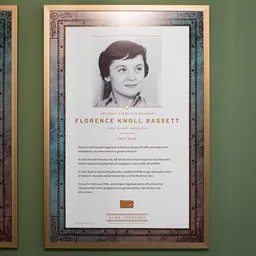
Pulgram, a Holocaust survivor, began his career in the late 1940s, drawing concrete details and wall sections as he worked on construction documents at Finch Alexander. As his career progressed, he began to specialize in corporate interiors, as a number of interior designers did. This esteemed group includes Davis Allen, Florence Knoll, Margaret McCurry, and Margo Grant Walsh. Pulgram's philosophy was that interior design is a continuation of the architecture of the space and needs to be carefully designed and contracted for; he was an advocate for architecture firms moving into the area of commercial interiors. In 1963, he created his own firm – Associated Space Design. The focus of his firm was interiors – he was known for his corporate environments including Coca-Cola and Black & Decker. His book, Designing the Automated Office, focused on how technology was changing the office environment and the need to develop strategies in design to incorporate equipment in the workplace. Pulgram believed in a holistic approach to office design. Balancing physical requirements to meet human needs with aesthetic ambience to stimulate human aspirations was his focus. He worked tirelessly throughout his career to create interior contract documents – which are still used today. He was considered an expert in workplace design by the end of his career.
By the time that William arrived in the United States, his brother, Ernst, had already made it to America and served in the United States Army until he was released on medical leave. Upon arrival, William got a job in Atlanta, GA at a department store named Davison-Paxon. By 1943, Pulgram decided to enlist in the Army to help fight against the Nazi regime. Initially, he was rejected because he was not a United States Citizen. He then had to write letters to military leadership declaring that he volunteered to be drafted into the military. That petition was accepted and he joined the Army, participating in special services entertainment by playing the piano. He served for three years ending in 1946. He served in Atlanta, GA and Los Angeles, CA.
Education
In 1946, Pulgram attended Georgia Institute of Technology at twenty five years old, and graduated with a Bachelor of Architecture degree in 1950. The G.I. Bill aided him in his educational pursuits. The G.I. Bill was a program created by the government which rewarded WWII veterans. One of the rewards was financial coverage in the veteran's pursuit of education. Over two million veterans attended college under this program. This led to logistical problems with overcrowding at universities, but students did not mind, and were grateful for the opportunity to learn. Pulgram was one of these students. He later continued his education at Ecole des Beaux Arts in Paris, France.
Career Pulgram joined the firm Cecil Finch Alexander in Atlanta where he began working on creating contract documents for the firm's interior projects. There, he created a subsidiary firm of Finch Alexander Rothschild and Pascal, focusing on interiors. Pulgram then left and began his own firm, Associated Space Design (ASD), for the design of interior spaces in 1963. Before his death Pulgram was the chairman emeritus of ASD. He spent time consulting internationally on architecture and facility planning with an emphasis on effects of the information based society. Today, ASD is one of the largest interior design firms in the country. It offers complete design services, including product and graphic design.
The AIA Documents Committee In 1972, Pulgram was the chair of a taskforce for the AIA Documents Committee, which was responsible for developing interiors contract documents. This committee was full of members of the AIA (American Institute of Architects) and ASID (American Society of Interior Designers). In 1975, he became the Chairman for the AIA's pioneering Interiors Committee. The committee developed contract documents and started publishing information on subjects including starting a practice, identifying differences between interior design and architecture practices, developing client relationships, and how to obtain new work. The Interiors Committee has grown from only 50 members at its conception to nearly 1,500 members today. left
Projects
Alma Desk showroom in Atlanta, Georgia. Associated Space Design created a space where each showroom had a different perception of the community. The spaces created doubled as offices for the showroom staff. The space was created with irregular shapes and padded walls. The Huff-Feldman House Built in 1953, remodeled in 1955,1958 and again once it was purchased by the Feldman's and restored by Margaret Gilchrist Serro and interior designer Herbert Brito in 2000. It is 3,000 square feet and one of only five houses designed by Pulgram. Atlanta–Fulton County Stadium 1965. William Pulgram and his firm designed this project as a joint-venture team of FABRAP (Finch Alexander Barnes Rothschild & Paschal) and Heery, Inc. First National Bank Mid-1960s. Designed with Emory Roth and Sons of New York, it was a design to replace the Ten Eyck Brown's Peachtree Arcade (1916–17). TRM (task response module) System. 1970. Eppinger Furniture, INC used the TRM system in their office planning. TRMs are similar to wall units in homes used to hold decorations, books, and stereos. A TRM is able to hold any necessary item while also allowing the occupant to add items to make them feel more comfortable. Tampa Electric Company in Tampa, Florida. 1979. Atrium overlooking offices. Old Post Office in Washington, D.C. 1979. An adaptive restoration, the first project of its type in the U.S. government. Completed as part of the Pennsylvania Avenue Redevelopment Project. They had four children: Christopher, Anthony, Laurence, and Deirdre. Christopher is first violinist with the Atlanta Symphony Orchestra, Anthony was an opera singer with the New York City Opera and now lectures at Columbia University, Laurence works as an attorney in San Francisco, and Deirdre is the executive director of the EarthSpirit Community.
William Pulgram died in April 2020 at the age of 99. His wife Lucia preceded him in death by 70 days.
Don’t just read it —
keep it.
Full-length biographies made to live with: read them, listen on the way to work, watch them tonight.
- E-book
- Audio
- Video
Instant download · yours to keep · every purchase keeps this site free
Important facts
People in William Pulgram's life
Named in this biography and alive at the same time





Related people
Same field, nearest in time


Contemporaries
People whose lives overlapped William Pulgram's





Frequently asked questions
Who was William Pulgram?
Austrian-born American architect
When was William Pulgram born?
William Pulgram was born in 1921 in Vienna.
When did William Pulgram die?
William Pulgram died on 16 April 2020.
What was William Pulgram's occupation?
William Pulgram was an interior designer.
What nationality was William Pulgram?
William Pulgram was American and Austrian.
Sources & further reading
Cite this page
APA: Biography.guide. (2026). William Pulgram. https://biography.guide/william-pulgram/
MLA: "William Pulgram." Biography.guide, https://biography.guide/william-pulgram/.
Chicago: "William Pulgram." Biography.guide. https://biography.guide/william-pulgram/.
Data last updated: 2026-09-20 · Spot an error? Report a correction.
Page generated 2026-09-27 05:15 UTC