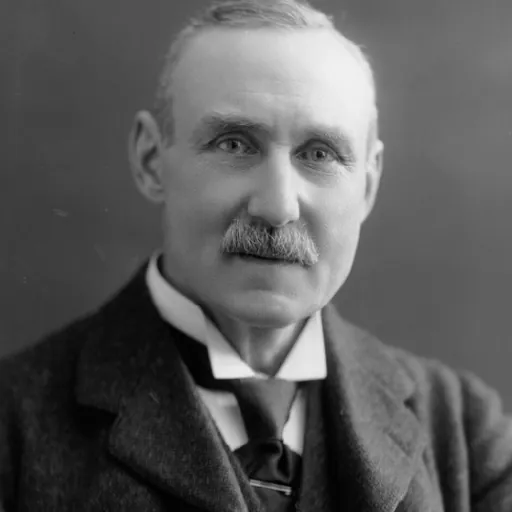
William Palmer, 2nd Earl of Selborne
British politician
About William Palmer, 2nd Earl of Selborne
Lived 1859 – 1942 (aged 82). William Palmer, 2nd Earl of Selborne was a British diplomat, politician, member of parliament and minister.
William Waldegrave Palmer, 2nd Earl of Selborne (17 October 185926 February 1942), styled Viscount Wolmer between 1882 and 1895, was a British politician and colonial administrator, who served as High Commissioner for Southern Africa.
Background and education Selborne was the son of Lord Chancellor Roundell Palmer, 1st Earl of Selborne, and Lady Laura, daughter of Vice-Admiral William Waldegrave, 8th Earl Waldegrave. He was educated at Temple Grove School, Winchester College and University College, Oxford, where he took a first class degree in history.
He was commissioned as a Second lieutenant in the part-time 3rd (Hampshire Militia) Battalion, Hampshire Regiment on 21 May 1879, promoted to Lieutenant on 23 March 1881, Captain on 29 July 1885, and to the command as a Lieutenant-Colonel on 22 April 1899. At the end of his term of command he was appointed Honorary Colonel of the battalion on 23 July 1904, a position that he retained until his death, by which time he was the only remaining officer of the battalion, which had never been re-embodied after World War I.
Political career
1882–1910
As Viscount Wolmer, he was assistant private secretary to the Chancellor of the Exchequer, Hugh Childers, from 1882 to 1885, when he was elected Liberal Member of Parliament for Petersfield. Like his father, he became a Liberal Unionist in 1886 when William Ewart Gladstone proposed Irish Home Rule. He retained his seat till 1892, when he was elected for Edinburgh West. Despite succeeding to the Earldom on his father's death, on 13 May 1895 he attempted to sit as before in the Commons, arguing that, although he was now a Peer, he had not requested a writ of summons to the Lords. After some debate, on 21 May the Commons moved a by-election writ.
After the 1895 general election, Selborne, now sitting in the Lords, was appointed Under-Secretary of State for the Colonies by his father-in-law Lord Salisbury, where he became junior to the Colonial Secretary Joseph Chamberlain. During the difficult period before the outbreak of the Second Boer War he progressed rapidly. and made First Lord of the Admiralty under Salisbury, with a seat in the cabinet, an office he retained when Arthur Balfour became Prime Minister in 1902. In 1905 he succeeded Lord Milner as High Commissioner for Southern Africa and governor of the Transvaal and Orange River colonies. He assumed office at Pretoria in May of that year. He had gone out with the intention of guiding the destinies of South Africa during a period when the ex-Boer republics would be in a transitional state between crown colony government and self-government, and letters patent were issued granting the Transvaal representative institutions.
He ceased to be governor of the Orange River Colony on its assumption of Responsible government in June 1907, but retained his other posts until May 1910, retiring on the eve of the establishment of the Union of South Africa.
Apart from his political career Selborne served as Master of the Worshipful Company of Mercers in 1910 and 1933, as his father had done before him, in 1875. In 1916, he was elected a member of the Society for Psychical Research. He was also Warden (chairman of the governors) of Winchester College between 1920 and 1925 and High Steward of Winchester between 1929 and 1942. In 1939, after the failure of the Munich Agreement and appeasement in general to halt Nazi Germany's expansionism in Continental Europe, he wrote a letter to The Daily Telegraph advocating for Winston Churchill to be admitted into the National Government Cabinet. He was made a Knight Companion of the Garter in 1909.
Family Lord Selborne married Lady Maud Cecil, elder daughter of future Prime Minister Robert Cecil, 3rd Marquess of Salisbury, in 1883. A Suiderberg, Pretoria district, Lady Selborne, is named after her.
They had three sons and one daughter. Lady Mabel Laura Georgiana Palmer (6 October 188415 July 1958); married Charles Grey, 5th Earl Grey, and had two daughters. Roundell Cecil Palmer, 3rd Earl of Selborne (15 April 18873 September 1971); married, firstly, the Hon. Grace Ridley in 1910; had issue. Married, secondly, Valerie Irene Josephine Margaret de Thomka de Thomkahaza in 1966; no issue. The Hon. Robert Stafford Arthur Palmer (26 September 188821 January 1916) The Hon. William Jocelyn Lewis Palmer (15 September 18946 June 1971); married the Hon. Dorothy Cicely Sybil Loder, daughter of Gerald Loder, 1st Baron Wakehurst in 1922 and had two children.
His second son, the Hon. Robert Palmer, was a captain in the Hampshire Regiment and was killed on active service in Mesopotamia in 1916.
Arms
Don’t just read it —
keep it.
Full-length biographies made to live with: read them, listen on the way to work, watch them tonight.
- E-book
- Audio
- Video
Instant download · yours to keep · every purchase keeps this site free
Important facts
Family & relationships
People in William Palmer, 2nd Earl of Selborne's life
Named in this biography and alive at the same time



Related people
Same field, nearest in time
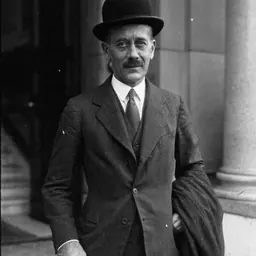
Contemporaries
People whose lives overlapped William Palmer, 2nd Earl of Selborne's


Frequently asked questions
Who was William Palmer, 2nd Earl of Selborne?
British politician (1859-1942)
When was William Palmer, 2nd Earl of Selborne born?
William Palmer, 2nd Earl of Selborne was born on 17 October 1859 in London.
When did William Palmer, 2nd Earl of Selborne die?
William Palmer, 2nd Earl of Selborne died on 26 February 1942 in London.
What was William Palmer, 2nd Earl of Selborne's occupation?
William Palmer, 2nd Earl of Selborne was a diplomat, politician, member of parliament and minister.
What nationality was William Palmer, 2nd Earl of Selborne?
William Palmer, 2nd Earl of Selborne was British.
Sources & further reading
· Wikipedia: William Palmer, 2nd Earl of Selborne
· DBpedia: William Palmer, 2nd Earl of Selborne
Cite this page
APA: Biography.guide. (2026). William Palmer, 2nd Earl of Selborne. https://biography.guide/william-palmer-2nd-earl-of-selborne/
MLA: "William Palmer, 2nd Earl of Selborne." Biography.guide, https://biography.guide/william-palmer-2nd-earl-of-selborne/.
Chicago: "William Palmer, 2nd Earl of Selborne." Biography.guide. https://biography.guide/william-palmer-2nd-earl-of-selborne/.
Data last updated: 2026-09-23 · Spot an error? Report a correction.
Portrait: Wikimedia Commons · author & licence
Page generated 2026-09-27 05:04 UTC