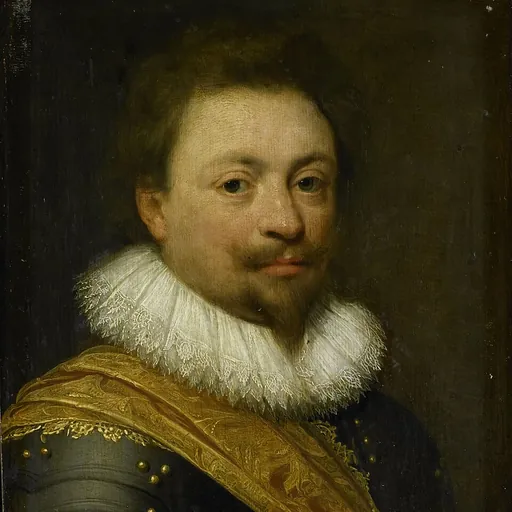
William of Nassau-Siegen
Count of Nassau-Siegen, field marshal in the Dutch army, governor of Emmerik, Heusden and Sluis, lord of Poederoijen, owner/creator of the album amicorum of Wilhelm van Nassau-Hilchenbach
About William of Nassau-Siegen
Lived 1592 – 1642 (aged 49). William of Nassau-Siegen was a military personnel and governor.
William, Count of Nassau-Siegen (13 August 1592 – 17 July 1642), , official titles: Graf zu Nassau, Katzenelnbogen, Vianden und Diez, Herr zu Beilstein, was Count of Nassau-Siegen, a part of the County of Nassau from 1624 to 1642. A member of the House of Nassau-Siegen, a cadet branch of the Ottonian Line of the House of Nassau, he was a professional soldier who served in the armies of the Hanseatic League and the Republic of Venice, then with the Dutch States Army during the Eighty Years War. Promoted field marshal in 1633, he was successively governor of Emmerich, Heusden and Sluis.
Personal details William was born in Dillenburg on 13 August 1592, the fifth son of Count John VII 'the Middle' of Nassau-Siegen and his first wife, Countess Magdalene of Waldeck-Wildungen. He studied in Heidelberg and then went – along with the later 'Winter King' Frederick of the Palatinate – to the court of Henri de La Tour d'Auvergne, the Duke of Bouillon, in Sedan. William visited England. In 1625 he became governor of Emmerich, (which meant they were willing to spend money on an annuity for life).
During the Siege of 's-Hertogenbosch in 1629, William had his headquarters in , from where 's-Hertogenbosch was first shelled on 15 May. Accompanied by 24 companies of infantry and some cavalry, William was sent to the Bommelerwaard by Prince Frederick Henry of Orange to prevent an invasion by Hendrik Graaf van den Bergh, then commander of the Army of Flanders. In the year 1629, William's salary was £400, equivalent to in , per month.
In 1631 William purchased the heerlijkheid of Poederoijen on the River Meuse. William captured the Kruisschans on the Scheldt and and other sconces near Antwerp, later Orsoy, in the following year the Sterreschans and those of Philippine in .
In 1636, the strongly defended Schenkenschanz was captured from the Spanish by William and his brother John Maurice. In 1637, William became governor of Sluis which meant Frederick Henry's entire enterprise failed.
To the surprise of his relatives, John 'the Younger' joined the Spaniards in 1617, the opponents of the House of Nassau and the Dutch Republic. In the same year, his older brother John Ernest died in the service of the Republic of Venice. John 'the Middle' had to decide whether an enemy of Nassau and the Netherlands could remain his heir. On 15 November 1617, John declared his will of 8 April 1607 to be null and void. Abolition of the primogeniture would have meant a division of the small country and John opposed all proposals in that direction. In an amicable agreement, he had his son sign a declaration on 31 December 1617, in which the latter declared that, although he remained a Catholic, he would not force his subjects to any other than the existing religious confession.
Siegen in 1617. From Braun & Hogenberg, Civitates orbis terrarum Band 6, Cologne, 1617. On the left Siegen Castle.
For John 'the Younger', only one third of the county was provided for in the third will. On 6 August 1621, he was informed of this, with a statement of the reasons that had led his father to take this step. On 9 May 1623, i.e. not until two years later, John 'the Younger' protested against this with a letter from Frankfurt to the councillors of Siegen. He had not been idle and had not hesitated to denounce his father to the Emperor. At the time of his letter of protest he was certainly already aware of the , which Emperor Ferdinand II officially issued some time later, on 27 June 1623, informing John 'the Middle' that at the time of making his third will as a fellow combatant of the outlawed Winter King he was not entitled to make a will. He had to revoke it and answer to an imperial court within two months. It seems that John 'the Younger' then shrank from having the imperial decree delivered to his seriously ill father.
Succession dispute Everyone knew that there would be a dispute at the reading of the will on 11 December 1623. John 'the Younger' had the imperial decree read out and when his brothers demurred, he said as he stood up '' ('The Emperor will part us!'). He had taken the precaution of obtaining a further imperial decree on 20 November 1623 against Countess Dowager Margaret and her sons, in which the Emperor strictly forbade impeding John's assumption of government, his taking possession of the land and his inauguration. On 12 January 1624, John 'the Younger' was able to accept the homage from the town of Siegen but only because he had secretly let a squadron of selected horsemen into the town through the castle gate (that is, not through a city gate) in a heavy snowstorm, so that they could not be seen or heard by the town guards. With the exception of John Maurice and George Frederick, the younger brothers accepted only modest appanages. Henceforth, until 1645, the county of Nassau-Siegen had two governments, one in Siegen, the other in Hilchenbach. For a short period (1632–1635) this situation underwent a temporary change, during the Thirty Years' War, his brothers, who were fighting on the Protestant side, rebelled against John 'the Younger'. Countess Dowager Margaret, through the mediation of Louis Henry, turned to Gustavus Adolphus and asked for help against the machinations of her stepson John 'the Younger'. On 14 February 1632 the Swedish king sent an order from Frankfurt to Louis Henry to provide military support for his first cousin John Maurice. Louis Henry then occupied the city of Siegen with his regiment of Dutch and Swedish soldiers. One day later, on 29 February, John Maurice and his brother Henry arrived in Siegen. Just as John 'the Younger' had kept his cavalry in reserve eight years earlier, now John Maurice and Henry, supported by the presence of the Swedish regiment, negotiated with the citizens, who felt bound by the oath they had sworn to John 'the Younger'.
On 4 March, after long and difficult negotiations, the citizens paid homage to John Maurice and Henry. As field marshal of the Dutch States Army, he was succeeded by his brother-in-law .
Marriage and issue William married at Siegen Castle on 17 January 1619 – Culemborg, 6 July 1646 John William (Siegen Castle, 28 October 1619 Elisabeth Charlotte (Emmerich, 11 March 1626 – Culemborg, 16 November 1694Jul. to Count Josias II of Waldeck-Wildungen (Wildungen, 31 July 1636 – Kandia, 8 August 1669).
One of the daughters from this marriage was engaged to Count Crato of Nassau-Saarbrücken.
Known descendants William has several known descendants. Among them are: the German Emperors Wilhelm I, Frederick III and Wilhelm II, the monarchs George IV, William IV, Victoria, Edward VII, George V, Edward VIII, George VI, Elizabeth II and Charles III of the United Kingdom, the kings Leopold I, Leopold II, Albert I, Leopold III, Baudouin I, Albert II and Philippe I of the Belgians. Great-great-grandparents
Great-grandparents
Grandparents
Parents
Don’t just read it —
keep it.
Full-length biographies made to live with: read them, listen on the way to work, watch them tonight.
- E-book
- Audio
- Video
Instant download · yours to keep · every purchase keeps this site free
Important facts
Family & relationships
People in William of Nassau-Siegen's life
Named in this biography and alive at the same time
Related people
Same field, nearest in time



Contemporaries
People whose lives overlapped William of Nassau-Siegen's



Frequently asked questions
Who was William of Nassau-Siegen?
Count of Nassau-Siegen, field marshal in the Dutch army, governor of Emmerik, Heusden and Sluis, lord of Poederoijen, owner/creator of the album amicorum of Wilhelm van Nassau-Hilchenbach (1592–1642)
When was William of Nassau-Siegen born?
William of Nassau-Siegen was born on 13 August 1592 in Dillenburg.
When did William of Nassau-Siegen die?
William of Nassau-Siegen died on 17 July 1642 in Orsoy.
What was William of Nassau-Siegen's occupation?
William of Nassau-Siegen was a military personnel and governor.
Sources & further reading
· Wikipedia: William of Nassau-Siegen
· DBpedia: William, Count of Nassau-Siegen
Cite this page
APA: Biography.guide. (2026). William of Nassau-Siegen. https://biography.guide/william-of-nassau-siegen/
MLA: "William of Nassau-Siegen." Biography.guide, https://biography.guide/william-of-nassau-siegen/.
Chicago: "William of Nassau-Siegen." Biography.guide. https://biography.guide/william-of-nassau-siegen/.
Data last updated: 2026-09-20 · Spot an error? Report a correction.
Portrait: Wikimedia Commons · author & licence
Page generated 2026-09-27 04:57 UTC