
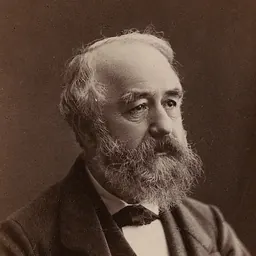
About William Morris Mordey
Lived 1856 – 1938 (aged 82). William Morris Mordey was an engineer.
William Morris Mordey (28 March 1856 – 1 July 1938) was a British electrical engineer and inventor who made important contributions the early electricity supply industry. A self-taught engineer from County Durham who later relocated to Bradford to continue working in Telegraphy, he became one of the practical pioneers of alternating-current engineering in Britain. His Mordey Victoria alternators were used at Bankside power station in the city of London (this site is now occupied by the Tate Modern) and at several other power station in Britain and abroad. He solved the problem of parallel alternator operation that made reliable public electricity supply possible, discovered the V-shaped alternator curves now known as V curve The symbol was later formalised in British Standard BS 3939 Part 6 (from 1966) and internationally as IEC 60417 Symbol 5032 where it remains the standard graphical notation for alternating current worldwide.
Mordey was formally recognised in his lifetime. Serving as President of the Institution of Electrical Engineers, receiving an IEE premium for his work on alternating current, and winning the Telford Medal Mordey also filed 38 British patents, many of which also filed internationally. His work extended from alternators, dynamos, transformers and public electricity supply to electricity meters, railway electrification, electric ignition, electric heating, relays and electromagnetic mineral separation. By the time of his death in 1938, his reputation had faded, partly because the early technical history of electricity supply was 'sadly neglected' and because Mordey himself published little about the difficulties he faced. His obituary in The Engineer described him as a pioneer whose work had scarcely received the recognition it deserved, and noted that few younger electrical engineers appreciated the importance of the Mordey Victoria alternator. William was the second son of John Goodchild Mordey and the grandson of Dr. William Mordey, a surgeon, magistrate and alderman who served multiple terms as Mayor of Sunderland, co-authored a medical account of the 1831 cholera outbreak, and helped establish the city's early public park and championed sanitary and cholera prevention measures.
At the age of fourteen, Mordey entered the postal telegraph service. After a short period in London he was transferred to Bradford.
The design differed significantly from other machines of the period. The magnet wheel, which contained a single coil, was designed so that the poles gripped around the thin disc-shaped armature winding in such a way that all poles on one side had the same polarity. The "Mordey Victoria" alternators played a significant role in the generation of single-phase current and the transition from gas lighting to electric lighting. These alternators, often paired with Raworth engines, were installed at many power plants across Britain and abroad.
Power station installations Mordey alternators and Raworth engines and switchgear were "as familiar to pioneer electrical engineers as Parsons' turbo-generators and Reyrolle switchgear are to those operating power stations at the present time." one of the first public power stations in Britain; Bankside, London (1891), which provided the first public AC electricity supply in London on the site now occupied by Tate Modern; and Lynmouth, Devon (1890), one of Britain's earliest hydroelectric installations, where a village that had never had a gas supply went directly from oil lamps to electric street lighting. And Wandsworth London (1900).
Niagara Falls During the planning phase for the Niagara Falls power transmission scheme, Professor George Forbes publicly recommended the Mordey Victoria Alternators for the project in a Cantor Lecture at the Society of Arts on 8 February 1892, stating that "in connection with the Niagara scheme he had recommended synchronising alternate-current machines, the Mordey being specially mentioned."
Great Northern Electric Light Station, Holloway In 1895 Mordey alternators provided the electric lighting of the Great Northern Railway's main line out of London. Generated from a single central works at Ashburton Grove, Holloway. The Engineer regarded the scheme as a pioneering one, noting that "the Great Northern Railway Company has outstripped most of the other companies in its endeavour to supply effective illumination over a large area". Rather than build a separate plant for each station, the company found it possible, in the congested district around the city, to supply many places from one generating station.
The station served Great Northern Hotel, the King's Cross, Holloway cattle docks, the Clarence and East goods yards, North Holloway, Finsbury Park and Harringay, the Ferme Park and Hornsey station. In total approximately forty miles of cable were laid transmitting power from three A14 Mordey Victoria machines. Contemporary recognition and high-frequency alternators In 1892 Nicola Tesla referred to a "machine of the Mordey type," explaining that this as a machine with pole projections of the same polarity. Tesla added that, with few projections and "an armature without iron, as used by Mordey," excellent results had been obtained. Tesla was not writing a retrospective history: he was treating "Mordey type" as a recognised technical category in contemporary high-frequency alternating current work.
Mordey was also credited in American technical literature. T.C Martin and Joseph Wetzler's The Electric Motor and its applications credited Mordey with first pointing out an important practical precaution concerning iron cores and motor efficiency. Later, J. A. Fleming connected the Mordey type to wireless work, writing that Fessenden, "like Tesla," adopted the Mordey type of alternator for high-frequency generation. These references do not make Mordey a radio inventor, but they show that his alternator architecture had a technical applications beyond early power generation.
Legacy in wireless telegraphy
The disc-armature design of the Mordey alternator found direct application in wireless telegraphy. When Canadian radio pioneer Reginald Fessenden constructed the high-frequency alternator used for the world's first radio broadcast on Christmas Eve 1906, transmitting voice and music from Brant Rock, Massachusetts to ships at sea, his machine shared the defining characteristics of the Mordey alternator. IEEE historian John S. Belrose described it as "a small machine of the Mordey type, having a fixed armature in the form of a thin disc, or ring, and a revolving field magnet with 360 teeth, or projections," generating 50,000 Hz at 139 revolutions per second.
Fessenden subsequently commissioned Ernst Alexanderson at General Electric to develop a higher-powered machine, which became the Alexanderson alternator used at Marconi's transatlantic wireless stations.
Consulting work
After leaving Brush in 1897, Mordey went on to work as a consulting engineer in London. By 1898 he was operating from 82 Victoria Street.
In 1902 he worked with Guy Cary Fricker on electricity meters. The Mordey-Fricker electricity meter was exhibited at the Royal Society conversation and described in The Engineer as a new and simple meter suitable for direct or alternating currents. It was intended especially for small consumers with only a few lamps. Recognition and institutional work Mordey co-authored "Electrical Action on Railways" with Bernard Maxwell Jenkin. It examined direct current. composition direct and alternating current methods of railway electrification. Lord Kelvin praised the authors for attacking the problem of long lines and for their case for single phase alternating current traction.
Mordey also received honourable mentions from the Council of the Society of Telegraph Engineers for his 1883 paper "Some Prejudicial Actions in Dynamo Machines." He was a member of the council of the Institution of Electrical Engineers from 1890 to 1894. For a contribution on AC working, including construction of alternator for parallel working, he received the institutions premium for that year.
When the Physicist Silvanus P. Thompson died in June 1916. Mordey, who had been had been a long-standing friend to Thompson,
The 1889 IEE paper: On Alternate-Current Working
On 23 May 1889, Mordey presented "On Alternate-Current Working" to the Institution of Electrical Engineers. One of the most significant single papers in the history of British electrical engineering. The paper was presented to an audience containing John Hopkinson, William Ayrton, John Ambrose Fleming, Gisbert Kapp, Sebastian Ferranti, Silvanus P. Thompson, W.H. Preece FRS, and John Smith Raworth. The discussion was so significant that a second meeting was convened on 30 May 1889, with the discussion running to 44 pages.
The paper contained six distinct areas of original engineering science:
Parallel working of alternators The paper introduced four significant contributions to electrical enginnering practice:
Testing methodology In his 1893 paper "On Testing and Working Alternators," Mordey explained the practical principles by which he and his colleagues operated alternators in parallel.
Iron aging in transformer cores Mordey also contributed to the understanding of iron ageing in transformer cores. Working with O. T. Bláthy, Mordey demonstrated in 1895 that "this augmentation of hysteresis loss in iron transformer cores was due to heating". Further investigation by H. F. Parshall and S. R. Roget in 1899 established that iron heated to between 40°C and 135°C undergoes a continuous increase in hysteresis loss over time, "and this increase is now called 'ageing' of the iron."
Mordey's identification of heating as the cause of transformer core degradation contributed to the development of non-ageing steel grades or “Swedish Iron,” later adopted in transformer manufacture.
The ∿ symbol In his 1889 IEE paper, Mordey proposed the ∿ symbol to denote periodicity (cycles per second, now known as hertz), writing, "I always write it thus, ∿ and I would suggest that this sign be used unless a better one be forthcoming, and that we agree to speak of periods, instead of alternations or reversals, and of periodicity instead of frequency or rates of alternation or of reversal." W. E. Ayrton, and J. A. Fleming. The Electrician also used the symbol in editorial notation and supply-table context from at least 1891, including national AC supply surveys, where it appears in forms such as "2,000 volts. 100~". Mordey continued use the symbol in his own later IEE papers including "2,000 volts 50~" in 1901 and 1909.
J. A. Fleming's adoption is especially significant because he carried the sign into his major wireless telegraphy textbooks, where it appeared alongside identification of the Tesla high-frequency alternator as the "Mordey or Disk Type", following Fessenden's 1906 radio broadcast.
The symbol was later formalised into British Standard BS 3939 1902 Patent GB190224112A: Improvements in alternating-current traction systems, with Arnold Greaves Hansard. 1912 Patent GB191224563A: Improvements in electric-ignition devices. 1919 Patent GB165822A: Improvements in electromagnetic separation or concentration of minerals. 1923''' Patent US1463713A: electromagnetic mineral separation US equivalent. A full list of Mordey's British patents is available via Espacenet
Physical survivals
The Science Museum Group holds at least six Mordey related objects across two institutions. Mordey was also a member of the advisory council of the Science Museum in South Kensington.
At the Science Museum's store at Wroughton, Wiltshire, object 1915-298 is a motor generator set comprising a Mordey inductor alternator and Victoria motor, credited to the Board of Trade.
At the Science and Industry Museum, Manchester, the Y1986.15 group comprises a complete Brush hydro-electric installation of 1894, originating from a water-powered electrical installation at Waterside near Hawkshead in the Lake District. The group of five objects includes Y1986.15.2, a Mordey Victoria Transformer rated at 3,000 watts, embossed with the words "Mordey Victoria Transformer" and manufactured by the Brush Electrical Engineering Company at Loughborough. The installation was made by Frederick Fowkes. A permanent People record for Mordey has been created in the museum's Collections Online database, linked to the Y1986.15 objects.
Death and legacy
Mordey spent the latter part of his life in retirement. He died at Warlingham, Surrey, on 1 July 1938, aged 82. while his later papers, medals, patents and IEE presidency brought formal professional recognition.
Unlike many of his contemporaries, whose reputation endured, Mordey's faded. His 1938 obituary in The Engineer opened by stating that his work in the early electricity-supply industry “The death of Mr. W. M. Mordey, at the age of eighty-two, removes from the electrical profession a man whose work in the early days of electricity supply scarcely seems to have received in recent times the recognition it deserves.” It added that "Few of the younger generation of electrical engineers appear to appreciate important part Mordey Victoria alternators played in the generation of single-phase current or to what extent the originator of those machines contributed to the solution of the problems that presented themselves when electric lighting began to replace gas." The obituary compared the former familiarity of Mordey alternators and Raworth engines with that of Parsons turbo-generators and Reyrolle switchgear to the succeeding generation.
The same obituary observed that the technical history of early electricity supply had been "sadly neglected" and that with Mordey's death "scarcely anyone is left" to record the practical difficulties of the pioneer era, noting that Mordey himself "never published anything directly relating to" the difficulties he had faced.
Don’t just read it —
keep it.
Full-length biographies made to live with: read them, listen on the way to work, watch them tonight.
- E-book
- Audio
- Video
Instant download · yours to keep · every purchase keeps this site free
Important facts
People in William Morris Mordey's life
Named in this biography and alive at the same time




Related people
Same field, nearest in time


Contemporaries
People whose lives overlapped William Morris Mordey's



Frequently asked questions
Who was William Morris Mordey?
British electrical engineer
When was William Morris Mordey born?
William Morris Mordey was born on 28 March 1856.
When did William Morris Mordey die?
William Morris Mordey died on 1 July 1938.
What was William Morris Mordey's occupation?
William Morris Mordey was an engineer.
Sources & further reading
· Wikipedia: William Morris Mordey
· DBpedia: William Morris Mordey
Cite this page
APA: Biography.guide. (2026). William Morris Mordey. https://biography.guide/william-morris-mordey/
MLA: "William Morris Mordey." Biography.guide, https://biography.guide/william-morris-mordey/.
Chicago: "William Morris Mordey." Biography.guide. https://biography.guide/william-morris-mordey/.
Data last updated: 2026-09-20 · Spot an error? Report a correction.
Page generated 2026-09-27 05:04 UTC