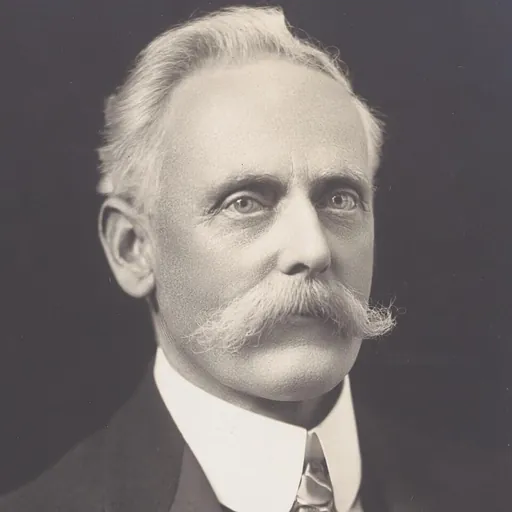
About William McWilliams
Lived 1856 – 1929 (aged 73). William McWilliams was an Australian politician and journalist.
William James McWilliams (12 October 1856 – 22 October 1929) was an Australian journalist and politician. He was the inaugural leader of the Country Party from 1920 to 1921 and served in federal parliament for nearly 20 years.
McWilliams was born in Bream Creek, Tasmania, to Irish immigrants. He became a journalist at a young age, working in both Hobart and Launceston, and becoming a newspaper editor and proprietor. McWilliams served in the Tasmanian House of Assembly from 1893 to 1900. He was elected to the House of Representatives at the 1903 federal election, standing as a Revenue Tariff candidate. He later affiliated with the Liberal Party and Nationalist Party, before helping co-found the Country Party after the 1919 election. McWilliams served briefly as the party's first leader before being replaced by Earle Page. He was defeated in 1922, but won re-election as an independent in 1928 where he contributed to the defeat of the Bruce–Page government.
Early life McWilliams was born on 12 October 1856 in Bream Creek, Tasmania. He was the third of five children of Eliza and Thomas James McWilliams. His parents were Irish immigrants – members of the Church of Ireland – who had immigrated to Tasmania in 1855 under an assisted passage scheme to establish the school at Franklin.
In parliament, McWilliams advocated strongly on behalf of farmers, investigated the possibility of introducing sugarbeet farming into Tasmania, and helped found the Tasmanian Meteorological Bureau. He also supported giving women and ex-convicts the vote but opposed the Federation, believing it should be delayed.
Federal politics Switching to federal politics, McWilliams won the Franklin at the 1903 election as a Revenue Tariffist supporting the Free Trade Party on most economic issues.
In parliament, McWilliams, like almost all his fellow members, strongly supported the White Australia Policy but opposed federal spending on issues such as the establishment of the High Court of Australia, a federal department of agriculture, a transcontinental railway, and federal acquisition of the Northern Territory. As in state parliament, McWilliams was a staunch advocate on rural matters, supporting the timber industry and primary producers.
Leader of the Country Party
After the 1919 federal election, which saw a number of candidates elected with the endorsement of state-based farmers' organisations, McWilliams was one of a five signatories to a letter drafted by William Gibson calling for the formation of a parliamentary Country Party, alongside Henry Gregory, William Hill and Edmund Jowett. He was elected as the party's inaugural leader on 25 February 1920, with Jowett as his deputy, largely on the basis that he was the only member with prior experience in federal parliament.
In his first parliamentary speech as leader, McWilliams proclaimed that the Country Party would end the "cursed system of centralization, under which hundreds of thousands of pounds are squandered in our city Departments, whilst necessary adjuncts to civilization, in the way of telephonic communication and mail services are denied to the residents of our back-blocks". The Country Party had eleven members in the House of Representatives, giving it the balance of power after Prime Minister Billy Hughes' Nationalist Party government narrowly failed to win a majority. On 10 March 1920, McWilliams demonstrated the Country Party's power by moving a motion to restrict supply, which the government took as a confidence motion and survived by only four votes. However, the party's policy agenda was driven by the party's whip Earle Page.
On 5 April 1921, the parliamentary Country Party decided to review its leadership structure, declaring all leadership positions vacant. McWilliams was not a candidate to continue as leader, with Page elected nearly unanimously as his replacement. In his memoirs, Page recalled that McWilliams had "shown an increasing tendency to vote against the majority". On one instance he had been the sole Country MP to vote in favour of a censure motion introduced by the ALP opposition. According to The News, he reportedly sought the endorsement of the Nationalist Campaign Council, the Tasmanian body co-ordinating the anti-Labor candidates, but wished to be endorsed as a Country Party candidate rather than as a Nationalist. After his narrow defeat he stated that he had had "organised capital attacking on one side and organised labour on the other".
At the 1928 election, McWilliams finally defeated Seabrook as an independent, joining Country Progressive MP Percy Stewart on the crossbench. In the final months of the Bruce–Page government he regularly voted with the opposition, eventually joining Stewart and four dissident Nationalists in bringing down the government on a confidence motion in September 1929. He was re-elected at the 1929 election with an increased majority and by one account was "tacitly supported by Labor in the 1928 and 1929 elections".
Personal life In 1893, McWilliams married Josephine Fullerton (née Hardy), who had previously been widowed. The couple had three children,
Don’t just read it —
keep it.
Full-length biographies made to live with: read them, listen on the way to work, watch them tonight.
- E-book
- Audio
- Video
Instant download · yours to keep · every purchase keeps this site free
Important facts
People in William McWilliams's life
Named in this biography and alive at the same time





Related people
Same field, nearest in time





Contemporaries
People whose lives overlapped William McWilliams's



Frequently asked questions
Who was William McWilliams?
Australian politician (1856–1929)
When was William McWilliams born?
William McWilliams was born on 12 October 1856 in Bream Creek.
When did William McWilliams die?
William McWilliams died on 22 October 1929 in Hobart.
What was William McWilliams's occupation?
William McWilliams was a politician and journalist.
What nationality was William McWilliams?
William McWilliams was Australian.
Sources & further reading
· Wikipedia: William McWilliams
Cite this page
APA: Biography.guide. (2026). William McWilliams. https://biography.guide/william-mcwilliams/
MLA: "William McWilliams." Biography.guide, https://biography.guide/william-mcwilliams/.
Chicago: "William McWilliams." Biography.guide. https://biography.guide/william-mcwilliams/.
Data last updated: 2026-09-23 · Spot an error? Report a correction.
Portrait: Wikimedia Commons · author & licence
Page generated 2026-09-27 05:07 UTC