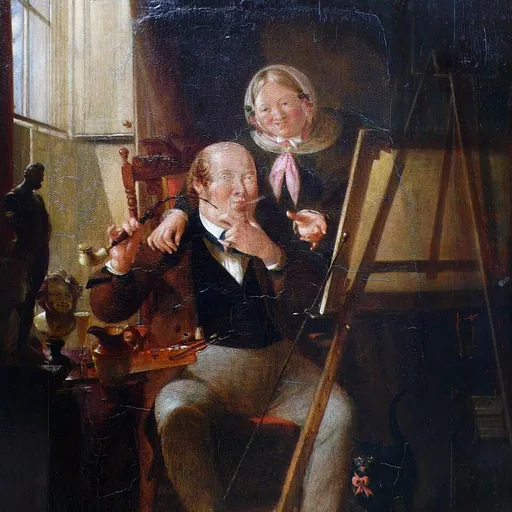
About William Kidd
Lived 1790 – 1863 (aged 72–73). William Kidd was a British painter.
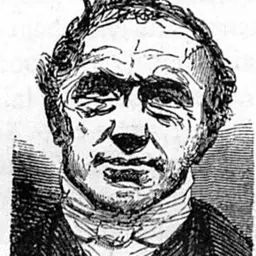
William Kidd H.R.S.A. (c.1796 – 24 December 1863) was a prolific Scottish artist known for his comic depictions of cosy domestic scenes in romantic-era Scotland and England. He also illustrated works of various authors including Sir Walter Scott and Robert Burns.
Early life
Little is known at this time of his family and early education. He was born in Scotland in 1796. At an early age he was apprenticed to James Howe (30 August 1780 – 11 July 1836) who was an Edinburgh artist known for his depictions of domestic animals. One of Kidd's earliest pieces, "Cobbler's Shop by W. Kidd, aged 13 years, apprentice to J. Howe" was exhibited in Edinburgh in 1809 at the first exhibition of the Associated Artists. Other pieces of the period include The Travelling Showman, Head of Cowgate, Flesh Caddie and various portraits of horses which won him some slight praise from critics of the period.
Kidd later apprenticed with Gavin Beugo, a house painter and decorator. David Roberts, R.A. was a fellow-apprentice of Beugo and lifelong friend. Kidd first exhibited at the Royal Academy in London in 1817 and his pieces were seldom absent from the Academy until about 1840. In approximately 1820, Kidd moved to London, as did many young aspiring artists of his time. Perhaps he was responding to the accolades from the critics who stated he: "…is on the high road to excellence in his particular department."
In the 1820s he began to explore and develop his comic depictions of domestic scenes. His clever humour and dramatic figure painting brought considerable praise and attracted the attention of many period authors and artists of note. His works of this period, 1820–1835, were compared to contemporary Sir David Wilkie, and many of his pieces were being turned into engravings for publications in books. Kidd was clearly influenced by the likes of Wilkie, William Allan and Alexander Carse; earlier proponents of the Scots genre painting.
Kidd's paintings of the period are often bright displays of homely scenes of peasant life, "the peasant with a cosy cottage, where a certain comfort surrounds the perennial making of love and butter, excited his easy interest." Another common theme of this time was various images of the Greenwich and Chelsea pensioners, the survivors of Trafalgar and Waterloo. It may have been that Kidd accompanied James Howe and Alexander Carse on their visit to the battlefield of Waterloo in 1815. Or he may have been copying earlier themes from Wilkie. In letters to Allan in 1853 he mentioned he had not recovered from illness suffered seven years previously. The sons of artist Benjamin Robert Haydon (1786–1846) provide further insight into this mysterious illness, "Kidd went mad shortly after my father's death from horror and Fred saw him in Hanwell Asylum in '47-8. Frank Haydon." B.R. Haydon had attempted suicide by shooting himself however when the bullet failed to kill him he completed the task with his straight razor. The poverty and events of Haydon's life were too familiar subjects to his friend Kidd.
Additional events in the early 1850s further contributed to his continued decline. In 1851, John Henry Pegg, a lawyer and husband of his stepdaughter Isobella, died. Isobella and her two children moved back to London to live with her mother and Kidd. In 1852, his stepson, Captain John Carphin, was killed in a gunfight in California and his other stepson, George Carphin first mate of the Eglinton, was shipwrecked on the coast of Australia. The news of these events, Kidd's lingering mental illness and the failing finances may have contributed to the death of Kidd's wife and she died in July 1854 leaving Kidd alone with the burden of a stepdaughter and two stepgrandchildren.
Later years
From about 1855 through to his death on 24 December 1863, Kidd painted very little, if at all. Any pieces that may have been done during this period were probably replicates or re-workings of earlier pieces. Furthermore, it seems that during this period his stepdaughter was taking care of him due to his failing health. Kidd and his stepdaughter continued to send letters to beg for funds from various persons within the Royal Scottish Academy. Upon hearing of Kidd's death, David Roberts, R.A., in his diary writes: "Poor fellow, he was one of those sons of genius quite incapable of managing his worldly affairs, and had lived from hand to mouth, as the saying is, all his days. All my attempts to help him seemed to have no effect; but latterly, with £50 yearly from the Academy and other helps, he must have been as well off as he ever had been at any former period of his life."
Kidd's contemporaries had high praise for his work. Roberts states: "By far the best artist among them was my late friend William Kidd, who afterwards painted many excellent pictures, embodying the humour and pathos of Scottish life in a most delightful manner." McKay recounts Kidd "seems never to have had much success, though his works reveal a talent which ought to have given him a high rank amongst painters."
Kidd's pieces failed to have a lasting impact on the art world. Walter Armstrong in his book, Scottish Painters: a critical study, harshly but correctly states "Kidd's pictures are almost, if not quite, unknown in galleries. They are to be met with pretty frequently in the dealers' shops, where they are often called by other names. I must confess that only at rare intervals have I found myself confronted by one that deserved a place even in the most liberal 'National Gallery of British Art'." That being said, today examples of Kidd's labours can be found in the Patrick Allan-Fraser Hospitalfield Trust in Arbroath, Scotland; in the Burns Monument Trust; the National Gallery of Scotland in Edinburgh; the Tyne and Wear Museums; and in Leeds Museums and Galleries.
Don’t just read it —
keep it.
Full-length biographies made to live with: read them, listen on the way to work, watch them tonight.
- E-book
- Audio
- Video
Instant download · yours to keep · every purchase keeps this site free
Important facts
People in William Kidd's life
Named in this biography and alive at the same time



Related people
Same field, nearest in time


Contemporaries
People whose lives overlapped William Kidd's



Frequently asked questions
Who was William Kidd?
Scottish artist (1790-1863)
When was William Kidd born?
William Kidd was born in 1790 in Edinburgh.
When did William Kidd die?
William Kidd died on 24 December 1863 in London.
What was William Kidd's occupation?
William Kidd was a painter.
What nationality was William Kidd?
William Kidd was British.
Sources & further reading
· DBpedia: William Kidd (painter)
Cite this page
APA: Biography.guide. (2026). William Kidd. https://biography.guide/william-kidd-painter/
MLA: "William Kidd." Biography.guide, https://biography.guide/william-kidd-painter/.
Chicago: "William Kidd." Biography.guide. https://biography.guide/william-kidd-painter/.
Data last updated: 2026-09-23 · Spot an error? Report a correction.
Portrait: Wikimedia Commons · author & licence
Page generated 2026-09-27 05:05 UTC