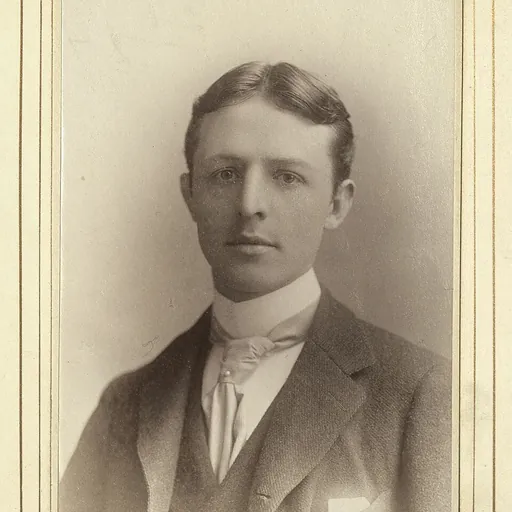
About William Jay Schieffelin
Lived 1866 – 1955 (aged 89). William Jay Schieffelin was an American business executive.
William Jay Schieffelin (April 14, 1866 – April 29, 1955), was an American businessman, philanthropist, and president of the Citizens Union (New York City).
Schieffelin joined the good government movement in New York City in the 1890s, and was active in the city's politics for more than thirty years, fighting against corruption and for the preservation of Central Park.
Schieffelin was a strong advocate for the rights and social progress of African Americans, women's suffrage, and the improvement of working conditions in factories.
Schieffelin was a supporter of World federalism and influenced U.S. foreign policy from the beginning of World War I to the end of World War II. He was a member of the League to Enforce Peace group since 1915. Schieffelin was disappointed that the United States never joined the League of Nations after World War I. As chairman of the New York State Committee for World Federation, Schieffelin launched a campaign in 1943 that resulted in a resolution in the New York State Legislature declaring that only an international organization of all nations could lead to lasting peace. The resolution supported the United States' efforts to join the United Nations after World War II.
Schieffelin sided with interventionism during World War II. At a meeting organized by France Forever in 1940, Schieffelin said that the U.S. should act more decisively against Japan and Nazi Germany. He supported Wendell Willkie as Republican nominee for president in 1940, and he supported incumbent Democratic president Franklin D. Roosevelt during the 1944 presidential election.
Early life
William Jay Schieffelin was the first son of William Henry Schieffelin and Mary Jay Schieffelin.
William’s mother was the daughter of John Jay, who was the grandson of John Jay. His paternal ancestors were Jacob Schieffelin and Hannah Lawrence Schieffelin. The wedding took place at the Fifth Avenue Presbyterian Church and in the grand picture gallery of William Vanderbilt’s double villa at Fifth Avenue.
The couple had nine children: William Jay, Margaret Louisa, Mary Jay, John Jay, Louise, Bayard, Elliott, Barbara, and Henry.
The Schieffelin family lived at 5 East 66th Street in Manhattan (the building has been owned by the Lotos Club since 1947) and moved to 620 Park Avenue in 1925. They also owned an estate in Bar Harbor and on the Schieffelin Point peninsula in Maine called Tranquility Farm.
Military service
During the Spanish-American War in 1898, William Jay Schieffelin served as a volunteer captain and regimental adjutant of the 12th Regiment of the National Guard.
In 1898 President McKinley called for volunteers for the war with Spain. In August 1898, William Jay Schieffelin served as senior aide on the staff of General Peter Conover Hains. Initially, General Hains' brigade was ordered to board a ship to Cuba, but then the order changed and the brigade was on a transport ship to Puerto Rico. He managed Schieffelin & Co in the 5th generation after Jacob Schieffelin (1757–1835), who founded the company in 1794 (then Lawrence & Schieffelin, Pharma-Trade, at 195 Pearl Street in Manhattan). Schieffelin & Co was America's longest-running pharmaceutical business.
The City Club was founded in 1892 through the efforts of Edmond Kelly and Robert Fulton Cutting and the members of the City Reform Club. Schieffelin chaired the membership committee and was able to recruit 400 members. The club elected the distinguished attorney James C. Carter as its first president. City Club members and other independent leaders formed Good Government Clubs in many boroughs. They appointed Schieffelin to the committee and to the executive committee. The committee recommended William L. Strong for mayor and had him nominated by the Republican organization. That same year, mayor Strong appointed Theodore Roosevelt as New York City Police Commissioner.
Schieffelin knew Carl Schurz very well and admired him. In the 1890s he visited Carl Schurz, and they talked about Good Government topics.
Schieffelin knew J. Pierpont Morgan very well, because both were active in St. George Church.
The Citizens Union realized that the Walker administration was ripe for an investigation by a legislative committee. To generate public pressure for such an action, Schieffelin organized the so-called “Committee of One Thousand,” which called for the investigation and demanded that Samuel Seabury be named as counsel for the investigating committee. The legislature granted the request and appointed State Senator Hofstadter as Chairman.
Governor Franklin D. Roosevelt summoned mayor Walker to a hearing in Albany. Schieffelin attended the hearing as a complainant citizen and judge Seabury appeared as prosecutor. After the hearing, mayor Walker resigned.
France Forever On December 20, 1940, France Forever called a public meeting at Carnegie Hall, and William Jay Schieffelin was asked to speak as a representative of the Huguenot Society. In his speech, Schieffelin said: ”It is high time to discard that slogan ’Short of War’ which was put in political platforms to placate the isolationists and the pacifists. It is a cowardly slogan encouraging Hitler and Japan, saying we will not stand up like men and fight, even when our National safety and most cherished beliefs are threatened. We must stop Hitler ’Short of nothing’.”
League to Enforce Peace (1915), Federal Union, Inc. (1941), World Federation (1943)
Clarence Streit’s book "Union Now" impressed the public when it was published in 1939. Therefore, the Federal Union Inc., of which William Jay Schieffelin was New York’s chairman, hosted a dinner for the Uniting States of the World at the Waldorf Astoria on January 22, 1941.
For Schieffelin, this was the culmination of a movement called the League to Enforce Peace, founded in 1915 and headed by former President William Howard Taft. President Lowell of Harvard chaired the executive committee, which was made up of the chairmen of the various state committees. William Jay Schieffelin was chairman of the New York State committee.
Franklin D. Roosevelt’s mother, Sara Roosevelt, was a good friend of Schieffelin's mother, Mary Jay Schieffelin. The Roosevelts lived nearby on East 65th Street. Sara Roosevelt and Schieffelin and his wife went to meetings or social gatherings.
Drug Act of 1906 In 1906, Congress established a committee to investigate why the United States had a problem with addictive substances in medicines and pharmaceutical products and how this problem could be avoided. William Jay Schieffelin was invited by Congress to testify as an expert and help clarify the matter. The testimony of Schieffelin and other experts led to a tightening of drug laws in the United States. The Pure Food and Drug Act was passed by Congress in 1906.
American Leprosy Missions; Schieffelin Institute of Health in Karigiri, India In 1909 William Jay Schieffelin became chairman of the Committee of the American Mission to Lepers.
Death William Jay Schieffelin died on April 29, 1955, six years after his wife Maria Louise. Schieffelin was buried in the Vanderbilt Family Cemetery and Mausoleum. Honorary President of the New York College of Pharmacy (Columbia University) President of the Armstrong Association Adjutant of the 12th New York Infantry, Spanish-American War (1898) President of the National Wholesale Druggists Association (1910) Chairman of the New York State Committee of the League to Enforce Peace (1915) President of the Huguenot Society of America (1922–1947) Head of the Committee of One Thousand (1930) President of the Men’s League for Women’s Suffrage Chairman of the Christian Committee to Boycott Nazi Germany (1941) Fellow of the London Chemical Society Member of the American Chemical Society Member of the Society of Chemical Industry
Don’t just read it —
keep it.
Full-length biographies made to live with: read them, listen on the way to work, watch them tonight.
- E-book
- Audio
- Video
Instant download · yours to keep · every purchase keeps this site free
Important facts
People in William Jay Schieffelin's life
Named in this biography and alive at the same time




Related people
Same field, nearest in time


Contemporaries
People whose lives overlapped William Jay Schieffelin's



Frequently asked questions
Who was William Jay Schieffelin?
American businessman and philanthropist
When was William Jay Schieffelin born?
William Jay Schieffelin was born on 14 April 1866 in Manhattan.
When did William Jay Schieffelin die?
William Jay Schieffelin died on 29 April 1955.
What was William Jay Schieffelin's occupation?
William Jay Schieffelin was a business executive.
What nationality was William Jay Schieffelin?
William Jay Schieffelin was American.
Sources & further reading
· Wikipedia: William Jay Schieffelin
· DBpedia: William Jay Schieffelin
Cite this page
APA: Biography.guide. (2026). William Jay Schieffelin. https://biography.guide/william-jay-schieffelin/
MLA: "William Jay Schieffelin." Biography.guide, https://biography.guide/william-jay-schieffelin/.
Chicago: "William Jay Schieffelin." Biography.guide. https://biography.guide/william-jay-schieffelin/.
Data last updated: 2026-09-21 · Spot an error? Report a correction.
Portrait: Wikimedia Commons · author & licence
Page generated 2026-09-27 04:58 UTC