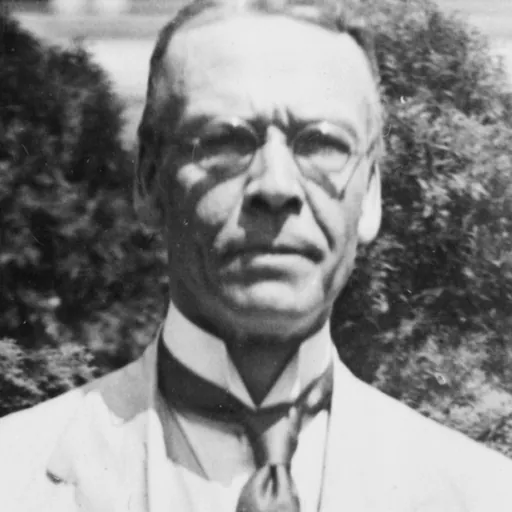
About William Jackson Pope
Lived 1870 – 1939 (aged 68). William Jackson Pope was a British chemist, university teacher and crystallographer, known for Stereochemistry.
Sir William Jackson Pope (31 March 1870 – 17 October 1939) was an English chemist.
Biography William Jackson Pope was born on 31 March 1870 in Hoxton to William (a saddler) and Alice (née Hall). His parents were staunch and active Wesleyans who had eight children, of whom William was the eldest. In 1878 he entered the Central Foundation School, in London, where his ability to learn rapidly gave him leisure at the age of twelve to carry out simple chemical experiments in his bedroom. While at school he also developed great skill as a photographer—many of his early photographs were in perfect condition fifty years later. From there he moved to the Finsbury Technical College, where he learned much from H E Armstrong; the two later became close friends.
Pope studied crystallography under H. A. Miers, and most of his earlier research focussed on measuring crystallographic data with a goniometer. These studies had an important influence on the development of his chemical work, for they enhanced the natural faculty of visualising spatial relationships. This drew him into the field of stereochemistry where his most notable achievements were to resolve a series of asymmetric, optically active compounds of nitrogen, sulfur, tin and selenium. This led to his appointment in 1901 to a chair of chemistry at the Manchester Municipal School of Technology. He was elected a Fellow of the Royal Society (FRS) in June 1902, and then to the 1702 chair of chemistry at Cambridge University in 1908.
During the First World War, Pope served on the Board of Invention and Research for the Admiralty and on the Chemical Warfare Committee at the Ministry of Munitions, where one of his contributions was a modified method for preparing mustard gas. He was appointed a Commander of the Order of the British Empire in the 1918 New Year Honours and was invested as a Knight Commander of the Order of the British Empire in the 1919 New Year Honours, the only chemist to be knighted for service during World War I.
Sir William died, unmarried, in Cambridge on 17 October 1939, after a long illness. A memorial service was held for him at St John’s College Chapel.
Don’t just read it —
keep it.
Full-length biographies made to live with: read them, listen on the way to work, watch them tonight.
- E-book
- Audio
- Video
Instant download · yours to keep · every purchase keeps this site free
Important facts
People in William Jackson Pope's life
Named in this biography and alive at the same time


Related people
Same field, nearest in time



Contemporaries
People whose lives overlapped William Jackson Pope's



Frequently asked questions
Who was William Jackson Pope?
British chemist (1870-1939)
When was William Jackson Pope born?
William Jackson Pope was born on 31 October 1870 in London.
When did William Jackson Pope die?
William Jackson Pope died on 17 October 1939 in Cambridge.
What was William Jackson Pope's occupation?
William Jackson Pope was a chemist, university teacher and crystallographer.
What was William Jackson Pope known for?
William Jackson Pope was known for Stereochemistry.
What nationality was William Jackson Pope?
William Jackson Pope was British.
Sources & further reading
· Wikipedia: William Jackson Pope
· DBpedia: William Jackson Pope
Cite this page
APA: Biography.guide. (2026). William Jackson Pope. https://biography.guide/william-jackson-pope/
MLA: "William Jackson Pope." Biography.guide, https://biography.guide/william-jackson-pope/.
Chicago: "William Jackson Pope." Biography.guide. https://biography.guide/william-jackson-pope/.
Data last updated: 2026-09-21 · Spot an error? Report a correction.
Portrait: Wikimedia Commons · author & licence
Page generated 2026-09-27 04:59 UTC