About William Homan Thorpe
Lived 1902 – 1986 (aged 84). William Homan Thorpe was a British ornithologist, zoologist, entomologist and biologist.
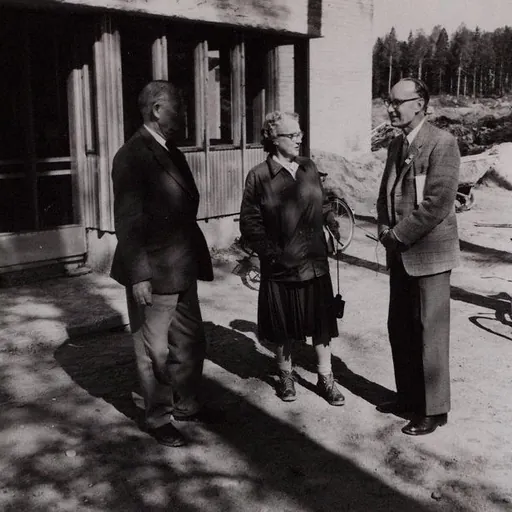
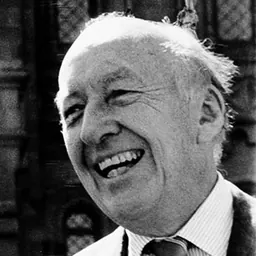
Mr and Mrs J.P. Niven of the South African Ornithological Society with Dr W.H. Thorpe (right) during the XII Ornithological Congress in Finland, Otaniemi, June 7, 1958 William Homan Thorpe FRS (1 April 1902 – 7 April 1986) was a British zoologist, ethologist and ornithologist who was Professor of Animal Ethology at the University of Cambridge. Together with Nikolaas Tinbergen, Patrick Bateson and Robert Hinde, Thorpe contributed to the growth and acceptance of behavioural biology in Great Britain.
Biography Early life and career Thorpe was born in Hastings and grew up in Weston-super-Mare. His father Francis Homan was a borough accountant who also worked with the London Missionary Society while his mother took part in the women's suffrage movement and was involved in Christian pacifism. He was taken care of by a nurse Ellen Clara Birt while his parents travelled in the United States.
He studied for a while at Clarence School, Weston-super-Mare and was sent at fourteen to Mill Hill School, after which he entered Jesus College, Cambridge, in 1921 to obtain a degree in Agriculture. He had been influenced by a talk by Maxwell Lefroy that there was a growing need for entomologists. In 1925 he began to work in the Department of Agriculture on insect pests. He continued on this line during two years at the University of California as a Rockefeller Fellow. Awarded the PhD from Cambridge in 1929, he then moved to the Imperial Institute of Entomology, returning to Cambridge three years later as a lecturer in Entomology and Fellow of Jesus College. A religious conscientious objector, during World War II he studied insects that preyed on stored food.
In 1943 he published an extensive review on insect learning, following it with a similar work on birds in 1951. He closely followed the burgeoning ethological research of Konrad Lorenz and Niko Tinbergen, introducing their work to English readers. In 1951–52 he was the Prather Lecturer at Harvard University, and in 1956 published his book Learning and Instinct in Animals. In 1950 he became the first director of the Cambridge Ornithological Field Station; he was appointed Reader in Zoology in 1959 and awarded a personal chair in 1966.
Bird song When the sound spectrograph was launched he saw that recording sound frequencies and intensities over time made it possible to quantitatively analyze bird song. He obtained the first of these devices in the UK, fathering a group of talented investigators of song. He also led a rigorously controlled study of imprinting learning.
Other He was a member of the advisory committee to the Anti-Concorde Project and as a vocal conservationist led in saving Wicken Fen from draining and development.
Thorpe was a critic of mechanistic materialism. He authored the book Purpose in a World of Chance (1978); in opposition to Jacques Monod, he argued for purpose and mind in nature. Thorpe was a theist and argued for the compatibility of religious belief with the practice of science. He identified as a philosophical dualist.
Death He died in Woodwalton Fen.
Honours He was elected to the Royal Society in 1951 and speaker at the Gifford lectures from 1969 to 1971. He was president of the British Ornithologists' Union from 1955 to 1960.
Don’t just read it —
keep it.
Full-length biographies made to live with: read them, listen on the way to work, watch them tonight.
- E-book
- Audio
- Video
Instant download · yours to keep · every purchase keeps this site free
Important facts
People in William Homan Thorpe's life
Named in this biography and alive at the same time




Related people
Same field, nearest in time



Contemporaries
People whose lives overlapped William Homan Thorpe's

Frequently asked questions
Who was William Homan Thorpe?
British ethnologist (1902–1986)
When was William Homan Thorpe born?
William Homan Thorpe was born on 1 April 1902.
When did William Homan Thorpe die?
William Homan Thorpe died on 7 April 1986.
What was William Homan Thorpe's occupation?
William Homan Thorpe was an ornithologist, zoologist, entomologist and biologist.
What nationality was William Homan Thorpe?
William Homan Thorpe was British.
Sources & further reading
· Wikipedia: William Homan Thorpe
· DBpedia: William Homan Thorpe
Cite this page
APA: Biography.guide. (2026). William Homan Thorpe. https://biography.guide/william-homan-thorpe/
MLA: "William Homan Thorpe." Biography.guide, https://biography.guide/william-homan-thorpe/.
Chicago: "William Homan Thorpe." Biography.guide. https://biography.guide/william-homan-thorpe/.
Data last updated: 2026-09-21 · Spot an error? Report a correction.
Portrait: Wikimedia Commons · author & licence
Page generated 2026-09-27 05:00 UTC